
Blog
Why use edge trims? Enhance safety and style in flooring

Apr
TL;DR:
- Properly installed edge trims protect floors, conceal gaps, and reduce trip hazards.
- Solid metal trims like brass offer durability and long-lasting finish in high-traffic areas.
- Correct installation, including securing to the subfloor and leaving expansion gaps, is essential for longevity.
Most people assume edge trims are the last thing you add to a room once the real work is done. A cosmetic afterthought. In reality, a well-chosen edge trim is doing several important jobs at once: protecting your flooring investment, concealing expansion gaps that prevent buckling, and most critically, reducing trip hazards that lead to real accidents in both homes and commercial spaces. This guide covers everything you need to know about edge trims, from what they actually are, to which materials last, to the installation mistakes that catch even experienced contractors off guard.
Table of Contents
- What are edge trims and where are they used?
- Key benefits of using edge trims
- Types of edge trims: choosing the best material for your needs
- Common installation mistakes and how to avoid them
- Why quality and correct installation matter more than you think
- Upgrade your space with premium edge trims
- Frequently asked questions
Key Takeaways
| Point | Details |
|---|---|
| Edge trims boost safety | A professionally installed trim can cut trip risks at flooring transitions by 30 percent. |
| Protects and perfects your floors | Edge trims conceal joints and expansion gaps, preventing unsightly buckling and chipping. |
| Material quality matters | Brass and robust trims last longest and are more reliable than low-cost alternatives. |
| Installation is crucial | Poor fit accounts for up to 40 percent of edge trim failures, so follow expert guidance. |
What are edge trims and where are they used?
An edge trim is a profiled strip of material fitted at the junction between two floor surfaces or at an exposed flooring edge. Think of the strip you see at a doorway where carpet meets hard flooring, or the neat border that finishes a tiled step. That strip is an edge trim, and what edge trims do goes well beyond looking tidy.
Edge trims appear in a wide range of settings:
- Doorways and thresholds, where two flooring types meet at room boundaries
- Floor level changes, such as steps, raised platforms, or transitions between rooms with different subfloor heights
- Exposed flooring edges, particularly around staircases, hearths, or bay windows where the floor would otherwise be left raw and vulnerable
- Wet rooms and bathrooms, where a sealed edge prevents moisture from getting beneath the floor
- Commercial and retail spaces, where heavy foot traffic makes unprotected edges a real liability
One function that often surprises people is the role edge trims play in accommodating floor movement. Floating floors, such as laminate and luxury vinyl tile (LVT), are not fixed to the subfloor. They expand and contract with changes in temperature and humidity. Expansion gaps of 8 to 12mm must be left around the perimeter and at doorways to allow this natural movement without the floor buckling or lifting.
Without an edge trim, these gaps are exposed and unsightly. With the right trim in place, the gap is hidden, the floor can move freely, and the finish looks entirely intentional. It is a structural solution disguised as a decorative one.
You can read more about this dual role in our detailed edge trim guide, which covers profile types and installation considerations for both residential and commercial projects.
Key benefits of using edge trims
Once you understand what edge trims do, the case for using them properly becomes very clear. The benefits span safety, durability, compliance, and aesthetics.
Safety is the most urgent reason. Unprotected transitions between flooring types or heights create trip hazards, particularly for older adults and young children. The role of edge trims in preventing these accidents is well documented: quality trims fitted correctly reduce trip hazards by up to 30% in residential settings. That is not a marginal improvement.

Flooring protection is equally important. Exposed flooring edges chip, fray, and lift over time. A trim guards the edge mechanically, preventing damage that would otherwise require costly repairs or early replacement of the entire floor section.
Regulatory compliance matters in commercial settings especially. UK flooring trim standards require that floor transitions meet slip resistance values, with a pendulum test value (PTV) of 36 or above required in public spaces. Choosing a trim that meets this threshold is not optional in many commercial projects.
| Benefit | What it means in practice |
|---|---|
| Safety | Up to 30% fewer trip incidents at transitions |
| Edge protection | Prevents chipping, fraying, and moisture ingress |
| Slip resistance | Must meet PTV 36+ in commercial settings |
| Aesthetics | Clean, professional finish at every junction |
| Floor longevity | Protects expansion gaps and prevents buckling |
Key statistic: Over 40% of edge trim failures are caused not by the product itself but by poor installation. Getting the fitting right is just as important as choosing the right trim.
Pro Tip: Always check the manufacturer’s installation guidelines before fitting. A trim that suits your floor type but is fixed incorrectly will fail faster than a cheaper product fitted well.
Types of edge trims: choosing the best material for your needs
Not all edge trims are created equal. The material you choose has a direct impact on durability, safety, and appearance over time.
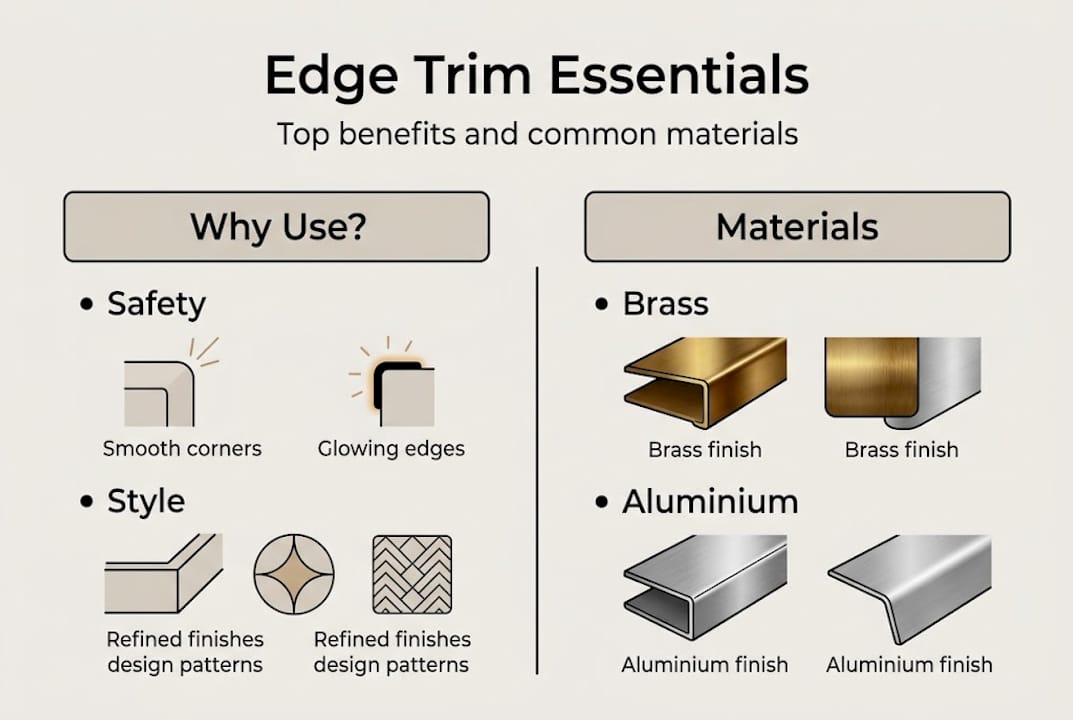
Brass is the premium choice for good reason. It is dense, corrosion-resistant, and exceptionally hard-wearing under foot traffic. Brass trims take a high-quality finish, look elegant in both traditional and contemporary interiors, and maintain their appearance for decades when cared for properly. They are the natural choice for hallways, living areas, and commercial spaces where appearance and longevity matter.
Aluminium is widely sold as a budget alternative, but poorly installed aluminium trims bend under load, corrode in damp conditions, and create sharp edges as they degrade, turning a finishing product into an actual hazard. The cost saving rarely justifies the risk.
PVC trims are sometimes used in temporary installations or low-budget projects. They discolour, crack in cold conditions, and lack the rigidity needed for high-traffic areas. Worth knowing before you commit to a project that needs to last.
At Quality Carpet Trims, we supply only solid metal trims, hand finished in 10 beautiful finishes, because we believe laminate edge trims and every other profile should be built to outlast the floor they protect.
How to choose the right trim for your project:
- Identify the location. Is it a wet room, a busy hallway, or a light-use bedroom? Each setting demands different durability.
- Assess expected wear. Commercial and public spaces need trims rated for heavy traffic. Residential spaces have more flexibility.
- Match the finish. The trim should complement your flooring and the room’s overall tone. Our 10 metal finishes make this straightforward.
- Set a realistic budget. Factor in the cost of replacement when comparing materials. Cheap trims rarely stay cheap for long.
For projects in public or commercial settings, commercial trim standards offer detailed guidance on compliance requirements.
Pro Tip: Spending a little more upfront on a solid metal trim almost always costs less in the long run than replacing a failed cheap alternative after six months of daily use.
Common installation mistakes and how to avoid them
Choosing the right trim is only half the job. How it is fitted determines whether it performs safely and looks good over time. The statistics here are sobering: over 40% of trim failures come down to installation errors rather than product quality.
“The trim is only as good as the installation behind it. A premium product fitted incorrectly will fail faster than an average product fitted with care.”
The most common mistakes include:
- Not securing to the subfloor. Trims should be anchored to the subfloor, not to the floating floor itself. Fixing into a floating floor prevents natural movement and causes buckling.
- Ignoring the expansion gap. Floating floors need 8 to 12mm of clearance. Trimming this gap too small or filling it with adhesive eliminates the flex the floor needs to survive seasonal changes.
- Mismatching trim type to the transition. Using a flat edge trim at a height change, for instance, creates a lip rather than smoothing the transition. Always match the trim profile to the specific junction type.
- Rushing the measurement. Trims cut even slightly too short leave gaps; cut too long, they create pressure points that lift over time.
- Skipping surface preparation. Adhesive or screw fixings fail on dusty, uneven, or damp subfloors. Clean and level the surface before fitting.
Our detailed edge trim installation guide walks through the full process with step-by-step instructions. If you are working specifically with carpet, the durable carpet trim fitting guide covers the techniques that deliver a long-lasting, professional result.
Why quality and correct installation matter more than you think
There is a temptation on any fitting project to cut costs at the finishing stage. The floor is down, the room looks good, and spending more on trims feels unnecessary. This is where most flooring mistakes begin.
A trim that fails does not just look bad. It creates a raised edge that trips people, exposes flooring to moisture and damage, and often means lifting and refitting sections of floor that would have been untouched with a proper trim in the first place. The cost of that remedial work almost always exceeds what was saved.
We have seen this pattern repeatedly. Contractors and homeowners who prioritise why trim quality matters from the outset end up with floors that look better for longer, require less maintenance, and pass inspection without issue. The trim is not the finishing touch. It is part of the structure. Treat it accordingly, choose a material built to last, fit it correctly, and it will serve you and your clients well for years without another thought.
Upgrade your space with premium edge trims
If this guide has shown you one thing, it is that the right edge trim earns its place on every flooring project, protecting edges, concealing gaps, meeting standards, and elevating the overall finish in one move.

At Quality Carpet Trims, we supply solid metal trims hand finished in 10 beautiful finishes, made in the UK and built to last. Whether you need matwell flooring trims for an entrance area, want to compare edge trim types before committing, or are ready to explore edge trims for a specific project, our team is on hand to help you find exactly what you need. Free samples available. Fast UK delivery.
Frequently asked questions
Are edge trims required by UK building regulations?
While not always mandatory for every domestic project, UK flooring standards often require trims to ensure safe transitions and meet slip resistance rules, particularly in commercial and public spaces where a PTV of 36 or above is required.
How do I select the right edge trim for my floor?
Match the trim material and profile to your flooring type, the room’s location, and the level of foot traffic expected. Poorly installed cheap trims bend and corrode quickly, so prioritise solid metal options for any high-use area.
Can edge trims help with uneven floor heights?
Yes. Specialist ramp and reducer profiles are designed precisely for this, creating a smooth height transition between surfaces and eliminating the raised lip that causes trips.
How wide should expansion gaps be for edge trim installation?
Expansion gaps of 8 to 12mm are standard for floating floors such as laminate and LVT, allowing the floor to move naturally with temperature and humidity changes without lifting or buckling.
Recommended
- Edge trims: essential for safe, stylish UK flooring
- Flooring Edge Trims: The Key to a Seamless Finish
- What Is Carpet Edge Trim? 30% Safer, 3x More Durable
- What is an edge trim: essential guide for flooring transitions