
Blog
Why trims enhance decor: a homeowner’s guide

May
TL;DR:
- Trims create visual boundaries and depth in a room, making spaces feel complete and intentionally designed. Consistent, properly scaled trims signal quality and enhance home value through subtle but powerful visual cues. In 2026, trims play a vital role in colour drenching trends by unifying interior schemes with durable, stylish finishes.
Most people walk into a beautifully finished room and feel the difference without being able to name it. That feeling — of a space that looks complete, considered, and well put together — is often down to trims. Understanding why trims enhance decor is not just useful for interior designers. It is the difference between a room that looks finished and one that feels like something is missing. In this guide, you will learn exactly how trims work across every dimension of interior design, from proportion and cohesion to perceived quality and 2026 trends.
Table of Contents
- Key takeaways
- Why trims enhance decor more than you think
- Proportion, cohesion, and visual flow
- How trims signal quality and boost home value
- Trims and 2026 interior design trends
- Choosing and fitting the right trims
- My honest take on trims and why they matter
- Premium trims from Qualitycarpettrims
- FAQ
Key takeaways
| Point | Details |
|---|---|
| Trims define and finish spaces | Trims create clean visual transitions that make rooms feel complete rather than flat or unresolved. |
| Consistency is everything | Using matching trim profiles throughout your home builds cohesion and a sense of intentional design. |
| Scale affects perception | Correctly proportioned trims make ceilings feel taller and rooms feel more balanced. |
| Trims signal quality | Visitors and buyers notice the feeling of craftsmanship trims create, even if they cannot articulate why. |
| Material choice matters | Solid brass trims with powder-coated finishes outlast cheaper alternatives that split, bend, or dent over time. |
Why trims enhance decor more than you think
Trims are not decoration in the way that a picture or cushion is decoration. They are structural design elements that define how a room reads visually. Trim adds depth, shadow lines and defines room proportions, protecting vulnerable edges in the process. Without them, walls meet floors with no visual resolution, doors sit in openings that look raw, and rooms feel unfinished regardless of how expensive the furniture is.
The main types you will encounter are baseboards, door casings, crown moulding, and chair rails. Each serves a distinct purpose. Baseboards ground the wall to the floor. Door casings frame openings and give them visual weight. Crown moulding connects the wall to the ceiling in a way that draws the eye upward. Chair rails add a horizontal line that gives rooms proportion and protects walls from furniture damage.
The functional benefits are easy to overlook but genuinely important:
- Protecting plaster and drywall edges from knocks and scuffs
- Concealing construction joints where different materials meet
- Covering gaps left by building movement and thermal expansion
- Defining transitions between flooring types without visible joins
Pro Tip: When painting or refreshing a room, always paint the trim last. This lets you cut in neatly against the finished wall colour and produces a crisper, more professional result every time.
The aesthetic benefits run deeper. Trims create shadow lines that add three-dimensional depth to otherwise flat surfaces. A plain white wall with a well-fitted skirting board and door casing reads completely differently to the same wall with no trim at all. That depth is what gives a room the feeling of being designed rather than just built.

Proportion, cohesion, and visual flow
One of the most underappreciated aspects of how trims improve interior design is what happens when you repeat the same trim language across an entire home. Trim repetition across a home provides rhythm and consistency, making rooms feel connected and balanced. When you walk from your hallway into your sitting room and the same skirting profile, door casing, and moulding detail continues, your brain registers that cohesion as quality. It feels intentional.
The opposite is also true. Mismatched or poorly scaled trims create a visual disconnect that is hard to identify but easy to feel. You walk into a room and it just seems slightly off. That impression often comes from changing only one trim element while leaving others unchanged, which breaks the continuity the eye is following.
| Approach | Effect on room |
|---|---|
| Consistent trim profile throughout | Rooms feel connected, balanced, and deliberately designed |
| Mismatched trim profiles | Visual breaks appear at transition points, reducing perceived care |
| Oversized crown moulding in a low-ceiling room | Ceiling feels lower, proportions feel heavy and oppressive |
| Correctly scaled baseboards for room height | Walls feel grounded, ceiling height reads as generous |
Scale is where many homeowners get this wrong. Oversized crown moulding in a standard-height room can actually make the ceiling feel lower rather than grander. The reverse is equally true: thin, mean baseboards in a large room look inadequate and make the walls feel unsupported.
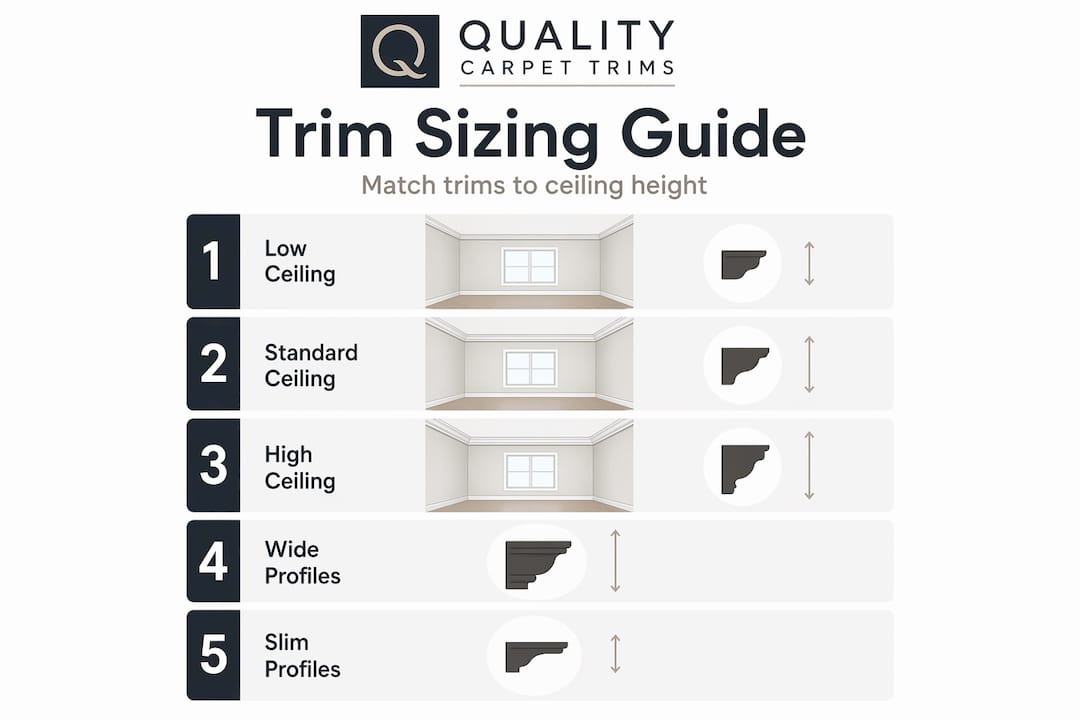
Pro Tip: As a general rule, baseboard height should increase with ceiling height. A room with 2.4 metre ceilings suits a 90 to 100mm skirting board, while a room with 3 metre ceilings can support 150mm or more without feeling heavy.
Visual inconsistencies most often appear at transition points between rooms or flooring types. Getting those transitions right is precisely where a quality flooring trim earns its place.
How trims signal quality and boost home value
There is something interesting about what trims do to perceived quality. Buyers and visitors rarely say “the trim work is excellent.” But homes with consistent trim that feels well cared for register immediately as higher quality, even to people with no knowledge of interior design. Trim works on the subconscious level, signalling that attention has been paid and corners have not been cut.
This matters enormously in a practical sense. You can spend thousands on a new kitchen or bathroom and still have a property that feels unfinished if the flooring transitions are bare, the skirting boards are cracked, or the door casings are mismatched. Conversely, trim upgrades improve how a home feels daily, not just when it goes to market.
For homeowners and renters working with a limited budget, trims represent one of the most cost-effective upgrades available:
- Replacing dated or damaged skirting boards refreshes an entire room for a fraction of a repaint or refurnish
- Adding or updating door casings gives tired doorways a completely new character
- Upgrading flooring transition trims removes the rough, unfinished look that haunts so many otherwise good rooms
- Consistent trim throughout signals a level of care that directly influences buyer impressions and market appeal
The investment is modest. The return on perception is significant.
Trims and 2026 interior design trends
One of the biggest interior trends of 2026 is colour drenching, and trims are central to it. Colour drenching incorporates trims to unify walls, ceilings, doors, and mouldings into one atmospheric, cohesive scheme. Rather than painting trim white as a default, more homeowners are choosing to match or tone their trims to the room’s overriding colour. The effect is dramatic and far more considered than the standard approach.
Interior designer Lucinda Griffith describes trims as the ‘jewellery’ of an interior scheme, likening them to fine accessories that elevate an outfit. That framing is worth sitting with. Trims are not the main event, but they are what makes the main event work. A plain neutral room with beautifully finished trims in a contrasting or complementary tone reads as designed. Without that detail, it just reads as plain.
For those who are not yet ready to commit to bold walls or patterned fabrics, designers recommend using trims as a controlled way to introduce colour and detail. A skirting board in a deep tone against a light wall, or a door casing in a warm metallic finish, introduces character without overwhelming the space. You can also explore flooring trim trends for 2026 to see how these principles apply specifically to floor-level transitions.
Where material quality becomes critical in this context is finish longevity. Cheaper trims made from inferior materials will discolour, split, or deform under the demands of daily life. Solid brass trims with powder-coated luxury finishes hold their colour and character over years of use. That consistency is what lets them function as genuine design features rather than purely functional elements that need replacing every few years.
Choosing and fitting the right trims
Getting trims right comes down to three things: proportion, consistency, and material quality. Here is a practical approach:
- Measure your ceiling height first. Let it guide your baseboard and crown moulding dimensions before you choose any profile. This single step prevents the most common proportioning errors.
- Choose one trim profile and apply it throughout. Consistent trim language across baseboards, door casings, and wall panels prevents visual mismatches and creates an intentional style. Do not mix ornate and minimal profiles in the same sightline.
- Match trim style to your home’s architecture. Modern trim uses clean, minimal profiles while traditional homes suit layered, detailed mouldings. The choice should align with your overall aesthetic goals rather than simply what is available.
- Invest in solid brass or premium powder-coated finishes for flooring trims. Wooden trims warp and swell. Plastic and rubber trims crack and yellow. Aluminium trims dent and scratch. Solid brass trims hold their form, resist daily wear, and retain their finish for far longer.
- Prioritise quality installation. Poorly fitted joints and gaps undermine trim’s entire effect. Consistent reveals, tight mitres at corners, and proper fixing will define whether the finished result looks professional or amateur.
Pro Tip: Before fitting any flooring trim, lay it in position dry and check how it reads from the main sightline into the room. A trim that looks fine up close can read awkwardly from the doorway. Adjust your choice before committing to installation.
You can read more about choosing the right finish in detail to help you select the profiles that will work best for your specific space.
My honest take on trims and why they matter
I have seen countless beautifully furnished rooms that feel incomplete simply because nobody thought about the trims. The sofa is perfect, the paint colour is spot on, and yet something reads as unresolved. Nine times out of ten, that feeling traces back to bare flooring transitions, mismatched skirting profiles, or flooring trims that were clearly chosen for price rather than quality.
What I have learnt working in this area is that trims are the detail that trained designers notice first and untrained buyers feel without knowing why. That combination is remarkably powerful. Spend properly on a trim that holds its finish and its form over years and you get a room that keeps looking right without constant maintenance.
The biggest mistake I see homeowners make is treating flooring trims as an afterthought. They spend months choosing carpet, flooring, and paint, and then buy whatever trim is cheapest on the day. Three years later the trim has faded, chipped, or bent out of shape and suddenly the floor it was supposed to complement looks tired. A solid brass trim in one of ten hand-finished finishes costs more upfront. But it will still look exactly right a decade from now, which no rubber or plastic alternative can claim.
My strong advice: decide on your trims at the same stage you choose your flooring. Treat them as a design element with the same weight as the floor itself. Your room will thank you for it.
— Matt
Premium trims from Qualitycarpettrims
If this article has convinced you that your trims deserve the same consideration as the rest of your interior, Qualitycarpettrims has exactly what you need. Every trim sold is solid brass, hand-finished in one of ten luxury powder-coated finishes designed to complement the most popular flooring and décor colour schemes found in UK homes. Unlike wooden trims that warp, plastic trims that crack, or aluminium trims that bend and scratch, these are built to hold their finish and form for the long term.
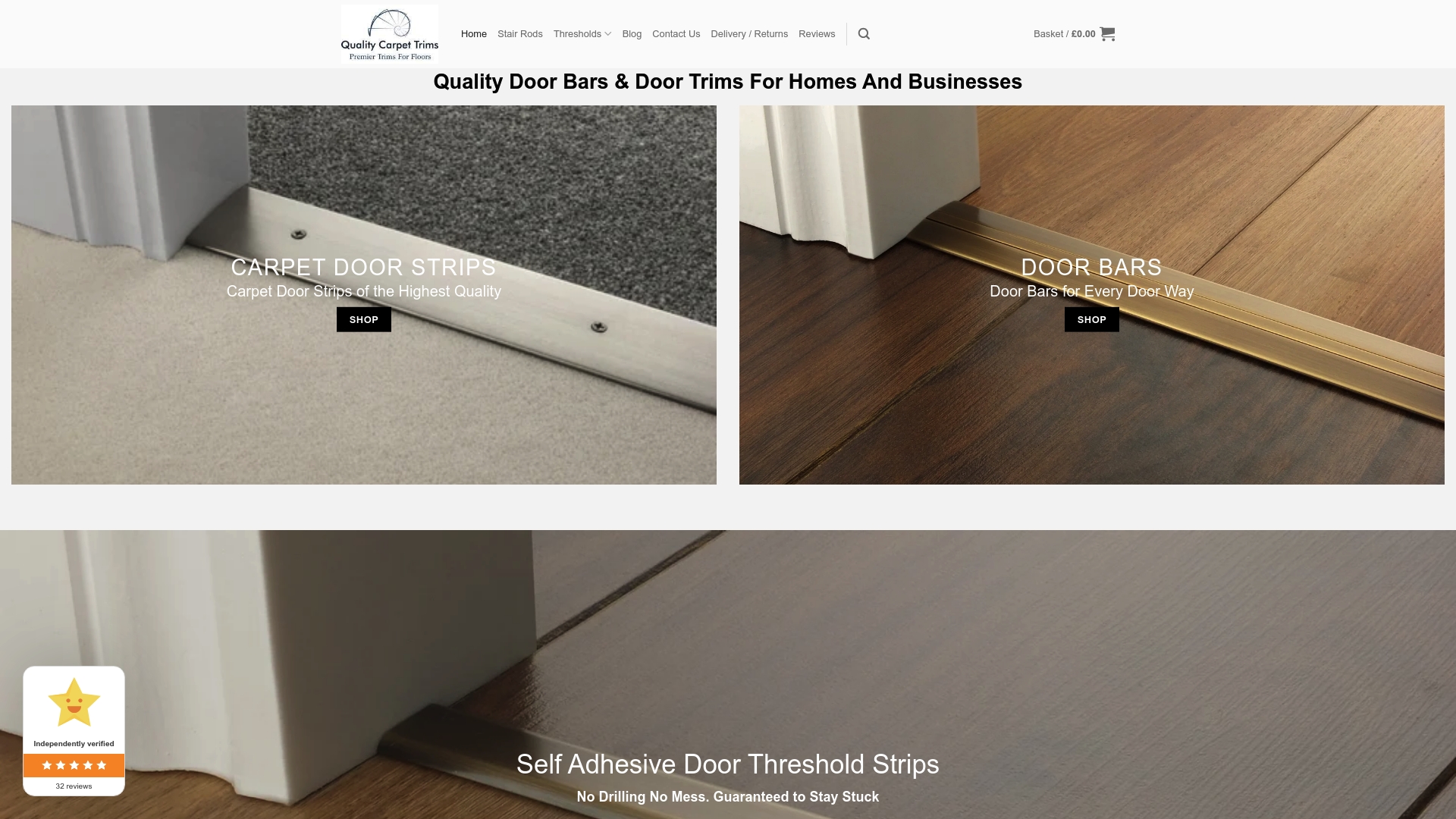
Whether you need matwell flooring trims to finish flooring edges with precision, door threshold bars for smooth room-to-room transitions, or carpet edge trims to join carpet sections cleanly, Qualitycarpettrims stocks the full range. Free samples, fast UK delivery, and expert guidance make it straightforward to choose the right profile and finish for your project. Explore the full range at qualitycarpettrims.co.uk and see what a proper trim can do for your space.
FAQ
Why do trims make a room look more finished?
Trims create clean transitions between surfaces and add depth through shadow lines, making rooms appear complete and intentional rather than flat. Without them, walls, floors, and ceilings meet without visual resolution.
Do trims actually add value to a home?
Yes. Homes with consistent, well-fitted trim signal craftsmanship and care to buyers, improving perceived quality even when buyers cannot identify trim as the specific reason. This perception translates into stronger market appeal and buyer confidence.
What is the best material for flooring trims?
Solid brass with a powder-coated finish is the most durable and visually consistent choice. Wooden trims warp, plastic and rubber trims crack and yellow, and aluminium trims dent easily. A solid brass trim holds its form and finish for years.
How do I choose the right trim size for my room?
Match trim scale to your ceiling height. Taller ceilings support wider, more substantial profiles, while standard-height rooms suit modest proportions. Oversized mouldings in low-ceiling rooms can make the space feel smaller rather than grander.
Can trims help with 2026 interior design trends?
Absolutely. Colour drenching, one of the dominant 2026 design trends, involves unifying walls, ceilings, and trims in a single cohesive colour scheme. Trims become an active design feature rather than a neutral background element in this approach.
Recommended
- The role of trims in home decor: a guide for UK homes
- Why trims matter: choosing the right finish for your renovation
- How trims transform decor for safer, stylish spaces
- Why floor trims matter: improve your home’s look and value