
Blog
What does a threshold do in your home?

May
TL;DR:
- A threshold at a doorway seals gaps, preventing draughts, water, insects, and noise from entering. Proper installation and quality materials are essential for energy efficiency, door protection, and long-lasting performance. Choosing the right threshold type and finish ensures a secure, functional transition between floors, reducing home comfort issues and energy costs.
Most homeowners walk over their door threshold a dozen times a day without giving it a second thought. That strip of metal sitting at the base of your doorway looks simple enough, but what does a threshold do beyond covering a gap? The answer matters far more than you might expect. A threshold actively works to seal your home against draughts, water, insects, and noise, all while protecting your flooring and creating a safe, finished transition between surfaces. Get it wrong and you will feel it in your heating bill.
Table of Contents
- Key takeaways
- What does a threshold do physically?
- Signs your threshold is not doing its job
- Thresholds and energy efficiency in UK homes
- Choosing the right threshold for your home
- My honest take on thresholds
- Finish your doorway properly with Qualitycarpettrims
- FAQ
Key takeaways
| Point | Details |
|---|---|
| Thresholds seal your doorway | They block draughts, water, dust, and insects from entering under the door. |
| Poor installation causes real problems | Incorrect height or profile leads to draughts, water staining, and latching difficulties. |
| Energy efficiency gains are significant | A well-fitted threshold reduces air leakage and lowers your home’s heating workload. |
| Material quality determines longevity | Solid brass, powder-coated thresholds resist denting and corrosion where cheaper options fail. |
| Flooring transitions need proper planning | Threshold height must align with adjacent flooring to prevent tripping and door drag. |
What does a threshold do physically?
A threshold is the strip fitted at the base of a doorway, sitting between the bottom of the door and the floor. Its primary job is to seal under-door gaps, blocking draughts, water, dust, and insects from creeping into your home. Without it, even a well-fitted door leaves enough of a gap for cold air and moisture to pass freely.
Thresholds do not work in isolation. They pair with a door sweep or automatic door bottom fitted to the underside of the door itself. Together, these two components create a reliable compression seal. When the door closes, the sweep presses down against the threshold, closing off the gap completely. If either component is missing or worn, the seal fails regardless of how good the other one is.
Beyond sealing, thresholds protect door edges and flooring from daily wear, weather damage, and moisture ingress. Water pooling at an unprotected door base will eventually damage both the door frame and the floor covering underneath. A threshold redirects and sheds that water before it becomes a problem.
Here is what a threshold actively does in your home:
- Blocks cold air and draughts entering at floor level
- Prevents rainwater and surface water from tracking under the door
- Stops dust, debris, and small insects from finding a route inside
- Provides a finished edge that protects flooring from lifting or fraying at the doorway
- Creates a safe, level transition between two floor surfaces of different heights
- Reduces noise travelling through the gap at the bottom of exterior and interior doors
Pro Tip: When fitting a new threshold, check the condition of your door sweep at the same time. A perfect threshold paired with a worn sweep will still let draughts through. Replace both together for a complete seal.
Signs your threshold is not doing its job
You might not notice a failing threshold until the effects become uncomfortable. Bottom-of-door draughts are the most common symptom, and they almost always point to a threshold or door sweep problem rather than a frame issue. If you feel cold air moving across the floor near an exterior door on a windy day, that is your threshold telling you something is wrong.
Water staining on the floor just inside an exterior door is another tell-tale sign. After heavy rain, if you notice water marks or damp patches at the door base, the threshold is no longer forming a watertight seal. This can lead to damage beneath the surface, including subfloor moisture problems that are expensive to fix.
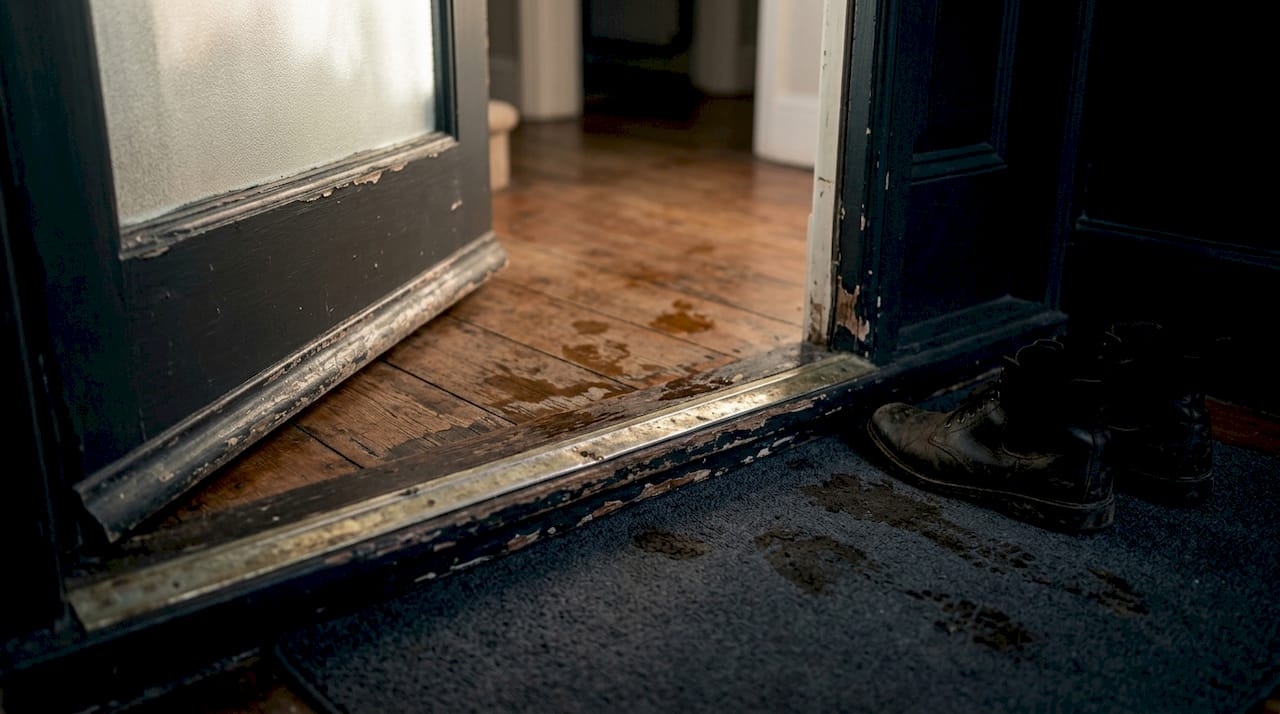
Difficulty latching a door can also point to threshold trouble. If the threshold height has shifted or the profile no longer aligns correctly with the door sweep, the door bottom may drag or create resistance that makes latching difficult. This is more common after flooring replacement, where flooring changes affect threshold performance and require the threshold to be refitted or replaced.
Pro Tip: Hold a piece of thin paper under a closed exterior door on a breezy day. If you can pull it out without resistance, your threshold and sweep combination is not sealing properly. It is a quick, free test that tells you exactly where you stand.
Use this checklist to diagnose threshold problems:
- Run your hand along the bottom of the door on a cold day to feel for air movement
- Check for water staining or damp patches on the floor just inside exterior doors
- Look for wear marks or compression damage on the threshold surface itself
- Inspect the door sweep for tears, compression loss, or missing sections
- Check whether the door closes and latches without dragging on the threshold
- Look for misalignment causing overlooked drafts by observing light visible under the closed door
Thresholds and energy efficiency in UK homes
The importance of thresholds in reducing energy loss is something many homeowners genuinely underestimate. Air leakage at doors and windows is one of the primary causes of heat loss in UK homes, and the gap at the base of a door is one of the most direct routes for warm air to escape and cold air to enter.
A well-fitted threshold keeps indoor temperatures consistent by cutting the air leakage that forces your boiler to work harder. Research confirms that sealed thresholds reduce heating workload, making them one of the lowest-cost, highest-impact improvements available to homeowners.
The effect on noise is worth noting too. Even a modest reduction in the gap at a door base noticeably cuts the level of external noise that enters a room. For homes on busy streets or near neighbours, a properly sealed threshold makes a practical difference to how peaceful your interior feels.
If you are exploring door threshold benefits for UK homes, thresholds sit alongside draught excluders, letterbox covers, and keyhole covers as simple upgrades that collectively make a meaningful difference to your energy bills and comfort. Individually modest, together they add up fast.
For more ideas on door and window sealing to cut energy costs, the tips on door and window insulation resource covers the broader picture of where homes typically lose the most heat.
Choosing the right threshold for your home
Not all thresholds are the same shape or profile, and the wrong choice can undermine both the look and performance of your doorway. Understanding the main types helps you pick the right one.
Saddle thresholds sit across the full width of the doorway and are the most common exterior option. They are raised slightly above floor level and designed to shed water away from the door base. Low-profile thresholds sit closer to the floor, making them a better choice where accessibility matters or where there is minimal height difference between two floor surfaces. Interlocking thresholds use a two-part design where the door sweep hooks into the threshold profile, creating an extremely tight seal particularly suited to exposed or weather-heavy locations.
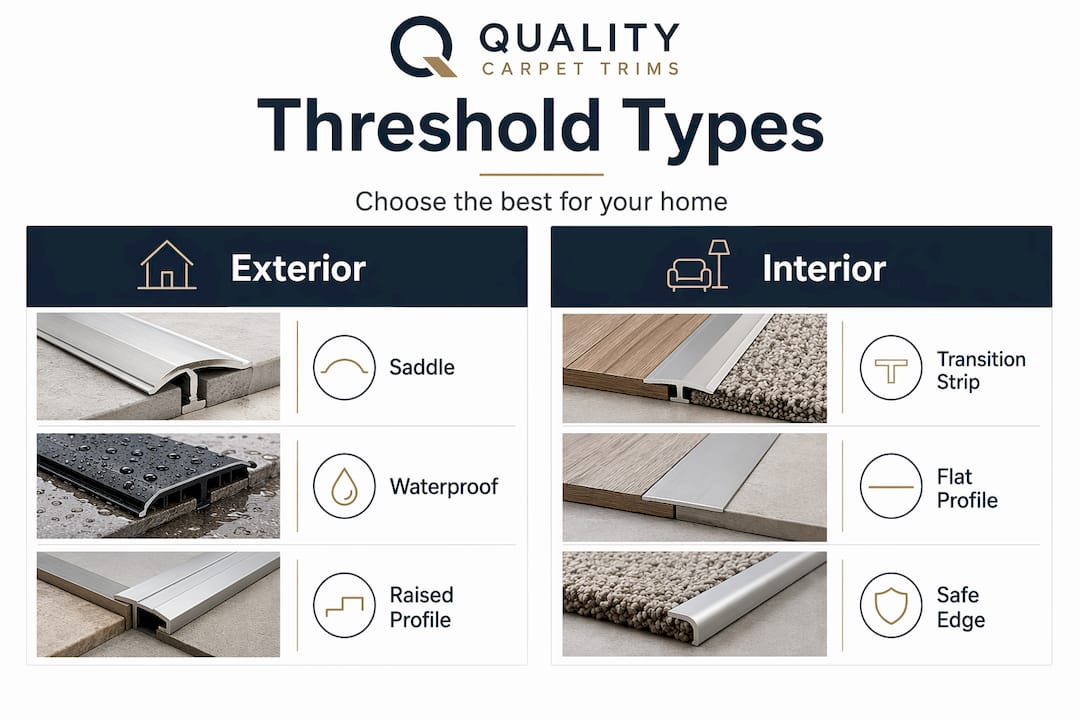
| Threshold type | Best suited for | Key benefit |
|---|---|---|
| Saddle | Exterior doors with height change | Water shedding and robust sealing |
| Low-profile | Accessible doorways, minimal height difference | Smooth transition, reduced trip risk |
| Interlocking | Exposed or high-wind locations | Maximum draught and weather sealing |
Choosing the right threshold also means choosing the right material. Wooden trims swell, split, and rot with moisture exposure. Plastic and aluminium options bend, dent, and lose their finish within a couple of years. Solid brass thresholds with a powder-coated finish are in a different category entirely. They will not split, dent, or corrode, and the finish holds its appearance through years of foot traffic and weather exposure.
Qualitycarpettrims supplies solid brass thresholds hand-finished in ten luxury finishes, including options to match brushed brass, satin nickel, antique bronze, and other popular interior hardware tones. The idea is that your threshold looks as considered as the rest of your interior rather than being an afterthought.
When selecting your threshold, think about these factors:
- The height difference between the two floor surfaces at the door base
- The level of weather exposure the door receives
- The foot traffic volume across the doorway
- The finish of surrounding door hardware and flooring
- Compliance with accessibility requirements if the doorway is frequently used by elderly or mobility-impaired family members
A transition strip for uneven floors may be needed where flooring height differences are significant, to create a safe, graded transition rather than an abrupt step.
My honest take on thresholds
I have seen more avoidable home comfort problems caused by bad threshold choices than almost anything else in interior renovation. The pattern is almost always the same. Someone refits a kitchen or replaces their hallway flooring, the installer fits a cheap trim to finish the job, and six months later the homeowner is calling about unexplained cold spots or draughts they cannot locate.
What surprises me is how many people think the threshold is an aesthetic decision. You pick the colour and that is that. In my experience, the functional side of the choice matters far more. Getting the height right, matching the profile to the door sweep, checking the door alignment after flooring work — these are the details that separate a doorway that actually performs from one that just looks finished.
I have also seen what happens with inferior materials over time. Wooden thresholds swell and lift after a couple of winters. Plastic strips crack along the screw holes. Aluminium ones dent the first time anything heavy crosses them. Solid brass simply does not do those things, which is why I always recommend it to anyone planning a renovation they want to last.
If you are doing the work yourself, take time to read a proper guide to door thresholds before you start. The small decisions you make at this stage save a lot of frustration later.
— Matt
Finish your doorway properly with Qualitycarpettrims
If this article has made you look at your threshold differently, you are not alone. Choosing a threshold that actually works means choosing one built to last.
Qualitycarpettrims makes solid brass door threshold bars hand-finished in ten luxury finishes, designed specifically for UK homes and renovation projects. These premium door threshold bars will not split, bend, or dent the way cheaper options do, and they are made right here in Britain. Whether you need a saddle profile for an exposed front door or a low-profile bar for a smooth interior transition, the range at Qualitycarpettrims covers it. Browse the full collection of threshold strips and request a free sample to see the quality for yourself before you commit.
FAQ
What is the main purpose of a threshold?
A threshold seals the gap at the base of a doorway, blocking draughts, water, dust, and insects from entering the home. It also protects flooring edges and creates a safe transition between floor surfaces.
How does a threshold work with a door sweep?
The threshold and door sweep work as a pair. When the door closes, the sweep on the door base presses down against the threshold surface, creating a compression seal that prevents air and water from passing underneath.
What happens if a threshold is the wrong height?
If a threshold is too high or too low relative to the door sweep, the seal will fail. This commonly causes draughts at the base of the door, water ingress after rain, and sometimes difficulty latching the door correctly.
Why choose solid brass over other threshold materials?
Solid brass thresholds with a powder-coated finish resist corrosion, denting, and splitting over long periods of use. Cheaper options made from plastic, aluminium, or wood deteriorate far faster, particularly in exposed or high-traffic doorways.
Do thresholds help with energy bills?
Yes. A well-sealed threshold reduces air infiltration at the door base, which is one of the most common routes for heat loss in UK homes. Fitting the right threshold helps your heating system maintain consistent indoor temperatures with less effort.
Recommended
- What is a floor threshold? A practical UK guide
- What is a door threshold? Expert guide for UK homes
- Why use door thresholds? Key benefits for UK homes
- Door threshold benefits for stylish UK homes in 2026