
Blog
Why choose metal trims for your flooring project

Jul
TL;DR:
- Metal trims are the superior choice for flooring edges due to their durability, moisture resistance, and long lifespan. They enhance aesthetic appeal with clean lines and consistent finishes, making them a valuable architectural detail. Although more expensive initially, they offer lasting quality and reliability, reducing long-term replacement costs.
Metal trims are defined as the finishing profiles fitted at flooring edges, transitions, and doorways to protect exposed material and create a clean visual boundary. They are the single most important detail that separates a professional flooring installation from an amateur one. Solid brass trims, such as those hand finished by Qualitycarpettrims in 10 luxury powder coat colours, deliver strength and style that plastic, rubber, and wooden alternatives simply cannot match. This article explains the key advantages of metal trims, how they enhance design, and what you need to know before fitting them in your home.
Why choose metal trims over cheaper alternatives?
Metal trims are the superior choice for flooring edges because they resist splitting, bending, and denting under everyday load. Plastic, rubber, and wooden trims fail at the very point where flooring is most vulnerable: the edge. A plastic trim in a busy hallway will crack within a few years. A wooden trim will swell with moisture and split at the grain. Solid brass trims hold their shape and their finish for decades.
Metal trims withstand impact and wear far better than plastic, which deforms under repeated load. That matters in high-traffic areas like hallways, kitchens, and commercial entrances where a trim takes a beating every single day.
The advantages of metal trims go beyond raw strength. Powder coated brass does not peel, chip, or stain the way painted wood or plastic does. Powder coated finishes form a durable surface layer that resists UV fading and daily abrasion. That means the colour you choose on day one still looks sharp five years later.
- Resistance to splitting and cracking. Solid brass holds its form under foot traffic, furniture movement, and door impact.
- Moisture resistance. Metal trims seal edges against moisture ingress, protecting the subfloor and the flooring material beneath.
- Finish durability. Powder coating does not peel or flake like paint on wood or the surface layer on plastic trims.
- Long service life. Quality metal trims last 25 or more years, compared to 5–15 years for plastic alternatives.
- Structural integrity. Metal trims protect the edge of carpet, laminate, and vinyl from fraying, lifting, and undercutting.
Pro Tip: When comparing trims, press a fingernail firmly into the trim material. Plastic and rubber will mark immediately. Solid brass will not. That test tells you everything about long-term durability.
How do metal trims enhance aesthetic appeal in flooring design?
Metal trims are an architectural finishing detail, not just a functional edge protector. Modern metal trims create clean lines that define the boundary between flooring surfaces and give a room a finished, considered look. Interior designers use them to draw the eye along a floor plane and to separate zones within open-plan spaces.
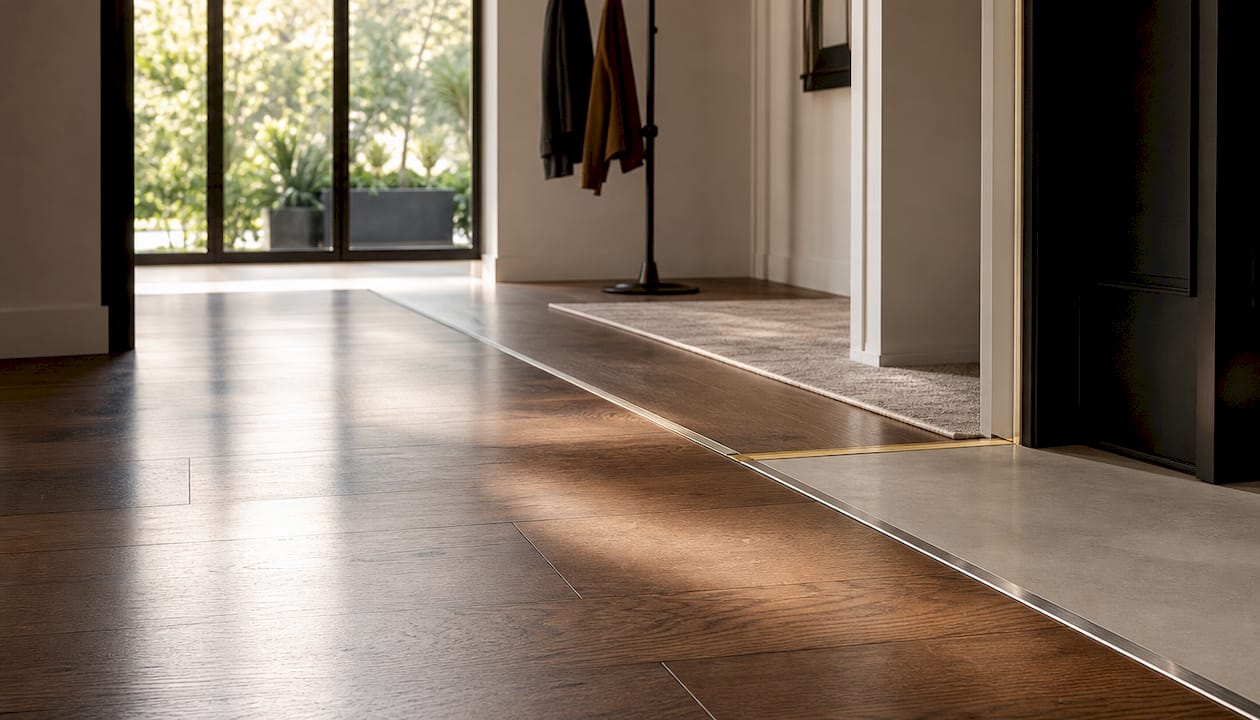
Qualitycarpettrims offers solid brass trims hand finished in 10 luxury powder coat colours. That range covers everything from warm antique gold tones to cool contemporary graphite. Each finish is applied by hand, which means the colour sits evenly across the profile without the thin, uneven coverage you get from mass-produced plastic trims.
The design benefits of metal trims include:
- Sharp, defined transitions. Metal creates a crisp line between carpet and hard flooring that grout lines and rubber edges cannot replicate.
- Colour consistency over time. Powder coat finishes maintain their tone without yellowing, fading, or staining.
- Compatibility with luxury interiors. Brass trims complement natural stone, hardwood-effect laminate, and premium vinyl in a way that plastic profiles never do.
- Architectural presence. A well-chosen metal trim reads as a design feature, not an afterthought.
- Finish options for every room. Warm finishes suit living rooms and bedrooms; cooler, darker finishes work well in kitchens and bathrooms.
Plastic and rubber trims discolour over time. They absorb cleaning chemicals, scuff easily, and develop a dull, aged appearance that undermines the rest of the room. A metal trim, by contrast, can be wiped clean and will look the same as the day it was fitted.
Pro Tip: In rooms with underfloor heating, choose a finish that complements your floor colour at its warmest tone. Brass and bronze finishes tend to look richer under warm light, while graphite and chrome-effect powder coats suit cooler, north-facing rooms.
Are metal trims worth the higher upfront cost?
Metal trims cost more than plastic or rubber at the point of purchase. That higher cost is fully justified by the lifespan and the protection they provide. Quality metal trims last 25 or more years, while plastic alternatives typically need replacing within 5–15 years. Over a 25-year period, you may replace a plastic trim two or three times. Each replacement means labour, disruption, and the risk of damaging the flooring around the edge.
Metal trim protects structural integrity by sealing edges against moisture and mechanical damage. Water ingress at a flooring edge is one of the most common causes of subfloor rot and laminate swelling. A solid brass trim fitted correctly eliminates that risk at the most vulnerable point.
The table below compares the long-term cost factors of metal trims against cheaper alternatives.
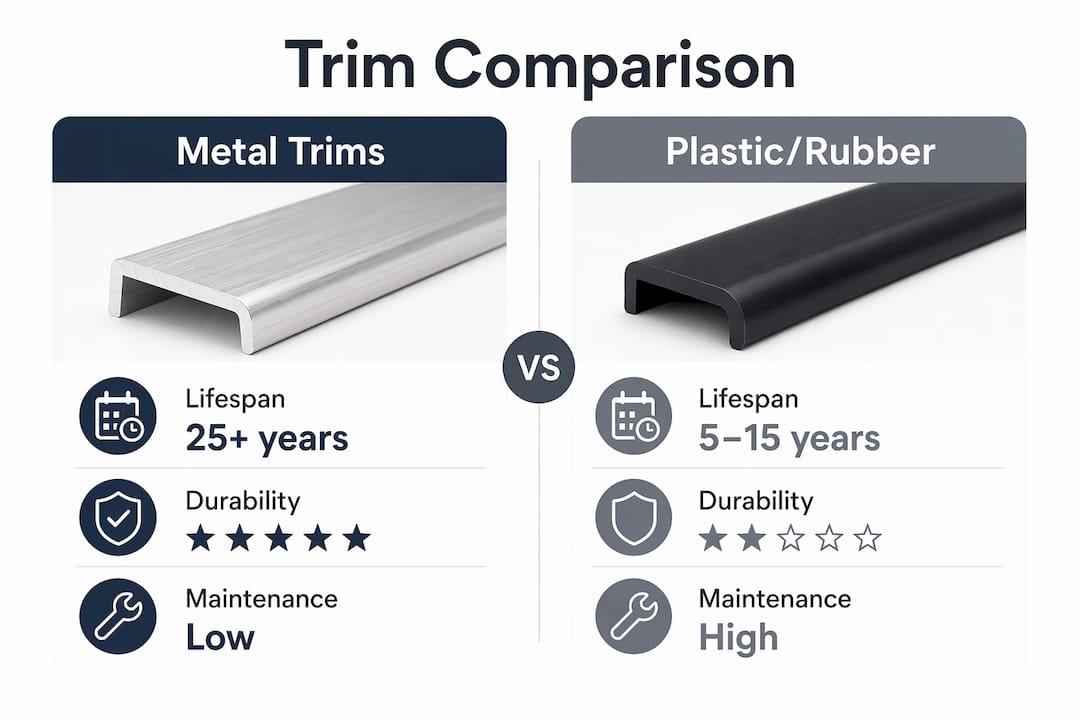
| Factor | Metal trims | Plastic or rubber trims |
|---|---|---|
| Expected lifespan | 25+ years | 5–15 years |
| Finish durability | Powder coat holds colour; does not peel | Surface layer fades, cracks, and discolours |
| Maintenance required | Wipe clean; no repainting needed | May need replacing when finish fails |
| Moisture protection | Seals edges against water ingress | Can lift and allow water underneath |
| Replacement frequency | Once per generation | Two to three times over 25 years |
Metal trims require minimal maintenance but deliver a higher return over their lifetime. The maths is straightforward: pay more once, or pay less repeatedly while accepting a worse result each time.
Pro Tip: When calculating the true cost of a trim, add the cost of fitting to the material price. A trim you replace twice costs three fitting fees. A metal trim fitted once costs one.
What should you know before fitting metal trims?
Metal trims require a flat, level substrate. Their rigidity is a strength in use, but it means they will not flex to accommodate an uneven floor. Metal trims need flat substrates to sit flush without gaps or rocking. Before fitting, check the floor with a spirit level and fill any dips with a floor levelling compound. This step takes 20 minutes and prevents a poor result.
Fitting metal trims is straightforward for a competent DIY homeowner or a professional installer. Most profiles fix with a clip system or a suitable adhesive, and the trim itself can be cut on-site with a mitre saw to achieve a precise fit at any angle or length. No specialist equipment is needed.
Follow these steps for a reliable installation:
- Prepare the substrate. Level the floor surface and remove any debris or adhesive residue from the edge zone.
- Measure and cut. Measure the opening or transition length carefully. Cut the trim to length using a mitre saw for a clean, square end.
- Check the profile. Select the correct profile shape for your flooring type. A carpet-to-hard-floor transition needs a different profile from a carpet-to-carpet join. Qualitycarpettrims’ flooring transition guide covers the right profile for every situation.
- Fix the trim. Use the clip system or adhesive recommended for the profile. Press firmly along the full length to seat the trim evenly.
- Check for gaps. Run a finger along both edges of the fitted trim. Any gap indicates an uneven substrate that needs addressing before the adhesive sets.
Pro Tip: Always allow for thermal expansion when fitting metal trims in rooms with underfloor heating. Leave a 1–2mm gap at each end of the trim run. Brass expands slightly with heat, and a trim fitted tight to a wall can bow over time if no allowance is made.
Maintenance is minimal. Wipe metal trims with a damp cloth and a mild detergent. Avoid abrasive cleaners, which can dull the powder coat surface. A trim cleaned this way will hold its finish for the full life of the floor.
Key takeaways
Solid brass metal trims outperform plastic and rubber alternatives on every measure that matters: lifespan, finish durability, moisture protection, and design quality.
| Point | Details |
|---|---|
| Durability advantage | Solid brass trims resist splitting, bending, and denting where plastic and rubber fail. |
| Lifespan comparison | Metal trims last 25 or more years; plastic alternatives last just 5–15 years. |
| Aesthetic value | Powder coat finishes maintain colour and sharpness without fading, peeling, or staining. |
| Installation requirement | A flat, level substrate is non-negotiable; fill dips before fitting any metal trim. |
| Long-term cost | One metal trim fitted once costs less over 25 years than replacing cheaper trims repeatedly. |
Why I stopped recommending anything other than solid metal trims
I have seen hundreds of flooring installations over the years, and the pattern is always the same. The homeowner chooses a plastic or rubber trim to save £10 or £15 at the point of purchase. Three years later, the trim is cracked, discoloured, or lifting at one end. The floor underneath has started to fray or lift because moisture got in at the edge. The fix costs far more than the saving.
Metal trims solve that problem permanently. A solid brass trim fitted correctly is, for all practical purposes, a permanent fixture. The floor will need replacing long before the trim does. That is the kind of reliability that adds genuine value to a property, and buyers notice it. A home with quality flooring edge trims throughout reads as a well-maintained, well-considered property.
The trend in UK interiors is clearly moving towards metal trims. Open-plan living spaces, luxury vinyl tile, and engineered flooring all demand a finishing detail that matches their quality. A plastic trim next to a £50-per-square-metre floor looks wrong. A hand-finished brass trim in the right colour looks intentional.
My strongest recommendation is to choose trims that are hand finished rather than mass-produced. The difference in finish quality is visible. Qualitycarpettrims produces solid brass trims finished by hand in 10 colours, and that level of care shows in the final result. If you are spending money on good flooring, protect it with a trim that is built to the same standard.
— Matt
Qualitycarpettrims: solid brass trims in 10 luxury finishes
Qualitycarpettrims supplies solid brass door bars and flooring trims hand finished in 10 powder coat colours, from warm antique brass to contemporary graphite. Every trim is made in the UK and finished by hand, which means consistent colour and a surface that holds up to daily use without peeling or fading.
If you are fitting carpet to hard flooring, updating a doorway threshold, or finishing a matwell, the matwell flooring trim range at Qualitycarpettrims covers the most popular profiles in all 10 finishes. Free samples are available so you can match the finish to your floor before you order. Fast UK delivery and expert advice make the process straightforward from selection to fitting.
FAQ
What makes metal trims better than plastic or rubber?
Metal trims resist splitting, bending, and denting where plastic and rubber fail under load. They also last 25 or more years, compared to 5–15 years for plastic alternatives, making them the better long-term choice.
Do metal trims require special tools to fit?
No specialist tools are needed. Metal trims can be cut to length on-site with a standard mitre saw and fixed with a clip system or adhesive, making them suitable for both professional installers and competent DIY homeowners.
How do I maintain a powder coated metal trim?
Wipe the trim with a damp cloth and a mild detergent. Avoid abrasive cleaners, which can dull the powder coat surface. No repainting or resealing is required over the life of the trim.
Why do metal trims need a flat substrate?
Metal trims are rigid and will not flex to fill gaps in an uneven floor. A level substrate is required so the trim sits flush along its full length without rocking or leaving gaps at the edges.
Are metal trims a good investment for property value?
Metal trims protect flooring edges against moisture ingress and mechanical damage, which directly preserves the condition of the floor and the subfloor beneath. A well-finished floor with quality trims throughout is a visible indicator of a well-maintained property.
Recommended
- Flooring Transition Guide for Perfect Metal Trim Fitting
- Flooring Edge Trims: The Key to a Seamless Finish
- Flooring trim types explained: choosing the right finish
- Metal carpet trims: protection, style, and lasting value