
Blog
What is hand finished trim? a UK homeowner’s guide

Jun
TL;DR:
- Hand finished trim involves manual shaping and surface preparation of interior woodwork, ensuring sharper profiles and better shadow lines than mass-produced profiles. It significantly enhances room aesthetics, particularly in baseboards, casings, and crown moulding, by maintaining precise geometry through multiple paint coats. Proper installation and craftsmanship are essential, with trim fitted before painting and profiles carefully matched during renovations to achieve a high-quality, cohesive finish.
Hand finished trim is the manual shaping, fitting, and surface preparation of decorative interior woodwork within finish carpentry installations. It covers visible elements like baseboards, door casings, crown moulding, and wainscoting, each manually finished for superior quality that mass-produced profiles simply cannot replicate. The term “hand finished” sits within the broader discipline of finish carpentry, which focuses entirely on what you see once a room is complete. If you are planning a renovation and wondering why some interiors feel genuinely polished while others just feel built, the answer almost always comes down to the quality and precision of the trim work.
What is hand finished trim and how does it differ from mass-produced?
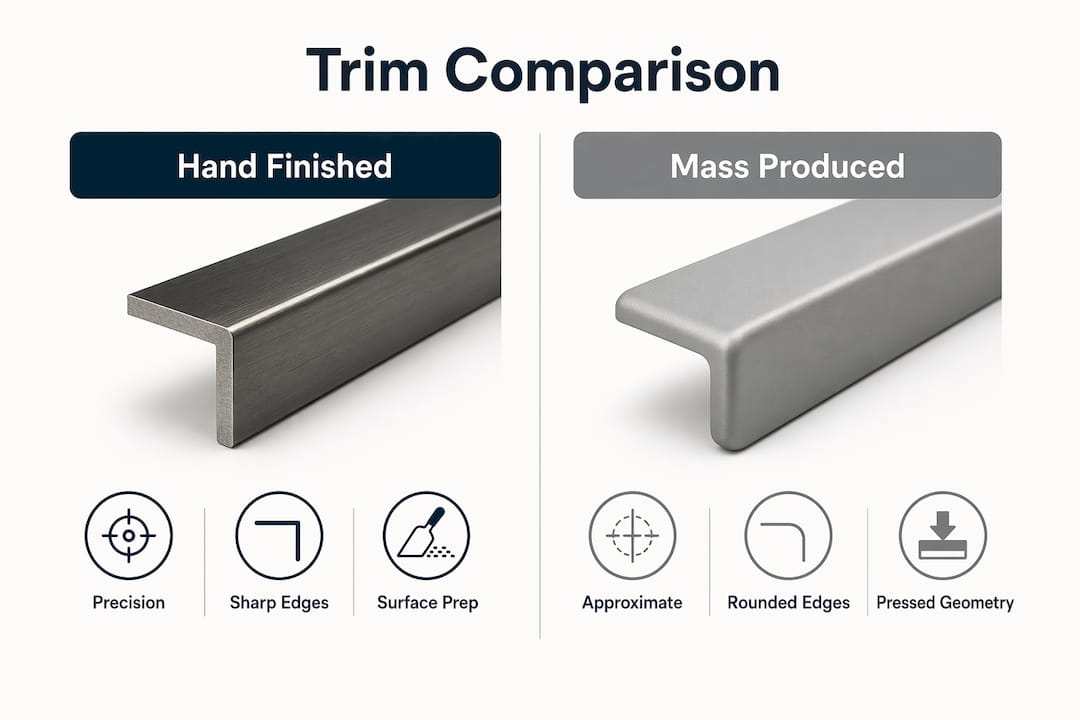
Hand finished trim is defined by two things: tight profile tolerances and careful surface preparation applied by a skilled craftsperson rather than a production line. Profiles ground to 1/32" tolerance hold their shadow lines through multiple paint coats, while retail profiles lose their edge definition by the third coat, making the trim appear flat against the wall. That distinction matters enormously in a finished room.
Mass-produced trims are pressed or extruded at speed. The geometry is approximate. Edges are slightly rounded, profiles are shallow, and the surface is rarely prepared to accept paint in a way that preserves crisp detail. Hand finished profiles, by contrast, are worked to maintain exact geometry so that light catches the edges and creates the shadow lines that give a room its architectural character.
Homeowners often assume “hand finished” refers only to the surface coating. In reality, achieving crisp shadow lines requires both tight profile tolerances and careful finishing applied in the correct sequence. One without the other produces a result that looks acceptable at first glance but loses its quality within a year of repainting.
Pro Tip: Before purchasing any trim profile, run your fingernail along the edge. A hand finished profile will have a sharp, defined ridge. A mass-produced profile will feel soft or rounded. That difference is exactly what you will see on your walls.
| Feature | Hand Finished Trim | Mass-Produced Trim |
|---|---|---|
| Profile tolerance | ~1/32" precision | Approximate, often rounded |
| Shadow line retention | Holds through multiple paint coats | Lost by third coat |
| Surface preparation | Manual, paint-ready | Machine-pressed, variable |
| Visual result after repainting | Crisp and defined | Flat and indistinct |
| Longevity of detail | Long-lasting | Degrades with each repaint |
Which interior elements benefit most from hand finishing?
Finish carpentry covers baseboards, door and window casings, crown moulding, wainscoting, and panel mouldings, and each of these elements gains significantly from hand finishing. They are not decorative afterthoughts. They are the components that cover the gaps between walls, floors, and ceilings, and define every transition in a room.
Here is how each element contributes:
- Baseboards run along the base of every wall, covering the gap between the floor surface and the plasterboard. A hand finished baseboard with a defined profile creates a clean visual boundary that grounds the room.
- Door and window casings frame every opening in the house. Poorly finished casings make doors look like afterthoughts. Hand finished casings make them look intentional and architectural.
- Crown moulding sits at the junction of wall and ceiling. Its profile is complex, and only a hand finished version maintains the geometry needed to cast proper shadow lines at that angle.
- Wainscoting covers the lower portion of a wall, typically in hallways and dining rooms. The panels and rails must align precisely, and hand finishing ensures the surface is consistent across every section.
- Panel mouldings add depth and detail to flat walls. They work only when the profiles are sharp enough to read clearly from across the room.
Finish carpentry pulls a space together through intentional transitions. Without it, a room feels unresolved regardless of how good the paint colour or furniture choices are.
How does hand finished trim interact with paint and finishing coats?
Trim is installed before the final coat of paint to preserve surface continuity and sharp geometry. This sequence is not optional. If you paint walls first and install trim afterwards, you create visible gaps and inconsistencies that no amount of caulk fully corrects.
The correct workflow is to install the trim, prime it, apply the first finish coat to walls and trim together, then apply the final coat. This approach means every surface receives the same number of coats and the trim profile retains its geometry throughout. Installing trim first and painting after preserves the shadow lines and sharp profiles that define the quality of the finish.
Soft, mass-produced profiles suffer most from this process. Each paint coat adds a fraction of a millimetre to every surface. On a sharp hand finished edge, that build-up is negligible. On a soft retail profile, it rounds the edge further with every coat until the profile reads as almost flat. After three or four repaints over the life of a house, the difference between the two approaches becomes stark.
Pro Tip: Always sand lightly between coats on hand finished trim using 220-grit paper. This removes any raised grain or brush marks without rounding the profile edges, keeping the geometry intact through every finishing layer.
What are the best practices for installing hand finished trim?
Precision is non-negotiable in finish carpentry because every cut and joint is fully visible. There is nowhere to hide a mistake. The following practices separate a professional result from an amateur one.
-
Measure every opening individually. No two door or window openings in a house are exactly the same size. Cutting all casings to a standard dimension produces gaps and misalignments. Measure each opening and cut to fit.
-
Account for out-of-square corners. Most walls are not perfectly plumb and most corners are not exactly 90 degrees. Finish carpenters anticipate imperfect angles and use a digital angle finder to set mitre cuts accurately rather than assuming a standard 45-degree cut will close the joint.
-
Lay out the full room before fixing anything. Place all trim pieces loosely in position before nailing. This lets you spot alignment problems, height inconsistencies, and profile mismatches before they become permanent.
-
Maintain consistent reveal on casings. The reveal is the small setback between the edge of the door frame and the face of the casing. A consistent reveal of around 6mm on every side of every opening is what gives a room its sense of order and intention.
-
Match profiles when renovating. Matching existing trim profiles in renovations often requires physical sampling and on-site profile matching. Taking a section of the existing trim to a specialist supplier is far more reliable than trying to match by eye from a catalogue.
-
Use the right fixings. Hand finished trim deserves proper fixing. Use a finish nailer with the correct nail length for the substrate, and set each nail head just below the surface so it can be filled and sanded flush without distorting the profile.
The DIY installation guide from Qualitycarpettrims covers the full workflow for floor-level trim in detail, which is worth reading alongside any room-level trim project.
Key takeaways
Hand finished trim is the single most effective way to give an interior the architectural quality that separates a genuinely finished room from one that is merely decorated.
| Point | Details |
|---|---|
| Definition of hand finished trim | Manually shaped and finished interior woodwork within finish carpentry, covering baseboards, casings, and mouldings. |
| Profile precision matters | Tolerances of around 1/32" preserve shadow lines through multiple paint coats; mass-produced profiles lose definition quickly. |
| Correct installation sequence | Install trim before the final paint coat to maintain surface continuity and sharp profile geometry. |
| Renovation matching | Always physically sample existing profiles when renovating; catalogue matching by eye produces visible inconsistencies. |
| Craftsmanship over materials | Good finish carpentry results from disciplined technique and basic tools, not exotic or expensive materials. |
Why the detail in trim work is never trivial
I have walked through hundreds of renovated homes over the years, and the ones that genuinely impress are almost never the ones with the most expensive finishes. They are the ones where someone cared about the trim. The baseboards sit tight to the floor. The casings have a consistent reveal. The crown moulding casts a proper shadow line at the ceiling. None of that happens by accident.
What strikes me most is how often homeowners invest heavily in kitchens and bathrooms, then accept whatever trim comes in a bundle from a builders’ merchant for the rest of the house. The trim is the last thing installed and the first thing your eye reads when you enter a room. It sets the tone for everything else.
The craftsmanship discipline behind hand finished trim is not about using rare materials or exotic profiles. Good finish carpentry comes from skilled use of basic tools and a refusal to accept approximate results. That is a mindset as much as a technique. The same principle applies to every finishing detail in a home, including the floor trims and door bars that connect different flooring surfaces. A room that is finished properly at every transition point feels complete. One that is not feels like a work in progress, no matter how much was spent on everything else.
If you are renovating, treat the trim as seriously as the tiles or the paint colour. You will notice the difference every single day.
— Matt
Premium hand finished trims from Qualitycarpettrims

If the quality of your trim work matters to you, the finishing products you choose need to match that standard. Qualitycarpettrims supplies solid brass door bars and flooring trims, hand finished in 10 luxury powder-coated colours to complement any interior scheme. Unlike plastic, rubber, or aluminium trims that bend, split, or dent within months, solid brass holds its form and its finish for the life of the floor. Browse the full range of premium solid brass thresholds to find the right profile and colour for your project. The team at Qualitycarpettrims also offers expert advice on fitting and product selection, so you get the right trim the first time. Free samples are available if you want to check the finish against your flooring before ordering.
FAQ
What is hand finished trim in simple terms?
Hand finished trim is decorative interior woodwork, such as baseboards, door casings, and crown moulding, that is manually shaped and surface-prepared to a higher standard than mass-produced profiles. The result is sharper edges, better shadow lines, and a finish that holds its quality through multiple paint coats.
Why use hand finished trims instead of standard retail profiles?
Retail profiles lose their edge definition by the third paint coat, making trim appear flat against the wall. Hand finished profiles maintain their geometry and shadow lines indefinitely, which is why they are the preferred choice for quality renovations.
What rooms benefit most from handcrafted trim?
Every room benefits, but hallways, living rooms, and dining rooms gain the most because these are the spaces where architectural detail is most visible. Crown moulding, wainscoting, and door casings in these areas define the character of the entire home.
How is trim hand finished during installation?
The process involves precise profile cutting, careful surface preparation, and installation before the final paint coat. Finish carpenters use layout strategies to manage imperfect walls and out-of-square corners, ensuring every joint is tight and every line is clean.
Can i match existing hand finished trim profiles in a renovation?
Yes, but it requires physical sampling rather than catalogue matching. Taking a section of the existing trim to a specialist supplier and having the profile matched on-site is the only reliable method for achieving a consistent result across the interior.
Recommended
- Hand-finished trims: the UK homeowner’s guide
- The role of trims in home decor: a guide for UK homes
- Floor trim types explained for UK homes: A full guide
- Premium flooring trim: enhance your UK home in style