
Blog
The role of trims in home decor: a guide for UK homes

May
TL;DR:
- Trims are essential architectural elements that protect surfaces, define spaces, and enhance home decor. Choosing the right style, scale, and material ensures visual cohesion, durability, and cost-effectiveness in renovation projects. High-quality trims, especially solid metal options, add lasting value and a refined finish to any interior.
Most homeowners treat trims as an afterthought, something to sort once the floors are down and the painting is done. That instinct undersells the role of trims in home decor considerably. Trims do far more than tidy up edges. They protect surfaces from daily wear, define the architectural character of a room, and bridge the practical gap between different flooring materials. For UK homeowners and interior designers working on residential renovations, choosing the right trim is one of the highest-return decisions you can make. This guide explains why, and how to get it right.
Table of Contents
- Understanding trims: beyond decoration to architectural essentials
- How trims elevate home decor while keeping costs in check
- Types of trims and selecting the right style for your space
- Choosing trims for flooring transitions: safety, movement, and longevity
- Creating cohesive and balanced interiors with consistent trim choices
- Rethinking trims: the unsung heroes of lasting home quality
- Upgrade your home with premium trims from Quality Carpet Trims
- Frequently asked questions
Understanding trims: beyond decoration to architectural essentials
Many people think of trims as simple strips of material applied around doors or along skirting boards. In reality, interior trim defines edges of a space and creates clean, consistent transitions while protecting walls from knocks, scuffs, and moisture damage. That dual purpose, functional and aesthetic, is what makes trims genuinely important in any renovation project.
Think of trims as the punctuation of a room. Without them, surfaces simply stop rather than conclude. With them, floors meet walls gracefully, doorways feel intentional, and the entire space reads as considered rather than cobbled together.
The most common trim types each carry their own role:
- Skirting boards (baseboards): Sit at the base of walls, protecting the plaster from furniture, feet, and hoovers while covering the expansion gap left by floating floors
- Door casings: Frame doorways and cover the raw junction between door frame and wall plaster, adding architectural detail
- Crown moulding (coving): Bridges the ceiling-to-wall angle, adding height and formality to a room
- Chair rails: Horizontal mouldings fixed at roughly hip height, originally to protect walls from furniture backs, now used to divide wall treatments and add interest
- Floor transition trims: Cover the join between two different flooring materials, such as carpet meeting tile or laminate meeting vinyl
Each of these does protective work that plain paint or bare edges simply cannot. They also give rooms a finished, balanced feel that buyers and visitors notice immediately, even if they cannot name exactly why the space feels well put together.
How trims elevate home decor while keeping costs in check
Interior designers have long understood something many homeowners discover too late: the details carry the design. As House & Garden notes, “trims always elevate a scheme and help keep costs low by adding character without redoing entire surfaces.” That is a principle worth taking seriously, especially mid-renovation when budgets are tightening.
The analogy that resonates most is clothing. You can wear a plain outfit and it will look entirely different depending on whether you add a well-chosen belt, a collar, or a cuff detail. Trims work exactly the same way in interiors. A standard curtain becomes a statement piece when finished with a contrast braid. A plain painted wall gains depth and period character with a panelling trim applied in a grid pattern.
The practical benefits of using trims to refresh a space rather than overhaul it include:
- Lower material cost: A roll of decorative trim costs a fraction of new curtain fabric or wall panelling
- Faster installation: Most trims can be fitted by a confident DIYer in a weekend
- Reversibility: Trims can be removed or replaced as tastes evolve without damaging the underlying surface
- Sustainability: Refreshing with trim avoids the waste of ripping out and replacing materials that still have life in them
For those using a carpet trims guide to work through options, this cost-effectiveness is one of the strongest arguments for investing in the right product from the outset rather than picking the cheapest option available.
Types of trims and selecting the right style for your space
Trims are not one-size-fits-all. The style and scale you choose must suit the room’s architecture, function, and proportions. Getting this wrong is one of the most common mistakes in home renovations, and it is one that immediately reads as “off” to anyone with a trained eye.

Baseboards, casings, and crown moulding define room edges, transitions, and add style to living areas and dining rooms. The question is which style to choose.
| Trim style | Profile character | Best suited to | Room scale |
|---|---|---|---|
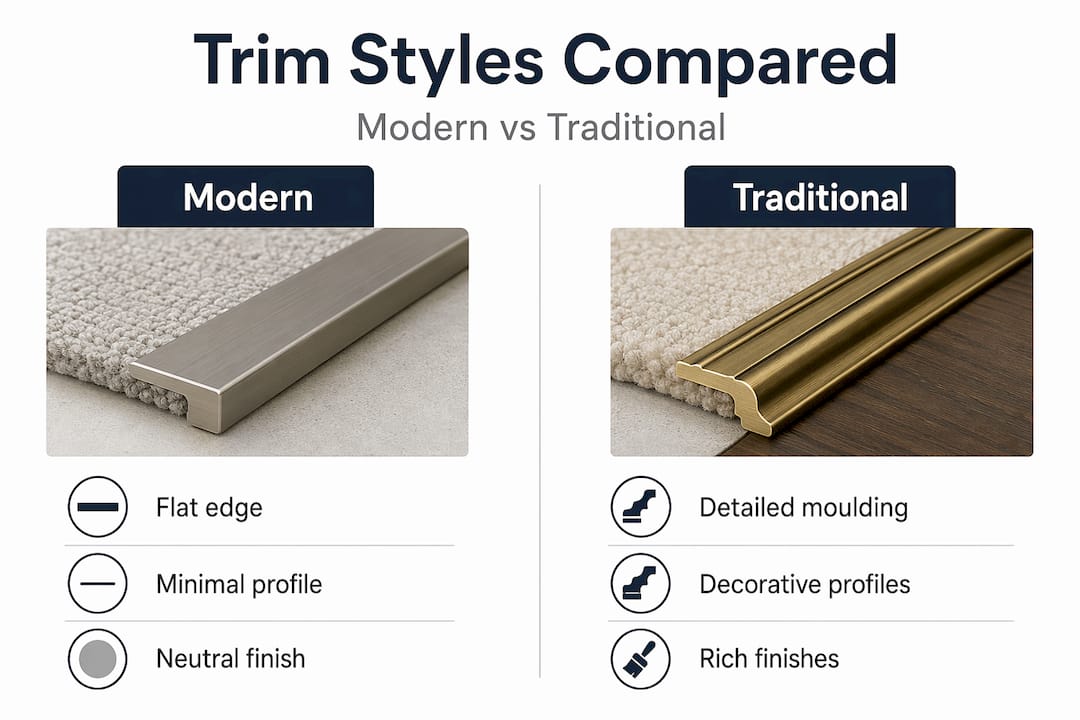
| Modern minimal | Flat, square edge, no detail | Contemporary, Scandi, industrial interiors | Works at any scale |
| Traditional ogee | Curved, stepped, layered | Period homes, Georgian, Victorian | Larger rooms, higher ceilings |
| Craftsman | Simple, thick, square with slight reveal | Arts and Crafts, Edwardian, transitional | Medium to large rooms |
| Art Deco | Geometric, bold angles | 1920s-30s period homes or bold contemporary | High-ceiling rooms |
As RIFFS Construction explains, “modern trims feature clean lines and minimal profiles; traditional trims offer decorative detail and layered profiles.” Matching that character to your home’s existing architecture is not optional; it is what determines whether the trim looks intentional or awkward.
When choosing scale, consider these principles:
- In rooms with ceilings above 2.7 metres: Use taller skirting boards (at least 150mm) and deeper crown moulding to fill the vertical space proportionately
- In compact rooms: Keep profiles slim to avoid making the room feel smaller or boxed in
- Across adjoining open-plan spaces: Use the same trim style throughout to maintain visual continuity
- Match to furniture weight: Heavier, more substantial furniture suits chunkier trim profiles; lighter, legged furniture suits slimmer profiles
Pro Tip: If you are unsure about scale, take the height of your skirting board as a rough guide. It should sit at roughly 1/12th of the ceiling height for a balanced proportion. A 2.4 metre ceiling suits a 200mm skirting board well.
Explore flooring transition methods for further guidance on where trim types intersect with flooring choices specifically.
Choosing trims for flooring transitions: safety, movement, and longevity
Flooring transition trims are where decorative trims in interiors meet genuine engineering requirements. A trim that looks right but is fitted incorrectly, or made from the wrong material, will fail within months.
The core challenge is movement. Transition profiles must allow flooring to move to prevent gaps, especially with floating or thickness-variable floors like laminate or LVT. Both laminate and luxury vinyl tile expand and contract with temperature and humidity changes. Fix them too rigidly and they buckle. Leave the transition unsupported and gaps appear.
Here is a practical guide to selecting and installing transition trims correctly:
- Measure the height difference between the two flooring surfaces before purchasing any trim. Many trim profiles are designed for specific height offsets, so this step is non-negotiable
- Identify the floor types on each side of the transition. Carpet to tile needs a different profile than laminate to laminate
- Choose solid metal construction over cheaper materials. Solid brass and powder-coated trims resist bending, splitting, and denting under foot traffic in a way that cheaper alternatives simply do not
- Fix to the subfloor, not the floor itself. The trim’s anchor track should be screwed into the subfloor, leaving the floor edge free to move beneath the trim’s cover plate
- Leave the correct expansion gap as specified by the flooring manufacturer before fitting the trim over it
Pro Tip: Never glue a transition trim directly to a floating floor. It sounds secure. It is not. As the floor moves seasonally, a glued trim either pulls away or forces the floor to buckle. Fixing to the subfloor is always the correct method.
Safety is also a genuine consideration. A trim that bridges a height difference cleanly reduces trip hazards, particularly important in homes with older residents or young children. Well-fitted trims around door thresholds are one of the simplest and most overlooked ways to make a home safer. For a full walkthrough, the guide on installing flooring edge trims covers the process in detail.
Creating cohesive and balanced interiors with consistent trim choices
One of the most common mistakes in trims in home styling is treating each room as a separate project. In homes where living rooms open to dining areas, or hallways connect to kitchens, inconsistent trim choices fracture the visual flow and make spaces feel unplanned.
Trim must maintain consistent proportions and styles across connected spaces to prevent visual disconnection and an unfinished appearance. This does not mean everything must be identical. It means the underlying logic must be the same.
Common mistakes that undermine cohesion include:
- Mixing profile styles: Running a flat modern skirting in one room against an ogee profile next door creates jarring contrast at the threshold
- Inconsistent heights: Skirting boards that change height between rooms without an architectural reason feel accidental rather than designed
- Mismatched finishes: White satin in one room against brilliant white in the next looks uncoordinated under natural light
- Scale mismatches: Heavy crown moulding in a small dining room next to no moulding in a larger connected living space reads as unbalanced
The table below illustrates how to match trim style to space for a coherent result:
| Room type | Ceiling height | Recommended skirting height | Trim style | Notes |
|---|---|---|---|---|
| Open-plan living/dining | 2.7m+ | 180-220mm | Consistent across both | Match profile exactly at the threshold |
| Period hallway | 3m+ | 220mm+ | Traditional ogee or torus | Sets the tone for adjoining rooms |
| Contemporary kitchen | 2.4m | 100-120mm | Flat, minimal | Match to cabinet plinths for clean line |
| Compact bedroom | 2.4m | 100mm | Slim, flat | Larger profiles reduce perceived space |
| Victorian reception room | 3m+ | 250mm | Multi-step traditional | Period-appropriate, suits proportions |
A useful approach for open-plan homes is to treat the whole ground floor as a single design unit for trim decisions, then allow minor variations in rooms that are separated by doors. For example, a dining room can carry a chair rail that the living room does not, adding formality, provided the skirting and casing profiles match throughout. See how carpet to tile transitions factor into these decisions for mixed flooring layouts.
Rethinking trims: the unsung heroes of lasting home quality
After years of supplying flooring trims to homeowners and trade professionals across the UK, we have noticed a consistent pattern. The jobs that disappoint people five years later are almost always the ones where the trim was treated as a last-minute purchase rather than a considered specification.
Here is the uncomfortable truth: trim adds perceived value by making a home feel completed and well-maintained without significant price increases. Yet most people spend weeks agonising over floor colour and then spend three minutes choosing the trim that will frame it for the next decade.
Solid brass and powder-coated trims are simply not in the same category as the aluminium or PVC alternatives you find in budget DIY stores. Cheap trims dent under furniture legs, discolour under cleaning products, and split at the mitre joints within a few years. A quality solid metal trim, hand-finished to match your interior, looks the same in year ten as it did on installation day. That consistency is what makes a home feel genuinely well built rather than just recently decorated.
We also hear from designers who argue that trims are less important in contemporary interiors where the aesthetic favours clean, unadorned surfaces. Our experience says the opposite. In minimal interiors, every detail is magnified. A poorly fitted or cheaply made transition strip is far more visible against a backdrop of restrained design than it would be in a busier traditional scheme. Minimal design demands better quality, not less of it.
Investing in quality trims through resources like using edge trims effectively reduces maintenance costs over time and contributes to the structural integrity of the flooring installation itself. That is not a small thing when you consider the labour cost of pulling up and refitting a floor because the transition has failed.
Upgrade your home with premium trims from Quality Carpet Trims
Having explored the trims impact on design and how much the right choice matters, the next step is finding products that actually deliver on that promise.
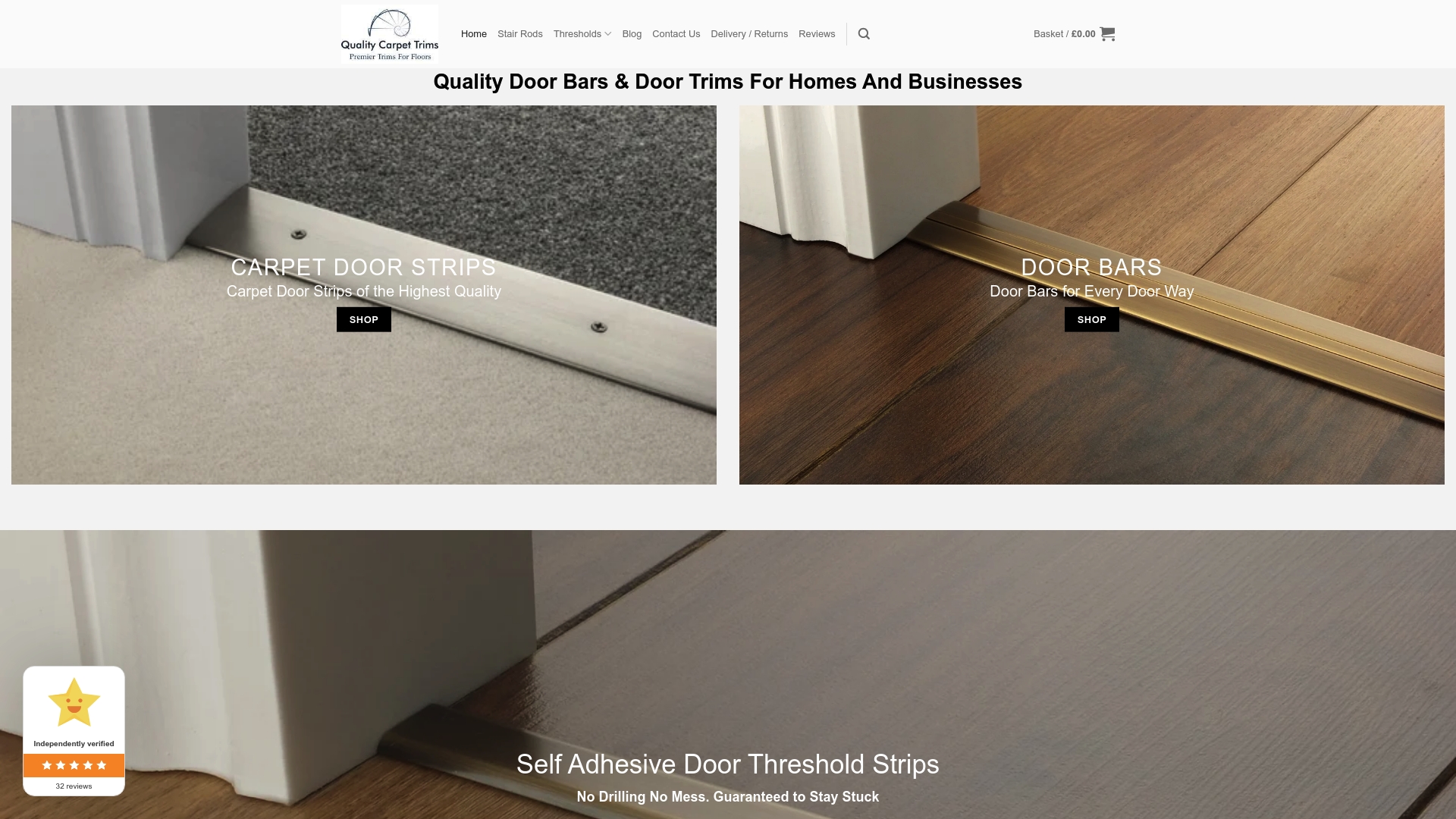
At Quality Carpet Trims, every trim is solid metal, hand-finished in the UK, and available in 10 luxury finishes designed to complement any interior scheme. Unlike the aluminium or PVC alternatives sold elsewhere, our trims resist splitting, bending, and denting under real-world conditions. Whether you need a matwell trim for an entrance, a door bar for a carpet-to-tile threshold, or an edge trim for a floating floor, there is a profile and finish matched to your project. The flooring trim types guide helps you identify the right profile before you order, and our fitting guides cover flooring edge trim installation step by step. Free samples are available so you can confirm the finish against your flooring before committing.
Frequently asked questions
What is the primary functional purpose of trims in home decor?
Trims protect walls from scuffs, dents, and moisture, cover gaps between surfaces, and define the edges of rooms for a finished, professional appearance.
Can trims really make a room look more luxurious without costly renovations?
Yes. Trims always elevate a scheme and can help keep costs low by adding architectural character and dimension without the expense of redoing entire surfaces.
How do trims accommodate flooring that moves, like laminate or vinyl?
Proper trims cap or bridge flooring edges without fixing the floor directly, since floors that float require trims that allow movement rather than pinning the edges down, preventing gaps and damage.
Why invest in solid brass or powder-coated trims compared to cheaper alternatives?
Solid brass and powder-coated trims offer superior durability, resisting splitting, bending, and denting in ways that cheap materials cannot, ensuring a lasting premium finish throughout the life of your renovation.
Recommended
- Floor trim types explained for UK homes: A full guide
- How trims transform decor for safer, stylish spaces
- Premium flooring trim: enhance your UK home in style
- Choose sustainable flooring trims for stylish UK homes