
Blog
Hand-finished trims: the UK homeowner’s guide

May
TL;DR:
- Hand-finished trims are crafted from solid brass or oak, offering superior durability, character, and authentic aging. They significantly enhance interior aesthetics by providing seamless transitions and elevating the space’s perceived quality. Proper selection, matching, and installation of these trims ensure a premium, long-lasting finish that outperforms mass-produced alternatives.
Most people treat flooring trims as an afterthought. You buy the floor, lay it beautifully, then grab whatever trim sits on the shelf to finish the edges. That decision is exactly where premium interiors come apart. What are hand-finished trims, and why do they matter so much? Simply put, they are trims crafted from solid materials, shaped and finished by skilled hands rather than mass-produced on automated lines, and the difference in quality, character, and longevity is not subtle. This guide explains what sets them apart, which types exist, and how to choose and install them correctly.
Table of Contents
- Understanding hand-finished trims: materials and finishes
- Common types and profiles of hand-finished trims in UK interiors
- How hand-finishing enhances durability and aesthetics
- Choosing the right hand-finished trim for your UK home or project
- Installation essentials and common pitfalls to avoid
- Why hand-finished trims remain unmatched for true luxury interiors
- Discover premium hand-finished trims for your UK home
- Frequently asked questions
Key Takeaways
| Point | Details |
|---|---|
| Premium materials | Solid brass and oak trims offer unmatched durability and evolving aesthetic appeal. |
| Seamless transitions | Hand-finished trims ensure flawless joins between different flooring and architectural features. |
| Custom finishes | Living finishes and bespoke staining guarantee unique, tailored trim appearances. |
| Proper installation | Correct fixing and expansion allowance are essential to maintain trim integrity. |
| Long-term value | Investing in hand-finished trims enhances both interior beauty and property value. |
Understanding hand-finished trims: materials and finishes
Hand-finished trims start with one non-negotiable factor: the material must be solid. Solid brass and solid oak are the two materials that genuinely reward hand-finishing. Brass accepts patina treatments that no machine can replicate consistently. Oak has grain, warmth, and structural integrity that hollow or composite alternatives simply cannot match.
Solid brass trims are often crafted with living finishes that evolve uniquely over time, developing a patina that enhances the trim’s character rather than degrading it. This is not a flaw in the finish. It is the point. A living finish on aged brass tells the story of the space it inhabits, and no two trims age identically. That authenticity is what separates a truly premium interior from one that merely looks expensive on day one.
Solid oak trims, meanwhile, can be supplied lacquered for immediate use or left unfinished so you can apply your own oil or stain to match your flooring precisely. The grain runs the full length of the piece, which matters enormously for visual continuity at transitions.
Choosing the right trim finish early in your project prevents mismatches that cannot easily be corrected later. Here is what to look for and what to avoid:
- Solid brass: Offers exceptional weight, resistance to denting, and a range of hand-applied finishes including satin, antique, and unlacquered options
- Solid oak: Natural warmth with genuine grain; compatible with most wood floor systems and suitable for staining or oiling to match
- Lacquered oak: Pre-finished and ready to use; ideal when your floor already has a factory lacquer finish
- Unfinished oak: Best when you want a perfect colour match using the same oil or stain as your floor
- Avoid plastic, aluminium, and rubber trims: These materials split under foot traffic, dent easily, fade within a few years, and offer no authentic visual quality whatsoever
The difference between these categories is not just aesthetic. Lesser materials fail structurally. Plastic trims crack in cold conditions. Aluminium trims dent and scratch, catching light in ways that look cheap. Solid brass and solid oak, finished by hand, outlast them by decades.
Common types and profiles of hand-finished trims in UK interiors
Understanding materials leads naturally to identifying the common types and profiles used in premium hand-finished trims. There are more options than most homeowners realise, and choosing the wrong profile for a given application causes problems that are frustrating and expensive to fix.
The most frequently used profiles in UK homes and commercial interiors include:
- T-bars: Span the gap between two floors of similar height, covering the expansion gap cleanly
- End profiles: Protect the exposed edge of a floor where it meets a wall, step, or threshold
- Stair nosings: Finish the front edge of each step, protecting the most worn part of any staircase
- Bonded stair nosings with mitred side returns: A more advanced profile that wraps the nosing around the corner of the step for a tailored appearance
- Dentil cornices: Architectural trims used at the wall-to-ceiling transition, typically in fibrous plaster, adding period detailing to heritage and Georgian-style UK homes
- Reducer profiles: Bridge a height difference between two different floor types, such as hardwood meeting ceramic tile
Solid oak end profiles for engineered floors typically measure 2.7m in length by 34mm in width by 15mm in height, designed to match flooring colours while accommodating natural wood expansion. Getting the dimensions right matters as much as the finish. A profile that is too narrow looks flimsy; too wide and it overwhelms the flooring.
Hand-finished oak T-bars and trims provide transitions between wood, tile, and carpet that genuinely disappear into the interior rather than announcing themselves. When grain and colour are matched correctly, the eye moves across the transition without registering it consciously. That is the goal.
| Trim type | Typical application | Key dimension to check |
|---|---|---|
| T-bar | Same-height floor transitions | Width relative to expansion gap |
| End profile | Floor edge at wall or step | Height match to floor thickness |
| Stair nosing | Step front edge protection | Depth and overhang for safety |
| Reducer | Height-difference transitions | Slope angle for underfoot comfort |
| Dentil cornice | Wall-to-ceiling architectural detail | Projection and repeat pattern |
For flooring edge trims explained in more detail, the critical factor is always whether the profile accommodates the specific floor thickness and expansion allowance required. Getting this wrong causes lifting, cracking, or visible gaps within months.
For a broader look at how these profiles work together, professional flooring transition methods provide the full picture.
How hand-finishing enhances durability and aesthetics
With trim types identified, focus now turns to how hand-finishing techniques ensure superior performance and appearance. This is where the real technical difference lies, and it is worth understanding before you buy.
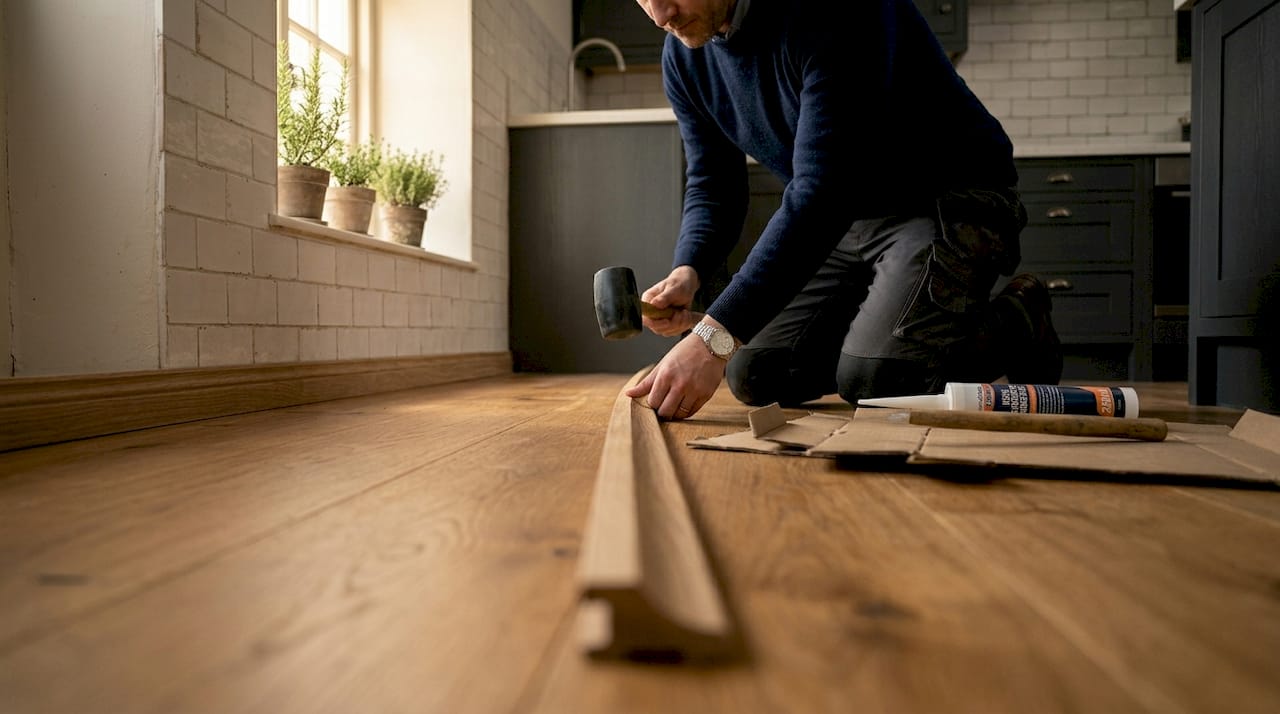
Hand-finishing is not just about applying a coating. It involves templating to the exact space, matching grain direction, and ensuring that mitred corners are cut and fitted without visible joints. Bonded nosings and mitred side returns ensure grain continuity and no visible joins, which is what creates a floor-to-stair transition that reads as a single designed element rather than a series of separate components bolted together.
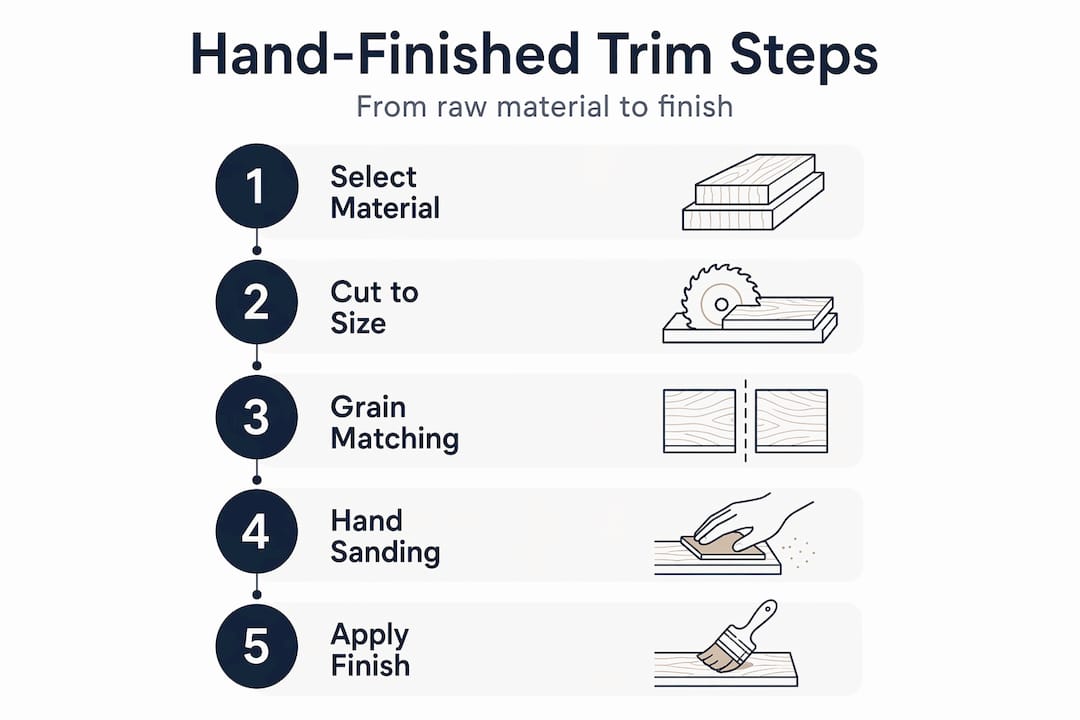
Durability also depends on how the trim is fixed. Solid oak trims require precise pinning or adhesive fixing that allows for natural floor expansion, preventing lift or warping as the wood responds to humidity changes across UK seasons. Fixing a trim too rigidly against a solid wall without any allowance for movement is one of the most common and avoidable mistakes.
Key factors that separate hand-finished trims from off-the-shelf alternatives:
- Grain flow: In quality oak trims, the grain runs consistently along the length, maintaining visual continuity across the transition
- Colour-matched finishing: Hand-applied stains and oils are matched in-house to the specific floor being installed, not guessed at from a catalogue swatch
- Weight and density: Solid brass trims stay in position; lightweight metal or plastic alternatives shift and creak underfoot
- Expansion tolerance: Professional hand-finished trims are designed with the correct tolerances built in; cheaper profiles rarely account for this adequately
- Surface protection during installation: Skilled fitters handle the finished surface carefully, protecting it from scratches and dents that would be irreversible
Pro Tip: If you are ordering unfinished oak trims, request a small offcut to test your stain or oil on before committing to the full application. The same oil looks different on the trim than on the floor slab because the grain density and cut direction vary. A test piece saves you from a costly visual mismatch.
For detailed guidance on fitting methods, professional flooring trim methods cover the specifics by profile type. For common problems and how to resolve them, solving flooring trim issues is worth reading before you start.
Choosing the right hand-finished trim for your UK home or project
Equipped with knowledge of finishing and durability, you can now apply it to make an informed trim choice. The decision is more nuanced than simply matching colour.
- Match trim material to floor material: Oak trims alongside oak or engineered wood floors; brass trims where a metal accent complements natural stone, marble, or dark hardwood
- Consider traffic levels: Solid brass trims are exceptionally well-suited to busy doorways where foot traffic would quickly wear lesser materials
- Lacquered versus unfinished oak: Lacquered if your floor has a factory finish; unfinished if you have used an oil or site-applied stain and need a precise match
- Brass finish selection: Choose a living, unlacquered finish if you want the trim to age gracefully; choose a lacquered brass if you prefer a consistent appearance over time
- Profile selection by height: Always measure your floor thickness before ordering. A profile specified for 15mm engineered board will not sit correctly on 20mm solid wood
Unfinished oak trims enable precise oil and stain matching to flooring tones, which is vital for natural oak installations where even a slight colour difference will be immediately obvious at the transition point.
| Scenario | Recommended trim | Finish type |
|---|---|---|
| Engineered oak floor to carpet | Oak T-bar | Unfinished or colour-matched lacquer |
| Hardwood to stone tile | Solid brass T-bar | Antique or satin brass |
| Top of staircase, heavy use | Solid brass or bonded oak nosing | Lacquered or satin brass |
| Georgian heritage property | Fibrous plaster dentil cornice | Hand-painted to match scheme |
| Open-plan kitchen to hallway | Brass reducer | Polished or aged finish |
Pro Tip: In open-plan spaces where multiple floor transitions occur, use the same trim material and finish throughout. Mixing brass at one doorway and chrome at another, or using two different oak profiles, fragments the visual flow of the space. Consistency here reads as intention.
For further guidance, choosing the right flooring trim covers the decision process in detail. For finish-specific advice, trim finishes explained is essential reading before you finalise your selection.
Installation essentials and common pitfalls to avoid
Understanding installation best practices ensures that the premium trims you have selected perform well over time. Even the best trim in the world fails prematurely if it is fixed incorrectly.
- Allow for expansion: Never fix a trim hard against both floors simultaneously without an expansion gap. Wood moves. Brass expands. The trim must accommodate this or it will buckle or lift within a single winter.
- Use the correct fixings: Pins or adhesive for oak trims depending on the subfloor type. Screw-down profiles for brass trims where mechanical fixing is required for high-traffic areas.
- Template first, cut second: For mitred returns and stair nosings, template the exact angle before cutting. A 1mm error at a mitre shows permanently.
- Protect the finish during fitting: Apply masking tape to the face of the trim before handling. One contact with a hammer handle leaves a mark that cannot be removed from an unlacquered brass finish.
- Fibrous plaster cornices require specialist fitting: Professional installers reinforce fibrous plaster cornices with hessian scrim to prevent cracking in high-ceiling UK heritage homes. This is not a DIY job unless you have specific experience with lime plaster and period-correct fixing methods.
- Check level before fixing: A trim fixed to an uneven subfloor will rock underfoot and work loose over time. Prepare the substrate first.
Pro Tip: When installing brass door bars in doorways with underfloor heating, check the manufacturer’s guidance on maximum surface temperature. Some lacquered finishes can be affected by sustained heat. Unlacquered living finishes are generally more tolerant in these situations.
For a full step-by-step walkthrough, installing flooring edge trims covers every profile type with clear guidance.
Why hand-finished trims remain unmatched for true luxury interiors
Here is the view from fifteen years of working closely with interior designers and premium floor installers across the UK: the trims are always the last decision and always the one clients later wish they had made first.
Mass production cannot replicate what hand-finishing delivers. Not because the technology does not exist, but because authentic character is not something you can programme into a machine. The living finishes that develop unique patinas over time reward those who invest in quality with evolving, authentic luxury that only improves with age. A mass-produced chrome trim looks exactly the same on day one as it does on day one in the next house, the house after that, and the house after that. There is no sense that the space has its own identity.
The argument against hand-finished trims usually comes down to cost. And yes, they cost more upfront. But consider what you are comparing. A plastic threshold that needs replacing every four years versus a solid brass bar that outlives the floor it sits beside. The maths are not complicated.
What this industry rarely says clearly enough is that trims are architectural details. They frame a space. They signal quality or they signal compromise. A beautifully laid floor finished with an inadequate trim is like framing a painting with tape. The flooring investment deserves a finish worthy of it.
Understanding the full importance of flooring trim puts this in context. The trim is not the afterthought. It is the full stop at the end of the sentence.
Discover premium hand-finished trims for your UK home
At Quality Carpet Trims, we supply solid metal door bars hand-finished in 10 beautiful finishes, crafted specifically to complement premium UK interiors. Every bar is made from solid metal, not hollow profiles or lightweight alloys, and each finish is applied by hand to ensure depth, consistency, and the kind of quality you can see and feel underfoot.
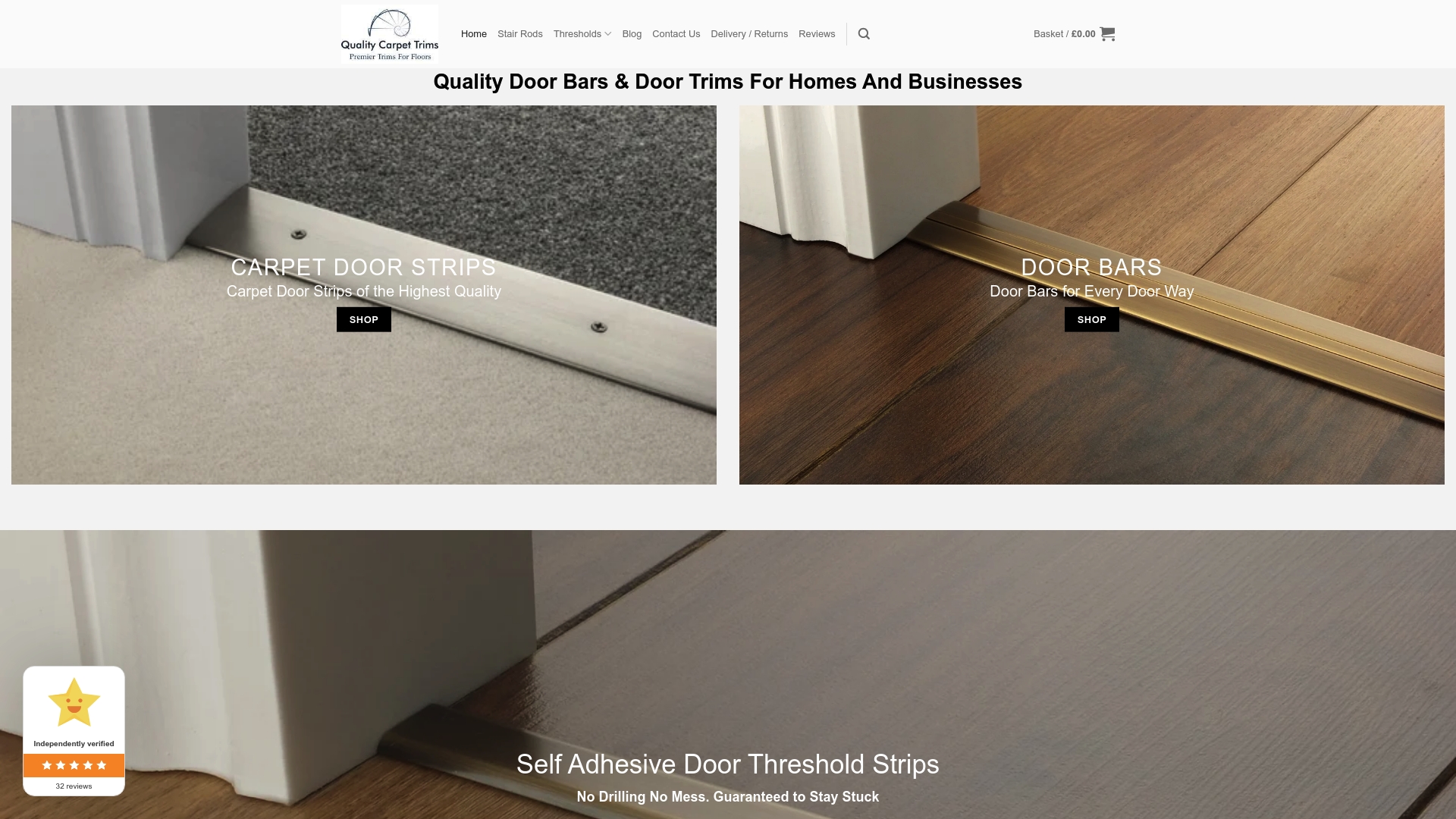
Whether you are a homeowner finishing a renovation or an interior designer specifying trims for a high-end project, our premium flooring trims range has the finish and profile to match your vision. Browse our flooring trim finish options to find the right patina for your space, or consult our flooring edge trims installation guide before you order to ensure a perfect fit. Free samples are available, and our team is on hand to advise on the right specification for every project.
Frequently asked questions
What are hand-finished trims made of?
Premium hand-finished trims are typically made from solid brass or solid oak, with finishes applied by hand for durability and unique character. Solid brass flat trims feature living finishes that develop distinctive patinas, making each piece genuinely unique.
Why choose hand-finished trims over standard trims?
Hand-finished trims offer superior durability, a bespoke appearance with unique patinas, and seamless integration with your flooring and interior design compared to mass-produced trims. Hand-finishing creates unique patinas that enhance authentic luxury joinery in a way no machine-made product can reproduce.
Can hand-finished oak trims be stained to match flooring?
Yes, unfinished oak trims allow precise oil or stain matching to your wood flooring’s colour for seamless transitions. Unfinished oak trims enable precise matching that is essential for natural oak installations where colour consistency at the transition point is critical.
How do I maintain the finish on brass hand-finished trims?
Regular dusting and occasional polishing with a suitable brass product will preserve the patina and prevent dulling. For living, unlacquered finishes, the patina that develops naturally over time is part of the trim’s character and does not require removal.
Are installation mistakes common with hand-finished trims?
Yes, improper fixing without allowing for floor expansion or careless handling of delicate surfaces can lead to premature damage. Proper installation with correct expansion consideration prevents lifting or warping, particularly important in the UK’s variable climate.
Recommended
- Premium flooring trim: enhance your UK home in style
- Floor trim types explained for UK homes: A full guide
- Edge trims: essential for safe, stylish UK flooring
- Choose sustainable flooring trims for stylish UK homes