
Blog
The role of trims for safety in flooring transitions

Jun
TL;DR:
- Flooring trims cover exposed edges and prevent trip hazards by creating secure, level transitions. Solid brass trims are the most reliable choice for long-term safety and aesthetic durability. Proper installation and compliance with UK regulations ensure trims maintain their safety function over time.
Flooring trims are defined as the finishing profiles that cover exposed edges, join different floor surfaces, and protect transitions between rooms. The role of trims for safety is direct: they eliminate trip hazards, cover sharp edges, and create secure, level crossings between floor types. Without them, a height difference of just a few millimetres between carpet and tile is enough to catch a foot and cause a fall. Solid brass trims, hand-finished to a professional standard, are the most reliable choice for homeowners and contractors who want a solution that holds its shape and its safety function for years.
What types of trims enhance safety in flooring?
Three trim categories carry the most weight when it comes to accident prevention: stair nosings, threshold trims, and tile edge trims. Each addresses a different hazard, and each demands a different specification.
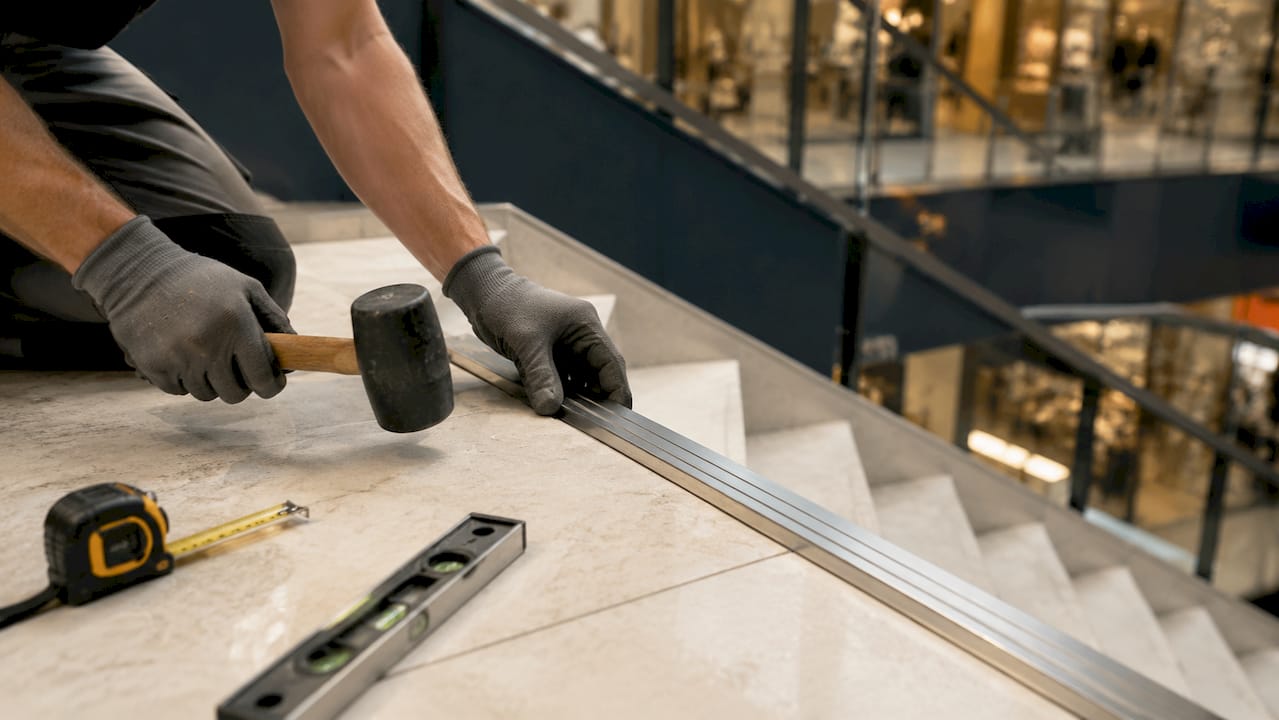
Stair nosings
Stair nosings define the leading edge of each tread. BS 8300 requires visually contrasting nosings with anti-slip inserts in UK commercial settings, with a minimum 30 LRV contrast against the stair tread. That contrast requirement exists because the human eye struggles to judge depth on a uniform stair surface, particularly in low light. Effective stair nosings transform ambiguous tread edges into clearly defined, slip-resistant boundaries that improve footing perception and reduce falls.
Threshold trims
Threshold trims span the gap between two floor surfaces at doorways and room transitions. ANSI A117.1 and ADA standards specify that accessible thresholds must have a maximum rise of 12.7mm, and any threshold over 6.4mm must be bevelled at no steeper than 1:2. These dimensions exist to prevent the toe-catch that causes trips. A well-fitted door threshold bar sits flush, holds firm, and removes the height differential that makes transitions dangerous.
Tile edge trims
Cut tile edges are sharp and create genuine injury hazards, particularly in bathrooms and wet areas where bare feet are the norm. Tile edge trims cover those exposed cuts and act as impact barriers. Metal tile trims provide a permanent, impact-resistant barrier that also reduces water ingress, prolonging tile life and preventing costly repairs.
The table below compares these three trim types across their key safety features and material durability.
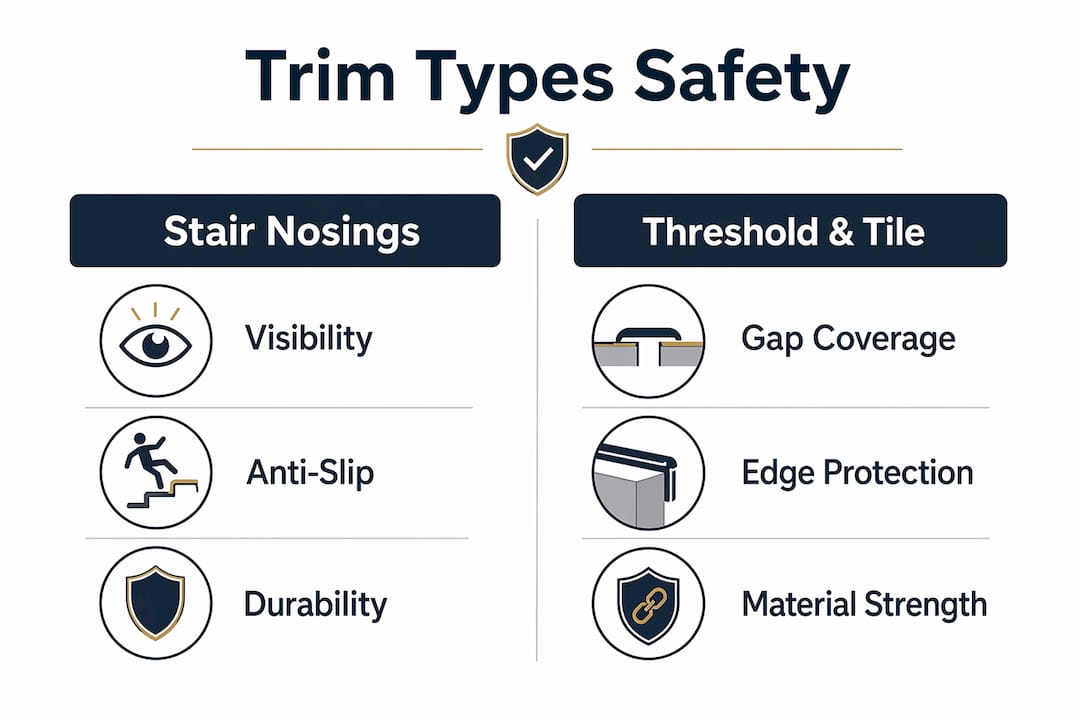
| Trim Type | Primary Safety Role | Material Recommendation | Durability |
|---|---|---|---|
| Stair Nosing | Slip resistance and edge visibility | Solid brass with anti-slip insert | Will not bend, dent, or split |
| Threshold Trim | Trip hazard elimination at transitions | Solid brass, powder-coated | Resists deformation under foot traffic |
| Tile Edge Trim | Sharp edge protection and water barrier | Solid brass | Permanent, impact-resistant |
Pro Tip: When selecting a threshold trim for a doorway between carpet and tile, choose a profile with a gentle bevel on both sides. This distributes foot pressure evenly and reduces the risk of the trim lifting under repeated use.
How do UK building regulations influence trim selection?
UK building regulations set the minimum standard for trim safety, and ignoring them creates both physical hazards and legal liability. Approved Document K governs protection from falling, collision, and impact, and it works alongside BS 8300, which addresses accessibility for disabled people. Together, they define what compliant stair nosings, thresholds, and edge trims must achieve.
- BS 8300 requires stair nosings in commercial settings to contrast visually with the tread by at least 30 LRV and to incorporate slip-resistant surfaces. Yellow anti-slip inserts on dark rubber nosings are a common compliant solution in public buildings.
- Approved Document K sets requirements for the geometry and visibility of stair edges in all new builds and significant refurbishments.
- ANSI A117.1 (referenced in international projects and increasingly used as a benchmark in UK commercial specifications) defines threshold bevel ratios and maximum rise heights to prevent trip hazards at doorways.
- Exit device trims on fire doors and emergency exits must allow immediate, unrestricted egress from inside while controlling exterior access. Changing these trims after installation can unintentionally cause compliance failures and life-safety risks.
For a broader overview of how these codes interact, the UK building regulations guide from ANDs Architecture covers thresholds, stairs, and tile installations in practical detail.
Trims must also remain securely anchored and flat throughout their service life. Substrate movement or poor installation can cause trim edges to lift or hollow, creating trip hazards even when the original profile was fully compliant. Compliance at installation is not enough. The trim must stay compliant under the conditions it will actually face.
Pro Tip: Before specifying trims for a commercial project, check whether the space falls under BS 8300 or Approved Document M for accessibility. Both documents overlap on stair nosings and thresholds, and specifying to the stricter requirement protects you from future compliance challenges.
What are the common installation errors that compromise trim safety?
Poor installation is the single most common reason a compliant trim becomes a hazard. The trim profile can be perfectly specified and still fail if the fitting is wrong.
The most frequent errors, and how to avoid them, are listed below.
- Lifted or hollowed thresholds. Substrate movement after installation is the leading cause. Fix this by ensuring the subfloor is fully stable and dry before fitting. Use the correct adhesive or mechanical fixing for the floor type.
- Using trims made from inferior materials. Rubber trims split. Plastic trims crack and deform. Wooden trims swell and warp. These failures create sharp edges and uneven surfaces that are more dangerous than no trim at all. Solid brass trims do not bend, dent, or split under normal foot traffic.
- Poor visual contrast on stair nosings. A nosing that blends into the tread colour fails its primary safety function. BS 8300 requires at least 30 LRV contrast. Choose a nosing finish that stands out clearly against the tread material.
- Mismatched exit device trims. Exit device trims are part of the life-safety assembly on fire doors. Replacing them with non-compliant alternatives can cause egress failures during an emergency.
- Ignoring bevel requirements on thresholds. A threshold that rises more than 12.7mm without the correct bevel ratio is a trip hazard by definition. Measure the height differential before selecting a profile.
A real-world illustration of what trim failure looks like at scale: a Ford Expedition recall involved peeling chrome interior trim causing razor-sharp edges and 65 reported injuries. The principle applies directly to flooring. A trim that degrades in service does not just look poor. It becomes a physical hazard.
Pro Tip: After fitting any threshold trim, press firmly along its full length and check for any hollow sound or movement. A hollow section means the adhesive bond has failed beneath the surface. Refit it before the edge lifts and creates a trip hazard.
How do trims enhance both safety and aesthetics?
The best trims do two jobs simultaneously. They protect people and they finish a space to a professional standard. These two goals are not in conflict. A well-chosen trim that sits flat, holds its finish, and complements the flooring around it is doing both.
Solid brass trims with powder-coated finishes are the clearest example of this principle in practice. Qualitycarpettrims supplies solid brass door bars hand-finished in 10 luxury finishes, including satin brass, antique bronze, and polished chrome effects. These finishes do not chip, fade, or peel under normal use. The brass substrate beneath will not deform under foot traffic, which means the trim stays flat and the safety function is maintained long-term.
Clean, precise trim edges also define the boundary between flooring materials in a way that reads as intentional and considered. A tile to tile threshold in a matching finish creates a visual full stop between two surfaces. It tells anyone walking through the space that the transition is deliberate and safe. The same logic applies to a vinyl floor edge trim at the perimeter of a room: it protects the cut edge of the vinyl and gives the floor a finished, professional appearance.
Colour and finish selection matters here. A trim in a contrasting finish draws the eye to a transition, which is useful on stairs and at doorways where you want people to notice the change in surface. A trim in a matching or complementary finish blends into the floor design, which suits open-plan spaces where visual continuity is the priority. Neither choice compromises safety when the trim profile is correctly specified and properly fitted.
Key takeaways
Flooring trims protect people and finish spaces properly. Solid brass, correctly fitted and regularly inspected, is the only trim material that reliably delivers both.
| Point | Details |
|---|---|
| Trims prevent trip hazards | Threshold trims must be flat, bevelled correctly, and securely fixed to eliminate height differentials. |
| UK regulations set the standard | BS 8300 and Approved Document K define minimum requirements for stair nosings and accessible thresholds. |
| Material quality determines longevity | Solid brass trims will not bend, split, or deform; inferior materials create new hazards as they degrade. |
| Installation quality is critical | A compliant trim profile fitted poorly is still a hazard; check for hollow sections and lifted edges after fitting. |
| Aesthetics and safety work together | Finish and colour selection can reinforce safety cues while complementing the overall floor design. |
Why i think most people underestimate the importance of trims in safety
I have seen hundreds of flooring projects where the trim was treated as an afterthought. The floor gets specified carefully, the installation is planned in detail, and then a cheap trim is ordered at the last minute to finish the job. That approach is a false economy, and I have watched it cause real problems.
The most common issue I see is a threshold that lifts within twelve months. The profile was correct. The finish looked fine on day one. But the material was too soft, the fixing was inadequate, or the substrate moved slightly after installation. The result is a raised edge that catches feet and, in a commercial setting, creates a liability.
Solid brass trims change that calculation entirely. The material holds its shape. The powder-coated finish does not degrade. When you fit a solid brass threshold correctly, you are not revisiting it in a year. That reliability is what makes the upfront cost worthwhile, not just for aesthetics, but for the ongoing safety function the trim is there to provide.
My advice to contractors is to inspect every trim at the six-month mark after installation, particularly in high-traffic areas. Press along the full length. Listen for hollow sections. Check that the finish is intact. Catching a problem early costs almost nothing. Waiting until someone trips costs considerably more.
For homeowners, the same principle applies. A trim that looks fine from a distance may have started to lift at one end. Get down and check it. The safety benefits of edge trims only hold as long as the trim itself is in good condition.
— Matt
Solid brass flooring trims built for safety and style

Qualitycarpettrims supplies solid brass flooring trims hand-finished in 10 luxury finishes, designed for homeowners and contractors who need a trim that performs and looks the part. Every trim is manufactured in the UK, will not bend or dent under foot traffic, and holds its finish without chipping or peeling. Browse the full range of luxury brass flooring trims to find the right profile for your transition, whether you are finishing a doorway, protecting a tile edge, or completing a stair nosing. For guidance on which profile suits your specific floor types, the flooring trim types guide covers every option in plain language.
FAQ
What is the role of trims for safety in flooring?
Flooring trims eliminate trip hazards at transitions, cover sharp edges, and create level, secure crossings between different floor surfaces. They are the primary physical barrier between a safe floor and an exposed hazard.
What height should a threshold trim be to comply with UK regulations?
ANSI A117.1 and ADA standards specify a maximum rise of 12.7mm for accessible thresholds. Any threshold over 6.4mm must be bevelled at no steeper than a 1:2 ratio to prevent trips.
Why are solid brass trims safer than cheaper alternatives?
Solid brass trims will not bend, split, or deform under foot traffic. Rubber, plastic, and wooden trims degrade over time, creating raised edges and sharp surfaces that introduce new hazards as they fail.
How do stair nosings reduce falls on stairs?
BS 8300 requires stair nosings in UK commercial settings to contrast with the tread by at least 30 LRV and to incorporate slip-resistant surfaces. This contrast and grip combination defines the tread edge clearly and reduces the risk of misjudging a step.
Can changing a door trim cause a safety compliance failure?
Yes. Exit device trims are part of the life-safety assembly on fire and emergency doors. Replacing them with non-compliant alternatives can prevent free egress in an emergency and cause a building inspection failure.
Recommended
- Professional flooring transition methods: 5 trim types
- Flooring Trim: Ensuring Seamless, Safe Transitions
- Installing Flooring Edge Trims for Seamless Floor Transitions
- How to Choose Flooring Transitions: Cut Trip Hazards 30%