
Blog
Ramp trims explained: The key to safe, stylish UK flooring

Apr
TL;DR:
- Ramp trims are specially profiled to safely bridge floor height differences.
- They are essential in doorways, bathrooms, and accessible spaces for safety and compliance.
- Proper measurement, selection, and installation of ramp trims ensure a professional, durable finish.
Grab any strip of metal and shove it between two floors of different heights, and you have a recipe for a trip hazard, a failed inspection, and a finish that looks rushed. It happens in thousands of UK homes and commercial spaces every year. The truth is that not all floor trims are created equal, and when floor levels differ, only a properly profiled ramp trim will do the job safely and correctly. This guide covers exactly what a ramp trim is, when you genuinely need one, how to choose the right specification, and how to fit it without the common mistakes that plague DIY renovations.
Table of Contents
- What is a ramp trim?
- When and why do you need ramp trims?
- Types and specifications of ramp trims
- Installation and best practices for ramp trims
- Alternatives and common misconceptions
- The truth most guides miss about ramp trims
- Get the perfect ramp trim solution for your project
- Frequently asked questions
Key Takeaways
| Point | Details |
|---|---|
| Ramp trims defined | A ramp trim bridges different floor heights safely and stylishly. |
| When required | Use a ramp trim whenever there’s over 2mm height difference between adjacent floors. |
| Types and choices | Select from a range of materials, sizes, and profiles for every project requirement. |
| Safety and standards | Correct ramps prevent trips and often meet UK/ADA accessibility standards. |
| Installation tips | Plan early and fit trims precisely for the best, most lasting results. |
What is a ramp trim?
A ramp trim is a specially profiled floor trim designed to bridge a difference in height between two adjoining floor surfaces. Unlike a flat threshold strip, which sits level across two surfaces of equal height, a ramp trim features a gradual slope that eases the transition from a lower floor to a higher one. That slope is the whole point. It turns a potential trip edge into a smooth, walkable surface.
You will find ramp trims used in doorways where, for example, a tiled bathroom floor sits higher than a carpeted hallway. They also appear between laminate and solid wood floors, between vinyl and stone, and anywhere that transition strips for uneven floors are needed to manage genuine level changes.
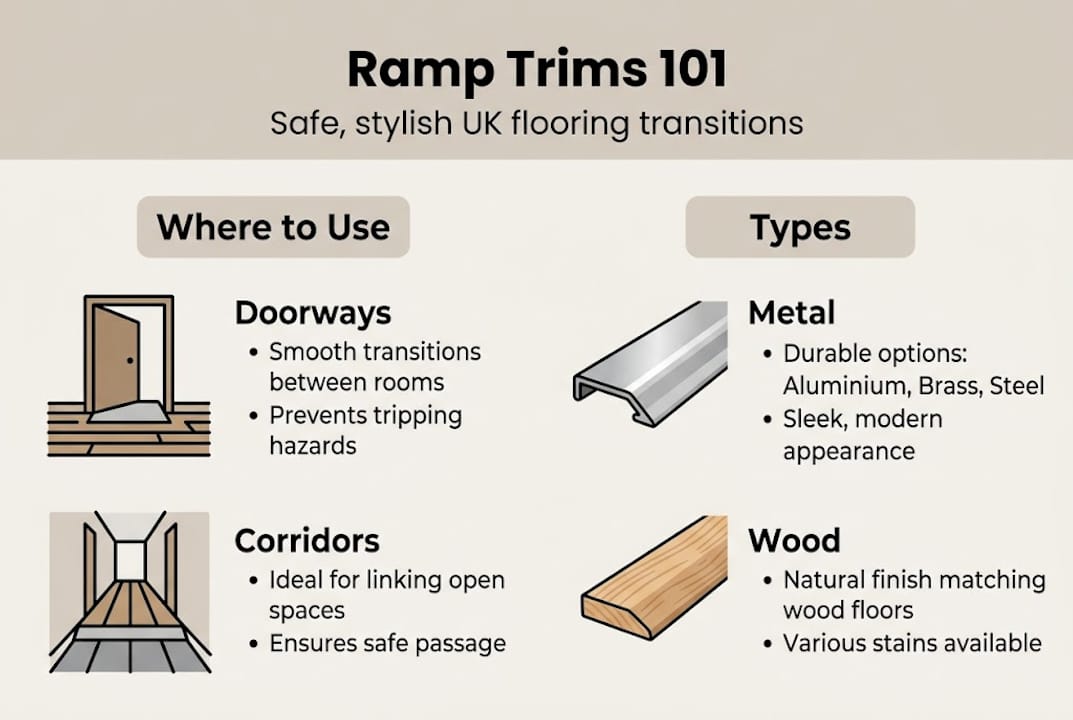
Ramp trims are not the same as expansion trims, which accommodate movement in floating floors, or T-bar trims, which join two floors at the same height. Each trim type has a specific purpose, and substituting one for another is where problems begin.
Here is a quick summary of what ramp trims offer:
- Safety: Eliminates abrupt edges that cause trips and falls
- Compliance: Meets accessibility standards for ramps and level changes
- Edge protection: Guards vulnerable flooring edges from chipping and wear
- Aesthetics: Delivers a clean, professional finish at every transition
“For height changes between 6.35mm and 12.7mm, a ramped assembly with a maximum 1:2 slope is required to meet accessibility standards. Height ranges vary by material: PVC covers 0 to 6mm, aluminium handles 3 to 18mm, and adjustable profiles can reach 26 to 30mm.”
As flooring transitions explained in detail, selecting the correct profile from the outset saves time, money, and potential liability down the line.
When and why do you need ramp trims?
A height difference of just 2mm between two floors is enough to create a trip hazard, particularly for elderly residents, young children, or anyone with limited mobility. Once that difference reaches 6mm or more, you are firmly in ramp trim territory, and in commercial or accessible spaces, the rules become even clearer.
Here are the most common situations where a ramp trim is not optional:
- Doorways between rooms where different flooring types create uneven levels
- Bathroom or kitchen thresholds where tiled floors sit higher than adjoining rooms
- Commercial premises where accessibility standards require a 1:2 slope for any rise
- Renovation projects where new flooring is laid over existing subfloor, raising the level
- Open-plan spaces where laminate or engineered floors meet original tiles or stone
Using a flat strip in any of these situations does not just look wrong. It can void your flooring warranty, fail a building inspection, and in a worst-case scenario, cause a serious fall. A guide to floor level transitions makes clear that the legal and practical stakes are real.
Pro Tip: Measure the height difference between both floors before ordering any trim. Do this after the flooring is fully laid and any underlay is in place, not before, as underlay thickness changes the final level significantly.
For contractors working on commercial builds, professional floor transition methods are increasingly part of project specifications, not an afterthought. Getting this right from the start protects your client, your reputation, and your project sign-off.
Types and specifications of ramp trims
Once the need for a ramp trim is confirmed, the next decision is which type to choose. The material, profile, and size all affect performance, longevity, and appearance.

Here is a comparison of the main ramp trim types and their typical specifications:
| Material | Height range | Best use case | Notes |
|---|---|---|---|
| PVC | 0 to 6mm | Light domestic use | Lower durability, budget option |
| Aluminium | 3 to 18mm | General domestic and light commercial | Versatile, widely available |
| Brass | 2 to 9mm (2-way) | Period homes, high-end interiors | Premium finish, durable |
| Adjustable | Up to 26 to 30mm | Complex or large level changes | Flexible but can appear bulky |
When selecting a ramp trim, consider these key factors:
- Height difference: Match the trim’s rated range to your actual measurement
- Foot traffic: High-traffic areas need solid metal profiles, not PVC
- Adjacent materials: Carpet-to-hard floor transitions often benefit from a compression ramp, which grips the carpet edge rather than simply sitting over it
- Finish: Choose a colour and finish that complements both floors and the room’s overall scheme
Familiarity with transition terms for designers helps when specifying trims for client projects, as the vocabulary around profiles, fixings, and tolerances is precise. It is also worth reviewing a reduce trip hazards guide to understand how specification choices directly affect safety outcomes.
Avoid over-engineering where it is not needed. A compression ramp for carpet-to-hard transitions is often the most elegant solution, while bulky adjustable ramps can be avoided entirely with careful planning at the design stage.
Installation and best practices for ramp trims
Knowing which trim to use is only half the story. Fitting it correctly is where the real difference shows.
Follow these steps for a clean, safe installation:
- Measure accurately: Record the height difference between both finished floor surfaces, including underlay
- Select the correct trim: Cross-reference your measurement with the trim’s rated height range
- Cut to length: Use a fine-toothed metal saw or mitre saw for a clean cut; score and snap works for some PVC profiles
- Prepare the subfloor: Ensure the subfloor is clean, flat, and free of debris where the fixing channel will sit
- Fix the channel or base: Screw or glue the fixing channel into position, centred on the joint between the two floors
- Clip or press the trim: Snap the ramp profile onto the channel, checking that both edges sit flush against each floor surface
- Check alignment: Walk the transition to confirm there is no rocking or movement
Pro Tip: Plan your transitions before you lay the flooring, not after. Knowing the trim’s footprint in advance means you can leave the correct gap at doorways and avoid the frustrating situation of having to lift newly laid boards to fit a channel.
For carpet-to-hard floor transitions, a step-by-step guide for trim fitting walks through the compression ramp method in detail. The most common mistake is fitting the trim before the carpet is stretched and tacked, which results in a loose, uneven finish. Always fit carpet first, then secure the trim over the edge.
Ignoring subfloor preparation is another frequent error. A trim fitted over an uneven base will rock underfoot, wear unevenly, and look unprofessional within months.
Alternatives and common misconceptions
Not every flooring project calls for a ramp trim, but the misconceptions around when alternatives are acceptable can lead to unsafe results.
Myth: A flat threshold strip works for any transition. This is one of the most common and dangerous assumptions in DIY flooring. A flat strip placed over a height difference does not eliminate the trip hazard. It creates a sharp edge on one side and a gap on the other.
Here is a realistic breakdown of when alternatives may work, and when they will not:
- T-bar or flat threshold: Suitable only where both floors are at the same level
- Expansion trim: For floating floors that need movement allowance at the same height
- Adjustable multi-purpose trims: Can work for moderate height differences, but check the slope ratio meets accessibility requirements
- Compression ramp: Ideal for carpet-to-hard floor transitions where the carpet edge needs to be held securely
“Any floor height change that requires a transition must meet the 1:2 slope standard to remain accessible and compliant. Shortcuts that ignore this create both a safety hazard and a potential legal liability.”
For projects where the level difference is borderline, alternatives to ramp trims are worth exploring, but only with a clear understanding of the limitations. An adjustable trim that looks fine on day one can become a hazard as floors settle and the height difference becomes more pronounced.
The bottom line is this: if there is a measurable height difference, use a ramp trim. The cost of getting it right is always less than the cost of putting it right later.
The truth most guides miss about ramp trims
Most articles on ramp trims treat them as a reactive fix, something you reach for when a problem is already visible. That is the wrong way to think about them. The professionals and homeowners who get the best results treat transition planning as part of the design process, not a last-minute correction.
The case for stylish transitions is often made on aesthetic grounds, but the real argument is about integrity. A poorly handled transition tells you everything about how a renovation was managed. It is the detail that clients notice, inspectors flag, and that undermines otherwise excellent work.
Even a 3mm height difference, ignored at the planning stage, can throw off the entire feel of a room. It creates a visual interruption that no amount of expensive flooring can compensate for. The best designers we work with specify their trim profiles at the same time as their floor finishes, not after. That discipline is what separates a truly polished result from one that merely looks finished.
Get the perfect ramp trim solution for your project
Armed with clear knowledge, you are ready to take the next step towards a flawless, safe finish.

At Quality Carpet Trims, we supply solid metal door bars and ramp trims that are hand-finished in 10 beautiful finishes, made right here in the UK. Whether you are a homeowner tackling a doorway transition or a contractor specifying trims across a full commercial fit-out, our range is built to perform and designed to impress. Start by exploring choosing the right trim to match your project requirements, or brush up on flooring trim terminology before you order. Ready to browse? Visit our shop flooring trims page and find the perfect finish for every transition in your project.
Frequently asked questions
What is the difference between a ramp trim and a threshold strip?
A ramp trim has a sloped profile specifically designed to manage height differences between floors, while a threshold strip is flat and only suitable where both floors sit at the same level.
What is the maximum floor height change a ramp trim can cover?
Most standard ramp trims handle up to 18mm, but adjustable profiles reach 26 to 30mm; always follow the 1:2 slope rule for accessible spaces regardless of the trim type used.
Are ramp trims required by UK building regulations?
In commercial and publicly accessible spaces, ramp trims are often required wherever floor height changes exceed 6mm, as accessibility standards specify a maximum 1:2 slope for any rise.
Can I install a ramp trim myself?
Yes, most homeowners can fit a ramp trim with accurate measurements and basic tools, though complex or commercial installations are best handled by a professional fitter.
Do ramp trims come in different materials and finishes?
Ramp trims are available in a range of materials including brass and solid metal, with finishes chosen to complement your décor and flooring type.
Recommended
- Flooring trim terminology explained for UK finishes 2026
- Commercial flooring trims: UK standards and installation
- Industry standards for flooring trims: a complete UK guide
- How to Choose Flooring Transitions: Cut Trip Hazards 30%
- How to install herringbone flooring for a flawless finish