
Blog
Quality assurance in trims: the 2026 guide for professionals

Jun
TL;DR:
- Quality assurance in flooring trims involves strict material checks, process capability monitoring, and functional testing to prevent safety hazards and defects. Proper inspection stages, physical trim cards, and real-world load testing ensure batch consistency and reliable installation performance. Implementing a documented quality system reduces project failures, enhances durability, and maintains professional standards.
Quality assurance in trims is the systematic process that guarantees flooring trims meet strict performance, safety, and aesthetic standards before and after installation. For residential and commercial interior projects, a failed trim is not a minor cosmetic issue. It creates trip hazards, damages flooring edges, and signals poor workmanship to every client who walks through the door. The trim inspection process spans material selection, production consistency, and final fitment. Getting it right from the start protects your project, your reputation, and your budget.
What are the key quality standards for trims in 2026?
Trim quality control is measured against defined benchmarks, not guesswork. In textile and manufacturing inspection, the standard AQL (Acceptable Quality Level) for critical defects is 0.0, meaning zero tolerance. Major defects are held to AQL 2.5. That distinction matters because a trim with a structural flaw is a critical defect, while a minor colour variation may fall under the major category.
Process capability is equally important. Manufacturing consistency is measured using the Cpk score, and a Cpk of ≥1.67 is the accepted minimum for highly stable production processes. A score below that threshold indicates too much variation between units. For flooring trims, that variation shows up as gaps, misaligned profiles, or finishes that differ visibly between batches.
Functional benchmarks also apply. A minimum button pull strength of 3 lb / 1.4 kg and repeated zipper operation tests are standard in trim inspection. For flooring trims specifically, the equivalent tests cover profile rigidity, finish adhesion, and resistance to deformation under load. Solid brass trims with powder-coated finishes meet these demands. Cheaper alternatives made from wood, plastic, rubber, or aluminium fail under the same conditions. They split, bend, and dent. That is not a style preference. It is a measurable performance gap.
| Quality metric | Benchmark |
|---|---|
| Critical defect AQL | 0.0 (zero tolerance) |
| Major defect AQL | 2.5 |
| Process capability (Cpk) | ≥1.67 |
| Minimum pull strength | 3 lb / 1.4 kg |
| Finish adhesion | No delamination under load test |
Pro Tip: Request Cpk data from your trim supplier before ordering large quantities. A supplier who cannot provide process capability scores cannot guarantee batch consistency.
How is the trim inspection process conducted?
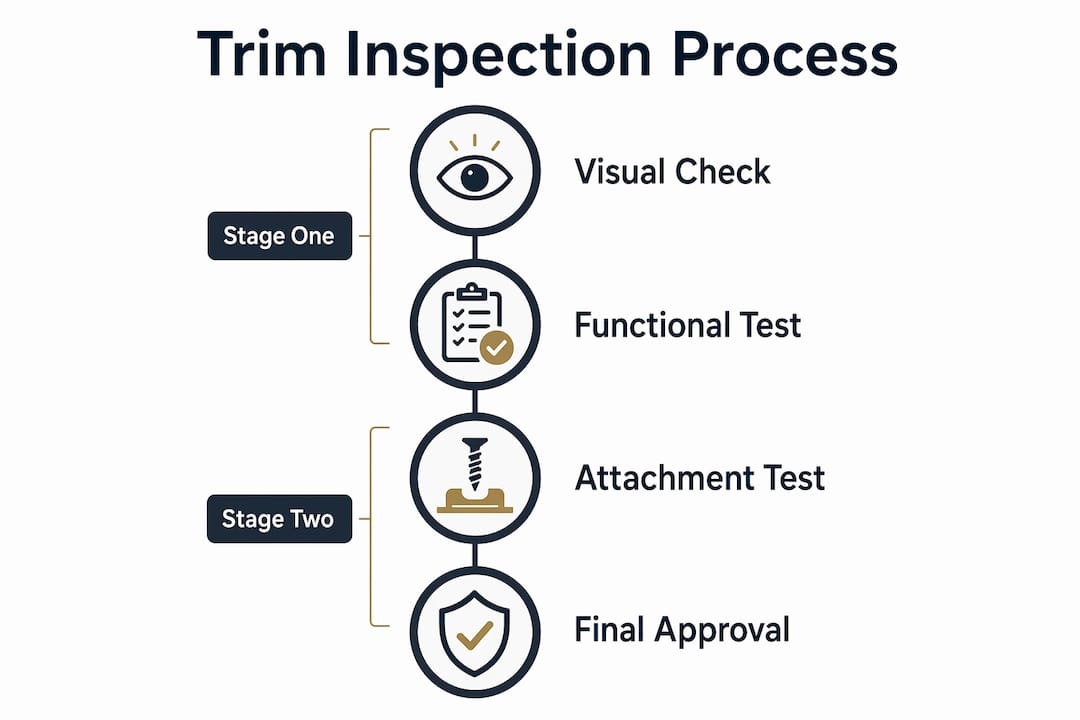
The inspection process runs in two distinct stages, and skipping either one creates risk. Dual-stage inspection covers material checks before production begins and pre-shipment verification of finished goods. Each stage catches different failure types.
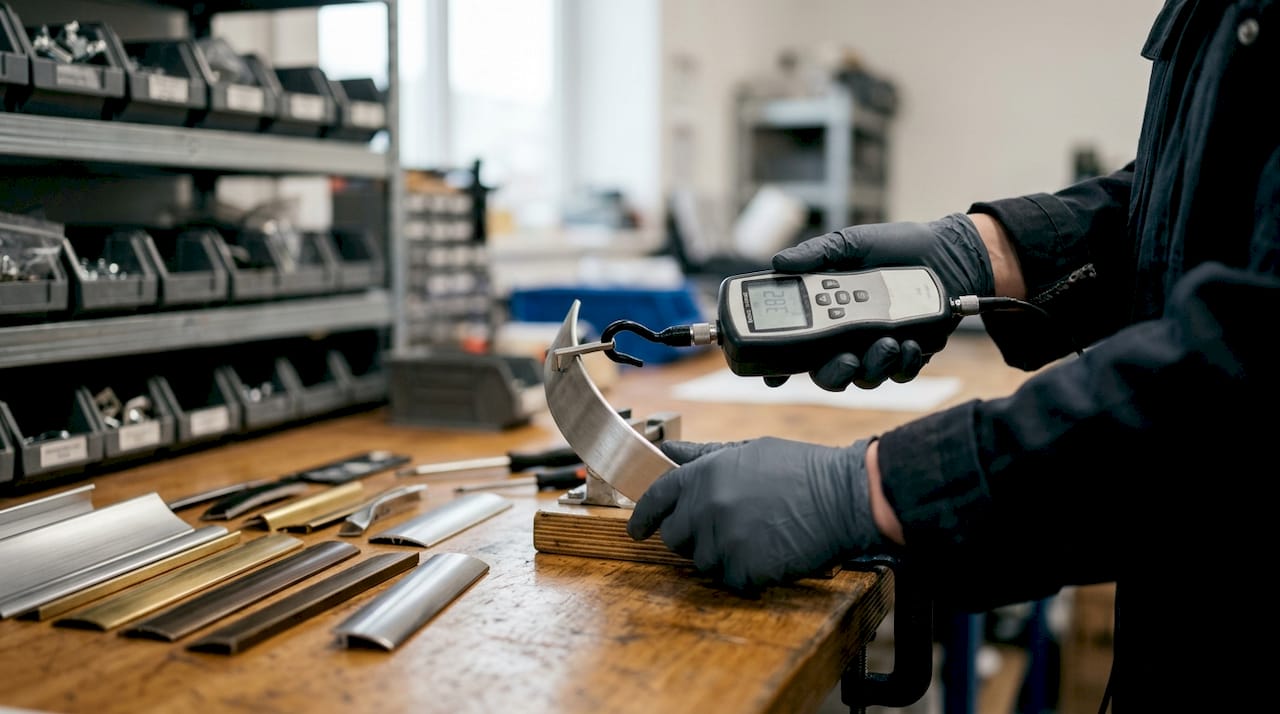
The 4-point system is the standard method for material inspection. It assigns defect points based on severity and size, and any roll or batch exceeding the acceptable point threshold is rejected before it enters production. Pre-shipment inspection then covers colour fastness, labelling compliance, stitching or bonding integrity, and functional durability. This structured approach removes subjectivity and reduces missed defects.
For flooring trims, the sequential inspection process looks like this:
- Raw material inspection. Check the base material for dimensional accuracy, surface consistency, and finish quality before any cutting or forming begins.
- In-line production checks. Monitor profile dimensions, finish adhesion, and batch colour consistency during production runs.
- Attachment and fitment testing. Verify that fixing methods, whether screw channels, adhesive backing, or clip systems, hold under stress without deforming the trim profile.
- Pre-shipment inspection. Inspect finished trims against the approved master sample for colour, profile shape, finish quality, and dimensional tolerances.
- Final approval sign-off. Confirm all parameters meet the agreed specification before despatch.
Testing attachment methods alongside the trim itself prevents the majority of post-installation failures. Stitch strength, rivet pressure, and adhesive bonding must all be validated together. A trim that looks perfect but pulls away from the floor within six months has failed the inspection process, even if it passed a visual check.
Pro Tip: Never rely on a visual approval alone. A trim can look correct and still fail under foot traffic. Always include a stress test on the fixing method as part of your sign-off process.
Why are trim cards and real-world testing essential?
Trim cards serve as the master standard in any quality-controlled production process. They contain all approved trim components in their physical form, and every subsequent batch is checked against them. Digital specifications cannot replicate texture, sheen, or how a finish behaves under different lighting conditions. A physical reference removes that ambiguity entirely.
The distinction between trim cards, lab dips, and swatches is worth understanding clearly:
- Trim cards contain the actual approved components. They are the binding reference for production and the first line of defence against substitution or quality drift.
- Lab dips are colour-matched samples used to verify dye consistency before full production. They confirm colour accuracy but do not represent the final product in full.
- Swatches show material texture and finish but are not approved production standards on their own.
Mismatches in trims most often occur when digital specs replace physical samples. A supplier working from a PDF cannot guarantee the same result as one working from an approved trim card. For flooring projects, that mismatch might mean a finish that reads as brushed gold on screen but arrives as pale champagne in person. The client notices. The rework cost follows.
Pre-production samples must undergo real-world testing before approval. For flooring trims, that means testing under load, across temperature variation, and against the specific flooring type they will transition. A solid brass trim with a powder-coated finish holds its colour and profile through all of those conditions. Cheaper materials do not.
How does trim quality assurance influence project outcomes?
Buyers judge entire projects by the quality of their trims. A floor that looks immaculate loses credibility the moment a visitor notices a buckled edge strip or a finish that has worn through. Trim quality is the last detail a client sees and the first one they remember when something goes wrong.
High-quality trims reduce rejection risk and support consistent batch performance across large projects. For commercial interiors, where dozens of doorways and floor transitions must match, batch consistency is not optional. It is a contractual requirement. A supplier who cannot guarantee finish consistency across a full order creates delays, disputes, and additional cost.
The performance gap between premium and generic trims is measurable:
| Failure type | Generic trims | Solid brass powder-coated trims |
|---|---|---|
| Surface deformation | Bends and dents under load | Holds profile under sustained pressure |
| Finish degradation | Peels, chips, or fades | Powder coat maintains colour and adhesion |
| Edge splitting | Common in wood and plastic | Does not occur in solid brass |
| Batch colour variation | Frequent without Cpk controls | Controlled through consistent manufacturing |
Premium trims like solid brass with powder-coated finishes eliminate the most common failure modes. Wood splits. Plastic bends. Rubber degrades. Aluminium scratches and oxidises. Solid brass does none of those things. That is why Qualitycarpettrims supplies only solid brass door bars, hand-finished in 10 luxury finishes. The role of trims in safety is just as significant as their appearance, particularly in commercial spaces with high foot traffic.
Pro Tip: When evaluating a trim supplier, ask for batch test reports from previous production runs. A supplier with documented Cpk scores and pre-shipment inspection records is a supplier you can trust with a large project.
Best practices for a solid trim quality assurance process
A quality assurance process is only as strong as its documentation. APQP (Advanced Product Quality Planning) and PPAP (Production Part Approval Process) are the frameworks that make quality auditable and repeatable. PPAP Level 3 submissions include DFMEA (Design Failure Mode and Effects Analysis), Cpk scores, control plans, and gauge R&R studies. Together, they create a traceable record that every unit conforms to the master sample.
For professionals and homeowners ordering flooring trims, the practical equivalent is a documented checklist applied before ordering and before installation. The following steps form the core of that process:
- Confirm the trim profile matches the flooring height differential at every transition point before ordering.
- Request a physical sample in your chosen finish and test it against your flooring under the actual lighting conditions of the room.
- Verify the supplier’s batch consistency by asking for finish and dimensional tolerances in writing.
- Check the fixing method is appropriate for your subfloor type. A fixing that works on concrete may not work on a timber subfloor without modification.
- Inspect each trim on delivery against the approved sample before installation begins. Do not assume the batch matches the sample without checking.
- Document the approved sample and keep it until the project is complete. If a dispute arises, the physical reference resolves it.
Final fitment testing is the step most often skipped. A trim that fits correctly in isolation may behave differently once the flooring is fully laid and the room reaches operating temperature. Test the full installation before signing off. The professional installation methods that reduce failure rates all include a final fitment check as standard.
Key takeaways
Effective quality assurance in trims depends on documented standards, physical references, and tested attachment methods applied consistently from production through to final installation.
| Point | Details |
|---|---|
| Use defined AQL benchmarks | Critical defects require AQL 0.0; major defects are held to AQL 2.5 for consistent quality. |
| Demand Cpk scores from suppliers | A Cpk of ≥1.67 confirms manufacturing consistency and reduces batch variation. |
| Rely on physical trim cards | Digital specs cannot replace physical references for colour, texture, and finish accuracy. |
| Test attachment methods, not just trims | Most post-installation failures relate to fixing methods, not the trim material itself. |
| Choose solid brass over cheaper materials | Wood, plastic, rubber, and aluminium all fail under conditions that solid brass withstands. |
Why the quality system matters more than the trim itself
I have seen projects where the trims were genuinely excellent but the quality process around them was non-existent. No physical samples approved before ordering. No batch checks on delivery. No fitment test before sign-off. The result was a beautiful trim that arrived in the wrong finish, fitted incorrectly, and had to be replaced at the contractor’s cost.
The lesson I keep coming back to is this: the quality system is the deliverable, not the trim. Automotive manufacturers figured this out decades ago. Their interior trim standards require documented APQP cycles, PPAP submissions, and Cpk scores because they know that a good part produced without a good process is an accident, not a guarantee.
For flooring projects, the same principle applies. A physical trim card is not bureaucracy. It is the only reliable way to confirm that what you approved is what you received. Spec sheets lie, or rather, they leave too much room for interpretation. A physical sample does not.
The other mistake I see regularly is accepting a visual approval as a final sign-off. A trim can look exactly right and still fail within months if the fixing method was not tested under real conditions. Foot traffic, temperature change, and subfloor movement all stress the attachment point, not the trim surface. Test both.
Qualitycarpettrims builds quality into the product from the start by using solid brass and powder-coated finishes that do not split, bend, or dent. But even the best trim needs a proper quality process around it. Invest in that process, and the trim will perform exactly as expected for years.
— Matt
Qualitycarpettrims: premium trims backed by real quality standards
Choosing the right trim is only half the decision. The other half is knowing the trim you receive matches what you approved.
Qualitycarpettrims supplies solid brass door bars and flooring trims, hand-finished in 10 luxury finishes. Every trim is manufactured in the UK to consistent quality standards, so the finish you see in the sample is the finish you receive in the batch. Whether you are fitting a single doorway or specifying trims across a commercial project, the Matwell flooring trim range gives you a product built to last. For projects requiring transitions between carpet and hard flooring, the carpet to hardfloor range covers every profile type. Contact Qualitycarpettrims directly for advice on finish selection, profile compatibility, and quality assurance support for your specific project.
FAQ
What is quality assurance in trims?
Quality assurance in trims is the process of verifying that flooring trims meet defined performance, aesthetic, and safety standards at every stage from production to installation. It covers material inspection, batch consistency, finish accuracy, and attachment integrity.
What AQL standard applies to trim quality control?
The standard AQL for critical defects in trim inspection is 0.0, meaning zero tolerance. Major defects are held to AQL 2.5, which allows a defined maximum defect rate across a production batch.
Why are physical trim cards better than digital specifications?
Physical trim cards capture texture, sheen, and finish behaviour under light in ways that digital specs cannot. They serve as the binding master standard, preventing substitutions and quality drift across production runs.
How do solid brass trims outperform cheaper alternatives?
Solid brass trims with powder-coated finishes resist deformation, finish degradation, and edge splitting under load and foot traffic. Wood, plastic, rubber, and aluminium all fail under the same conditions through bending, splitting, or surface deterioration.
What is the most common cause of trim failure after installation?
Most post-installation trim failures relate to the attachment method rather than the trim material itself. Testing stitch strength, rivet pressure, or adhesive bonding alongside the trim during inspection prevents the majority of these failures.
Recommended
- Industry terminology for trims: a professional guide
- Why use trims for commercial spaces: a complete guide
- How trims transform decor for safer, stylish spaces
- The role of trims in commercial spaces: a design guide