
Blog
Flooring trim terminology explained for UK finishes 2026

Mar
Flooring trim terminology explained for UK finishes 2026
Misunderstanding flooring trim terminology causes installation failures, trip hazards, and wasted materials across UK projects. Homeowners and contractors often confuse thresholds with reducers or select inappropriate profiles, leading to costly rework and safety risks. This guide clarifies essential UK flooring trim terms, explains functional differences, and provides practical selection frameworks to ensure professional, safe interior finishes. Mastering precise terminology improves supplier communication, prevents specification errors, and delivers superior project outcomes.
Table of Contents
- Understanding Flooring Trims Terminology
- Types Of Flooring Trims And Profiles
- Key Functions And Material Differences
- Common Misconceptions And What To Avoid
- Installation Challenges And Best Practices
- Additional Functional Benefits Of Flooring Trims
- Practical Framework For Flooring Trim Selection
- Explore Premium Flooring Trims For Your Project
- Frequently Asked Questions
Key takeaways
| Point | Details |
|---|---|
| Clear trim definitions | Understanding thresholds, reducers, T-mouldings, scotia, and stair nosing prevents ordering errors and improves project outcomes. |
| Trim types correspond to transitions | Each profile serves specific floor joins: equal height, varying height, wall edges, or stair protection. |
| Solid metal offers durability | Metal trims outlast PVC and resist moisture, reducing trip hazards and ensuring long-term performance. |
| Common errors stem from misuse | Wrong trim selection or improper installation causes safety risks and fitting failures in 35% of DIY projects. |
| Decision frameworks aid specification | Structured selection steps based on height, material, and environment ensure correct trim choice. |
Understanding flooring trims terminology
Flooring trims are essential finishing components that bridge gaps, protect edges, and create safe transitions between different flooring surfaces in UK interiors. Without precise terminology knowledge, ordering errors multiply, installations fail, and safety hazards emerge. Different flooring trims serve distinct roles: thresholds are T-shaped bars for doorways; T-mouldings connect floors of equal height; quarter-round and scotia trim hide expansion gaps along walls; reducers manage transitions between floors of differing heights.
Each term carries specific meaning in UK industry terminology flooring trims standards. Thresholds sit at doorways, bridging height differences between rooms with distinct flooring materials. T-mouldings create seamless joins where equal-height floors meet, allowing continuous movement. Scotia and quarter-round trims conceal necessary expansion gaps along wall perimeters whilst maintaining elegant aesthetics. Reducers provide gentle slopes between floors of varying heights, eliminating trip hazards.
Understanding these distinctions prevents specification mistakes that compromise safety and appearance. A threshold wrongly specified as a reducer creates dangerous edges. A T-moulding fitted where a reducer belongs fails functionally and aesthetically. Accurate terminology ensures suppliers deliver correct profiles, contractors install appropriate solutions, and finished projects meet UK building standards. Communication precision directly impacts project success, material costs, and long-term performance.
Essential UK flooring trim terms:
- Threshold: T-shaped bar bridging doorways and height transitions
- Reducer: Sloped profile connecting floors of different heights
- T-moulding: Equal-height floor connector allowing expansion
- Scotia: Concave trim covering expansion gaps along walls
- Quarter-round: Convex trim for wall-floor gap coverage
- Stair nosing: Edge protector for stair treads enhancing safety
Types of flooring trims and profiles
Each flooring trim type features distinct profiles engineered for specific UK application scenarios. Thresholds utilise T-shaped cross-sections that straddle height differences at doorways, securing to subfloors whilst accommodating carpet, laminate, or vinyl surfaces either side. Their vertical stem anchors firmly whilst horizontal flanges cover flooring edges, creating neat transitions between rooms with contrasting materials.
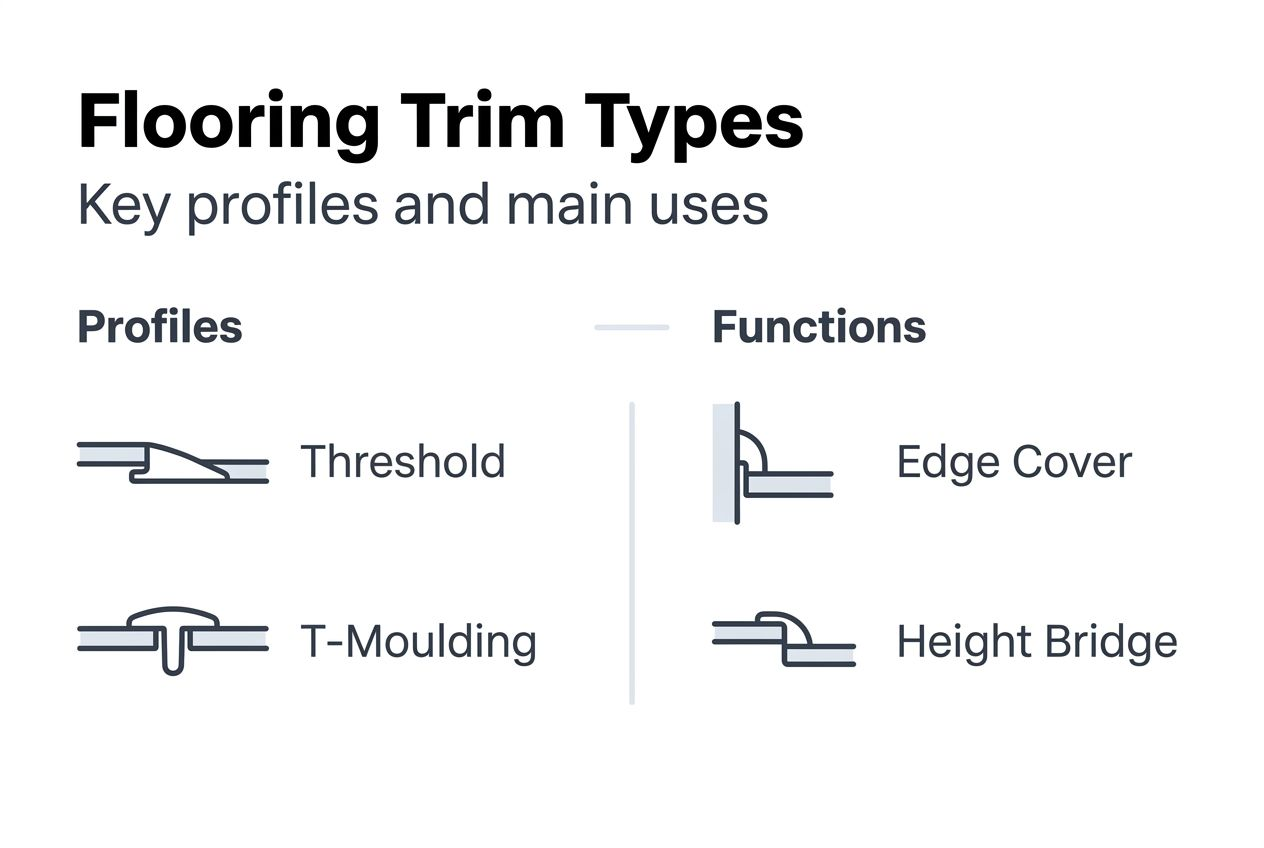
T-mouldings feature symmetrical profiles that sit between equal-height floors, typically where laminate or engineered wood meets identical surfaces in open-plan spaces. The central channel allows both floors to expand independently, preventing buckling whilst maintaining visual continuity. Quarter-round and scotia trims follow wall contours, their curved profiles elegantly concealing 8-12 mm expansion gaps mandatory for floating floors.
Reducer trims create gradual slopes between floors of differing heights, preventing the abrupt edges that cause trips and falls. Their angled profiles transition smoothly from higher to lower surfaces, typically where thick carpet meets thinner vinyl or laminate. Stair nosing wraps tread edges, combining slip resistance with impact protection to extend stair lifespan and improve safety compliance.

Trim type comparison table:
| Trim Type | Profile Shape | Primary Application | Height Management |
|---|---|---|---|
| Threshold | T-shaped | Doorways between rooms | Bridges differences up to 15 mm |
| T-moulding | Symmetrical channel | Equal-height floor joins | Accommodates identical heights |
| Reducer | Angled slope | Height transitions | Smooths differences 3-20 mm |
| Scotia/Quarter-round | Curved concave/convex | Wall-floor perimeter | Covers 8-12 mm expansion gaps |
| Stair nosing | L-shaped with grip | Stair tread edges | Protects vertical/horizontal edges |
Understanding these carpet trim profiles explained enables accurate specification. A bathroom threshold needs moisture resistance; a living room T-moulding requires aesthetic finish matching. Hallway reducers demand durability for high footfall; bedroom scotia prioritises discreet appearance. Matching profile to function ensures installations perform correctly across varied UK interior contexts, as detailed in this flooring transition guide UK.
Key functions and material differences
Flooring trims serve critical protective, functional, and aesthetic roles in UK interiors. Floor edge trims hide expansion gaps that allow engineered wood and laminate floors to expand and contract, preventing damage and maintaining floor integrity. Without proper trim coverage, unsightly gaps accumulate dust, moisture penetrates vulnerable edges, and floors warp or buckle prematurely.
Solid metal trims significantly outperform alternatives in durability, corrosion resistance, and longevity. Whilst PVC trims crack under impact and discolour over time, metal maintains structural integrity and appearance for decades. Aluminium oxidises and dents easily; solid brass, bronze, or stainless compositions resist wear in high-traffic zones. Hand-finished metal surfaces complement premium interiors with lustrous, professional aesthetics unachievable with plastic alternatives.
Safety improvements prove substantial with correct trim selection. Metal reducers and thresholds reduce trip hazards by up to 40% compared to poorly fitted or inappropriate profiles. Their rigid construction maintains precise edge geometry, preventing the lifting, flexing, or degradation common with inferior materials. In wet areas like kitchens and bathrooms, waterproof metal trims prevent moisture ingress that rots subfloors and breeds mould.
Material performance comparison:
| Material | Durability Rating | Moisture Resistance | Trip Hazard Reduction | Aesthetic Lifespan |
|---|---|---|---|---|
| Solid metal | Excellent | Superior | Up to 40% | 20+ years |
| PVC | Poor to Fair | Moderate | Minimal | 3-7 years |
| Aluminium | Fair to Good | Good | Moderate | 8-12 years |
| Wood | Fair | Poor | Variable | 5-10 years |
Pro tip: Specify hand-finished solid metal trims for visible, high-use zones like hallways and living areas. Their superior durability justifies higher initial cost through decades of maintenance-free service and sustained aesthetic appeal.
Selecting appropriate materials for environmental conditions proves essential. Wet areas demand corrosion-resistant metals; high-traffic zones require impact-resistant compositions. Matching material properties to application context, as explored in types of flooring trims explained, ensures trims fulfil protective, functional, and aesthetic roles throughout their service life.
Common misconceptions and what to avoid
Myths about flooring trims proliferate across UK DIY communities, causing expensive mistakes. One dangerous misconception suggests expansion gaps are optional for laminate or engineered wood floors. Reality contradicts this: 8-12 mm perimeter gaps remain mandatory to prevent buckling as humidity fluctuates seasonally. Trims cover these gaps aesthetically without eliminating their necessity.
Another myth claims all trims suit all applications interchangeably. This misunderstanding leads contractors to fit standard thresholds where reducers belong, creating trip hazards and building regulation violations. Each profile serves distinct functions; substituting arbitrarily compromises safety and performance. Common mistakes include fitting non-waterproof trims in kitchens or bathrooms and using incorrect profiles for transitions, which significantly impact durability and safety.
Height measurement errors compound during installation when contractors assume approximate measurements suffice. Precise measurement within 1-2 mm tolerance proves critical for proper trim seating and hazard prevention. Insufficient accuracy causes trims to sit proud, creating dangerous edges, or recessed, leaving gaps that trap debris and moisture.
Misconceptions to dispel:
- Myth: Expansion gaps are optional for floating floors
- Reality: 8-12 mm gaps prevent seasonal buckling damage
- Myth: Any trim works for any transition
- Reality: Profile must match height difference and floor types
- Myth: Approximate measurements are adequate
- Reality: 1-2 mm accuracy ensures safe, proper fitting
- Myth: PVC performs equally to metal in all contexts
- Reality: Metal offers superior durability and moisture resistance
Pro tip: Always request physical samples from suppliers before ordering. Verify terminology matches actual profiles by comparing samples against your specific transition requirements, eliminating misunderstandings before costly mistakes occur.
Ignoring moisture resistance requirements in wet areas accelerates trim degradation and subfloor damage. Non-waterproof materials absorb moisture, swell, and lose structural integrity within months. This oversight, detailed in installing flooring edge trims step guide, proves particularly costly in bathrooms and kitchens where water exposure is constant.
Installation challenges and best practices
Installation errors stemming from improper trim selection plague UK projects. Using improper trim types leads to frequent installation errors and trip hazards in UK projects; 35% of DIY installations report trim-related safety or fit issues. Addressing these challenges requires systematic approach and attention to measurement precision.
Successful installation follows structured methodology. Begin by measuring height differences at transition points using digital callipers or precision rulers, recording measurements within 1-2 mm tolerance. This accuracy determines whether thresholds, reducers, or T-mouldings suit the application. Next, identify flooring materials each side of transitions, as carpet-to-laminate requires different profiles than laminate-to-laminate joins.
Five-step installation framework:
- Measure precisely: Record height differences within 1-2 mm tolerance using calibrated tools
- Match profiles: Select trim types corresponding to flooring materials and transition heights
- Consider environment: Specify waterproof metal trims for kitchens, bathrooms, and moisture-prone areas
- Respect expansion gaps: Install trims covering 8-12 mm gaps without restricting natural floor movement
- Verify safety: Check installed trims for trip hazards, ensuring smooth transitions and secure fixing
Pro tip: Dry-fit all trims before final installation. Position trims without adhesive or fasteners, walk across transitions, and verify smooth passage. This simple practice reveals fitting issues, profile mismatches, or measurement errors before permanent fixing.
Avoiding non-waterproof trims in moisture-prone rooms prevents premature failure and costly replacement. Kitchens and bathrooms demand corrosion-resistant metal compositions that maintain integrity despite constant humidity and occasional water exposure. Selecting inappropriate materials in these contexts, as explained in flooring trims terminology explained, guarantees degradation within 12-24 months.
Post-installation verification proves essential. Walk transitions multiple times, feeling for proud edges or movement. Trims should sit flush, secure, and stable under foot traffic. Any lifting, flexing, or edge projection indicates improper installation requiring immediate correction. These best practices, detailed in the flooring edge trims installation guide, ensure safe, durable, professional results.
Additional functional benefits of flooring trims
Beyond basic transition coverage, properly specified flooring trims deliver substantial additional advantages in UK interiors. Safety improvements prove most significant: correctly installed reducers and thresholds reduce trip hazards by up to 40% compared to absent or inappropriate profiles. This reduction matters critically in homes with elderly residents or commercial spaces with liability concerns.
Compliance with UK building regulations requires safe, durable floor transitions in residential and commercial contexts. Inspectors scrutinise transition zones for trip hazards, adequate fixing, and appropriate materials. Quality trims simplify compliance demonstration, providing documented solutions that meet safety standards without custom fabrication.
Edge protection extends flooring lifespan substantially. Carpet edges fray without threshold protection; laminate corners chip under impact; vinyl lifts without secure edge retention. Metal trims shield vulnerable edges from foot traffic, furniture impacts, and cleaning equipment, preventing damage that necessitates premature replacement.
Functional benefits summary:
- Safety enhancement: Reduce trip hazards up to 40% through proper profile selection and installation
- Regulatory compliance: Meet UK building standards for safe floor transitions
- Edge protection: Shield flooring from impact damage and premature wear
- Visual continuity: Create polished, professional interior finishes connecting spaces cohesively
- Confidence assurance: Combine function with aesthetics for peace of mind
Aesthetic contributions prove equally valuable. Trims provide visual continuity between rooms, defining spaces whilst maintaining flow. Hand-finished metal surfaces in complementary finishes elevate interior design, transforming functional necessities into decorative features. This dual-purpose functionality justifies investment in premium trim solutions that serve practical and aesthetic roles simultaneously.
Practical framework for flooring trim selection
Selecting appropriate flooring trims demands structured decision-making based on measurable criteria. Begin by identifying flooring types at transition points: carpet, laminate, vinyl, tile, or hardwood. Document which materials meet at each location, as this information dictates compatible trim profiles.
Next, measure height differences precisely. Use digital callipers or metal rulers to record exact measurements at multiple points along transitions, averaging results for accuracy within 1-2 mm. Height differences determine whether thresholds, T-mouldings, or reducers apply. Equal heights require T-mouldings; differences under 3 mm suit low-profile thresholds; differences of 3-20 mm demand reducers.
Six-step selection framework:
- Identify flooring types: Document materials at each transition zone
- Measure height differences: Record precise measurements within 1-2 mm tolerance
- Select by function: Choose transition trims, edge trims, reducers, or stair nosing based on application
- Prioritise solid metal: Specify durable, moisture-resistant metal compositions for longevity
- Consider environment: Match material properties to wet areas, high traffic, or decorative zones
- Verify with checklist: Confirm specification accuracy before ordering using standardised criteria
Trim selection criteria table:
| Application Context | Recommended Trim Type | Optimal Material | Critical Considerations |
|---|---|---|---|
| Equal-height laminate join | T-moulding | Solid metal | Allow 8-12 mm expansion clearance |
| Doorway height difference | Threshold or reducer | Waterproof metal | Match height difference magnitude |
| Wall perimeter gap | Scotia or quarter-round | Metal or wood | Conceal 8-12 mm expansion gap |
| Wet area transition | Waterproof threshold | Corrosion-resistant metal | Prevent moisture ingress |
| Stair tread edge | Stair nosing | Impact-resistant metal | Enhance grip, protect edge |
Environmental factors significantly influence material selection. High-traffic hallways demand impact-resistant compositions; wet areas require corrosion-resistant metals; decorative living spaces benefit from hand-finished surfaces. Matching properties to context ensures trims perform reliably throughout their service life.
Utilising a verification checklist before ordering prevents specification errors. Confirm flooring types, height measurements, environmental conditions, and desired finishes align with selected trim profiles. This systematic approach, integrated with guidance from flooring trim types explained, minimises mistakes and ensures correct first-time purchases.
Final specification should reference precise terminology when communicating with suppliers. State “solid brass reducer for 8 mm carpet-to-laminate transition in hallway” rather than “transition strip.” Specificity eliminates ambiguity, ensuring supplied products match requirements exactly. This precision, combined with insights from flooring trim seamless safe transitions, guarantees professional outcomes.
Explore premium flooring trims for your project
Quality Carpet Trims offers an extensive range of hand-finished solid metal flooring trims engineered specifically for UK residential and commercial projects. Their specialist product selection includes thresholds, reducers, scotia trims, and stair nosings available in ten beautiful finishes, ensuring perfect aesthetic integration with your interior design scheme.

Visiting their website allows you to match the expert terminology covered in this guide with tangible product options, eliminating specification uncertainty. Browse the comprehensive flooring trim types explained guide to visualise how each profile suits your specific transitions. Their matwell flooring trim range demonstrates the quality and variety available from UK manufacturers committed to durability and precision.
Ordering from specialists reduces installation errors through accurate product descriptions aligned with industry terminology flooring trims standards. Their team provides expert guidance ensuring your selections match flooring types, height differences, and environmental conditions perfectly. Quality guarantees and fast delivery support confident purchasing decisions backed by British manufacturing excellence.
Frequently asked questions
What is the difference between a threshold and a reducer?
Thresholds are T-shaped profiles bridging doorways between rooms, typically managing height differences up to 15 mm with vertical fixing stems and horizontal flanges covering floor edges. Reducers create angled slopes between floors of different heights, providing gradual transitions that eliminate trip hazards where thicker flooring meets thinner surfaces.
Why are expansion gaps important and how do trims relate?
Expansion gaps of 8-12 mm prevent laminate and engineered wood floors from buckling as humidity causes seasonal expansion and contraction. Flooring trims cover these mandatory gaps aesthetically without restricting necessary floor movement. Omitting gaps or using trims that compress them causes warping, lifting, and premature floor failure.
What materials are best for flooring trims in wet or high-traffic areas?
Solid metal trims offer superior performance in kitchens, bathrooms, and busy hallways through corrosion resistance, impact durability, and long-term structural integrity. Avoid PVC or non-waterproof materials in these contexts, as moisture absorption causes swelling, discolouration, and degradation within months. Metal compositions maintain safety and appearance for decades.
How can I avoid installation errors with flooring trims?
Measure height differences at transitions within 1-2 mm tolerance using precision tools to ensure accurate trim selection. Match trim profiles to specific flooring types and environmental conditions, specifying waterproof metals for wet areas. Dry-fit trims before permanent installation to verify proper seating and smooth transitions, as detailed in the flooring edge trims installation guide, catching errors before costly fixing.
Recommended
- Industry Terminology: Flooring Trims Explained
- Flooring trim types explained: choosing the right finish
- Matwell Flooring Trim – Premier Flooring Trims. 10 Colours Order Online Now
- Flooring Trim: Ensuring Seamless, Safe Transitions