
Blog
What is a door threshold? Expert guide for UK homes

Mar
You might think door thresholds are just decorative strips at the base of your doorway, but they’re actually essential components that bridge flooring transitions, seal against drafts and moisture, and ensure compliance with UK accessibility standards. Many homeowners confuse thresholds with door sills or overlook their critical role in home comfort, energy efficiency, and safety. This guide clarifies what door thresholds are, how they differ from similar components, and why choosing the right type matters for your interior and exterior doorways. Whether you’re renovating, building new, or simply upgrading your home’s finish, understanding door thresholds helps you make informed decisions that enhance both function and aesthetics.
Table of Contents
- Key takeaways
- What is a door threshold and how does it differ from a door sill?
- UK building regulations and accessibility standards for door thresholds
- Types of door thresholds and materials for UK interiors and exteriors
- Practical tips for choosing and installing door thresholds in UK settings
- Find the perfect door threshold with Quality Carpet Trims
- Frequently asked questions
Key Takeaways
| Point | Details |
|---|---|
| Threshold functions | A door threshold bridges flooring transitions, seals drafts, moisture and pests, and provides a safe, smooth step for doors. |
| Threshold versus sill | The sill is the structural base of the door frame while the threshold sits on top as the walkable seal. |
| UK accessibility standards | Part M requires accessible thresholds to be no more than fifteen millimetres high and gradients no steeper than one in sixty for wheelchair access. |
| Thermal performance | External thresholds must achieve a maximum U value of 1.4 W/m2K or lower for new builds and 1.8 W/m2K for replacement doors. |
What is a door threshold and how does it differ from a door sill?
A door threshold is a strip at the base of a door bridging flooring transitions and sealing against drafts, water, and pests. This component sits directly beneath the door when closed, creating a physical barrier that prevents unwanted elements from passing through the gap between the door bottom and the floor. Thresholds serve multiple practical functions beyond their visible role as finishing touches.
The primary functions include bridging height differences between flooring surfaces, such as where carpet meets tile or laminate transitions to hardwood. They prevent drafts and moisture penetration, particularly crucial for external doors facing British weather conditions. Thresholds also deter pests from entering through gaps and provide a safe, smooth step-over point that reduces trip hazards. In commercial settings, they withstand heavy foot traffic whilst maintaining their sealing properties.
Many people confuse thresholds with door sills, but the sill is the structural base of the door frame whilst the threshold sits on top as the walkable seal. The sill forms part of the door frame’s load-bearing structure, typically made from timber or uPVC, and remains hidden beneath the threshold. The threshold, conversely, is the visible component you step over, designed for durability and aesthetics. Understanding this distinction helps when discussing replacements or repairs with contractors.

Interior applications include doorways between rooms with different flooring types, such as moving from carpeted bedrooms to tiled bathrooms. External applications involve transitions from interior flooring to outside surfaces, where weatherproofing becomes paramount. Quality threshold strips ensure these transitions remain smooth, safe, and visually appealing.
Key functions of door thresholds:
- Bridging different floor surface heights to create smooth transitions
- Sealing gaps against drafts, water ingress, and pest entry
- Providing accessibility aids that reduce trip hazards
- Creating aesthetic transitions that complement interior design
- Protecting door frame bases from wear and moisture damage
UK building regulations and accessibility standards for door thresholds
Part M of the UK Building Regulations establishes specific requirements for accessible threshold design, ensuring doorways accommodate wheelchair users and people with mobility limitations. These standards apply to new builds, extensions, and certain renovation projects. Regulations require accessible thresholds with 15mm maximum height and gradients no steeper than 1:60 for wheelchair access. External doors must incorporate ramps when threshold heights exceed these limits.
Thermal performance standards also govern external door thresholds to maintain energy efficiency. U-values must be 1.4 W/m²K or lower for new builds and 1.8 W/m²K for replacement doors. These requirements ensure thresholds don’t create thermal bridges that increase heating costs. Cold bridging through poorly insulated thresholds can lead to condensation issues and mould growth, particularly problematic in Britain’s damp climate.
Wheelchair clearance widths must meet minimum dimensions, typically 800mm for new dwellings, though 750mm may be acceptable in certain circumstances. Door opening forces should not exceed 30 Newtons at the leading edge, ensuring people with limited strength can operate doors easily. These measurements affect threshold design, as wider openings require longer threshold bars that maintain structural integrity whilst meeting accessibility criteria.
Key regulation points for compliant thresholds:
- Maximum threshold height of 15mm for accessible routes
- Gradient limits of 1:60 for ramped thresholds
- Thermal U-values of 1.4 W/m²K for new external doors
- Wheelchair clearance widths of 800mm minimum
- Maximum door opening force of 30 Newtons
When designing or selecting thresholds, consider:
- Measuring existing gaps accurately before ordering replacement thresholds
- Checking local building control requirements for your specific project
- Ensuring thermal breaks in metal thresholds for external applications
- Selecting appropriate sealing systems that maintain accessibility standards
- Verifying compatibility with door bottom seals and weatherstripping
Professional matwell flooring trims and extra wide door threshold bars help achieve compliance whilst maintaining aesthetic appeal. Installation must follow manufacturer guidelines to preserve warranty coverage and regulatory compliance.
Types of door thresholds and materials for UK interiors and exteriors
Flush thresholds prioritise seamless design and smooth transitions, sitting level with surrounding floor surfaces to eliminate steps entirely. These work brilliantly for interior doorways where aesthetics and accessibility take precedence over weatherproofing. Flush thresholds provide seamless design and accessibility but rely on brush seals rather than compression seals, making them less effective against weather. They suit modern interiors with open-plan layouts where visual continuity matters.
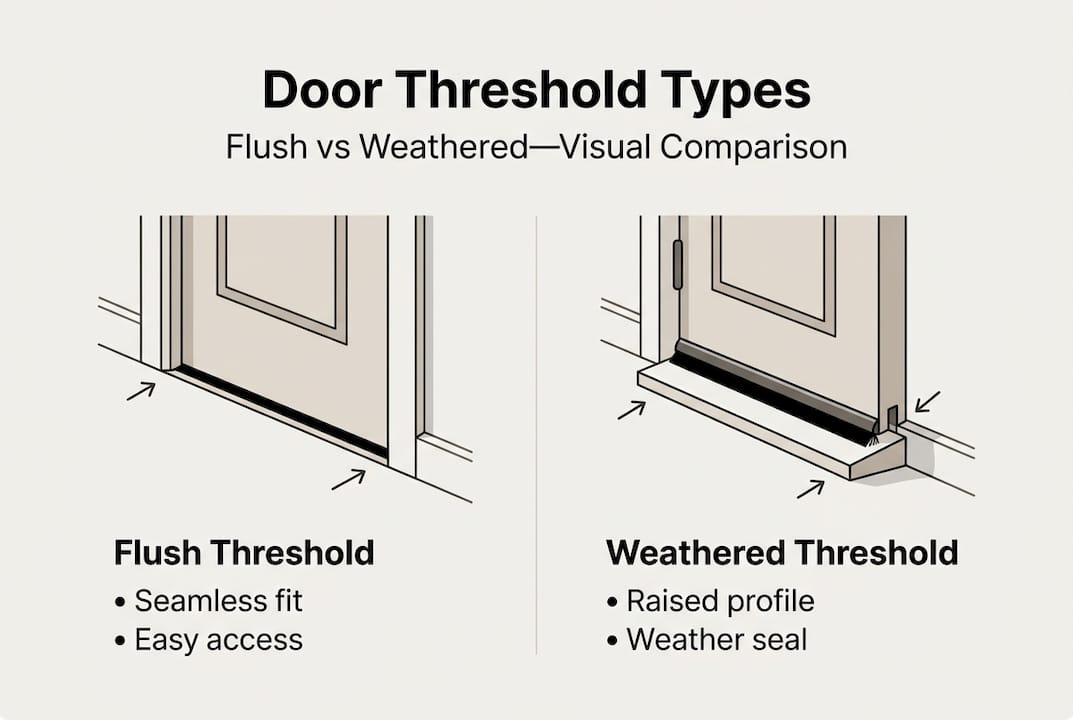
Weathered thresholds feature rebates and raised profiles designed specifically for external doors. These thresholds have rebates for compression seals, essential for UK external doors to prevent leaks, though they create a small step. The rebate allows door bottom seals to compress against the threshold surface, forming a watertight barrier against driving rain. This design proves crucial for exposed locations facing prevailing winds and heavy rainfall typical of British weather patterns.
| Feature | Flush threshold | Weathered threshold |
|---|---|---|
| Design | Level with floor surface | Raised profile with rebates |
| Weatherproofing | Limited, brush seals only | Excellent, compression seals |
| Step height | None, fully accessible | Small step, typically 10-15mm |
| Best applications | Interior doors, modern aesthetics | External doors, weather exposure |
| Maintenance | Low, minimal seal replacement | Moderate, seal checks needed |
Material selection significantly impacts threshold performance and longevity. Metal options including brass and bronze offer exceptional durability for high-traffic areas, resisting wear whilst maintaining their appearance. Solid metal thresholds withstand decades of use without degrading, making them cost-effective long-term investments. These materials suit both interior and exterior applications, with appropriate finishes protecting against corrosion in exposed locations.
Wood thresholds provide warmth and traditional character for interior doorways, complementing period properties and classic design schemes. However, timber requires more maintenance than metal and proves unsuitable for external use where moisture causes rot and warping. Specialist carpet trims and laminate transition strips offer purpose-designed solutions for specific flooring combinations, ensuring professional finishes.
Pros and cons by type and material:
- Metal thresholds: exceptional durability and traffic resistance; may feel cold underfoot; require thermal breaks externally
- Brass and bronze: beautiful patina develops over time; premium cost; excellent corrosion resistance
- Wood thresholds: warm aesthetic suits traditional interiors; requires regular maintenance; unsuitable for moisture exposure
- Flush designs: perfect accessibility and modern look; limited weatherproofing; best for interior use
- Weathered profiles: superior weather protection; creates small step; essential for external doors
Pro tip: Choose materials and threshold types considering location, traffic levels, and climate exposure. External doors in exposed positions need weathered metal thresholds with compression seals, whilst interior doorways benefit from flush designs that prioritise aesthetics and accessibility. Quality metal door bar thresholds and door threshold bars deliver professional results that last.
Practical tips for choosing and installing door thresholds in UK settings
Fire doors require strict adherence to gap specifications, with maximum 6mm bottom gaps and flat threshold sections mandated for safety and regulation compliance. These requirements ensure smoke seals function correctly whilst allowing door operation. Raised thresholds can interfere with intumescent seals that expand during fires, compromising the door’s protective function. Always verify fire door certification when selecting thresholds for fire-rated openings.
Bifold and sliding doors present unique challenges regarding flush thresholds and weatherproofing. Multiple door panels create numerous potential leak points, requiring careful seal design and installation. Flush thresholds for these applications often sacrifice some weather resistance for aesthetic appeal, making them better suited to covered or sheltered locations. Track systems must integrate seamlessly with threshold profiles to maintain smooth operation whilst preventing water ingress.
High-traffic settings use metal thresholds for durability and compliance, particularly in commercial properties and houses in multiple occupation. Threshold depth affects both performance and safety, with deeper profiles providing better weather protection but potentially creating trip hazards. Commercial applications typically specify minimum depths of 50mm to withstand heavy use whilst maintaining structural integrity over years of service.
Steps for selecting and installing thresholds:
- Measure door opening width and existing gap height accurately using a tape measure and spirit level
- Check building codes and fire safety requirements for your specific application and property type
- Choose materials based on location, with metal for external and high-traffic areas
- Ensure smooth transitions by selecting appropriate ramps or bevelled edges for accessibility
- Verify compatibility between threshold profile and existing door bottom seals
- Prepare substrate properly, ensuring level surfaces and adequate fixing points
- Use appropriate fixings for substrate type, whether timber, concrete, or screed
- Seal edges with flexible sealant to prevent moisture penetration beneath threshold
Pro tip: Prioritise thresholds with appropriate seals and ramps for weatherproofing whilst maintaining accessibility. External thresholds need compression seals and drainage channels to handle British weather, whilst interior applications benefit from flush designs that eliminate trip hazards. Consider seasonal temperature variations that cause materials to expand and contract, allowing appropriate tolerances during installation.
Replacing interior thresholds improves home aesthetics and function significantly. Old, worn thresholds create trip hazards and allow drafts, reducing comfort and increasing energy costs. Modern replacements offer improved sealing technology and contemporary finishes that complement updated interiors. The process typically takes under an hour per doorway for competent DIY enthusiasts, delivering immediate visual and practical benefits. Quality replacement interior door thresholds and carpet to laminate thresholds transform doorway appearances whilst solving functional issues.
Find the perfect door threshold with Quality Carpet Trims
Now you understand what door thresholds are and why they matter, finding the right products becomes straightforward. Quality Carpet Trims offers an extensive selection of door threshold bars specifically designed for UK homes and commercial properties. Our solid metal thresholds come hand-finished in ten beautiful finishes, ensuring perfect matches for your interior design scheme whilst delivering exceptional durability.
Our range includes solutions for every application, from interior room transitions to external doorways requiring weather protection. British-made products guarantee quality standards that withstand decades of use, backed by our quality guarantee. We also supply matwell flooring trims and threshold strips to complete your flooring projects with professional finishes. Free samples let you verify colour matches before ordering, whilst fast delivery ensures your project stays on schedule. Explore our complete range online and discover why contractors and DIY enthusiasts trust Quality Carpet Trims for premium flooring finishing products.
Frequently asked questions
What is the difference between a door sill and a door threshold?
The door sill forms the structural base of the door frame, typically made from timber or uPVC as part of the load-bearing structure. The threshold sits on top of the sill as the visible, walkable component that seals gaps and bridges flooring transitions. You step over the threshold, whilst the sill remains hidden beneath it.
Are flush thresholds better for accessibility?
Flush thresholds eliminate steps entirely, making them excellent for wheelchair access and meeting accessibility standards without requiring ramps. However, they provide limited weatherproofing compared to raised thresholds, making them better suited to interior applications. External doors in exposed locations need weathered thresholds despite the small step they create.
What materials last longest for external thresholds in the UK climate?
Solid metal thresholds in brass or bronze offer exceptional longevity for external applications, resisting corrosion and wear from British weather conditions. These materials withstand decades of exposure to rain, temperature fluctuations, and UV radiation without degrading. Proper installation with drainage channels and compression seals maximises their lifespan and performance.
Do UK building regulations set height limits for door thresholds?
Yes, Part M of UK Building Regulations limits accessible threshold heights to 15mm maximum, with gradients no steeper than 1:60 for ramped sections. External doors exceeding these limits require ramps to maintain accessibility. Fire doors have additional requirements with maximum 6mm bottom gaps to ensure proper seal function.
Can door thresholds help reduce drafts and energy loss?
Properly installed thresholds with appropriate seals significantly reduce drafts and energy loss through doorways. External thresholds meeting thermal U-value standards of 1.4 W/m²K prevent cold bridging that increases heating costs. Compression seals on weathered thresholds create airtight barriers against wind-driven drafts, improving comfort whilst lowering energy bills throughout the year.
Recommended
- Threshold Strips Guide for UK Homes: Types, Uses and Sizing – Quality Carpet Trims
- Doorway Details, Sorted: What Thresholds, Door Bars And Transition Strips Actually Do – Quality Carpet Trims
- Door Threshold Bars – Quality Carpet Trims
- Wood Door Bar Threshold – Quality Carpet Trims
- Bespoke decorative shutters: expert guide for UK homes