
Blog
Understanding flooring accessories: a homeowner’s guide

Jun
TL;DR:
- Flooring accessories are essential structural components that protect, finish, and facilitate smooth transitions in flooring installations. Proper selection and installation of trims, thresholds, and related accessories ensure a professional, durable, and safe floor finish that withstands daily wear.
Flooring accessories are the functional components that finish, protect, and connect flooring installations. Without them, even the most expensive floor covering will look unfinished, move incorrectly, or fail prematurely. The category covers trims, thresholds, door bars, scotia, stair nosings, and underlay. Each serves a distinct structural or aesthetic role. Understanding flooring accessories properly means recognising that they are not optional extras. They are built-in requirements for a floor that performs well, looks professional, and lasts. Suppliers like Qualitycarpettrims, and resources from the National Flooring Authority and Flooring Factory Outlet confirm that accessories are as important as the floor covering itself.
What are the main types of flooring accessories?
Flooring accessories divide into several clear categories, each solving a specific problem in your installation. Knowing which type you need before you buy saves time, money, and the frustration of a poor finish.
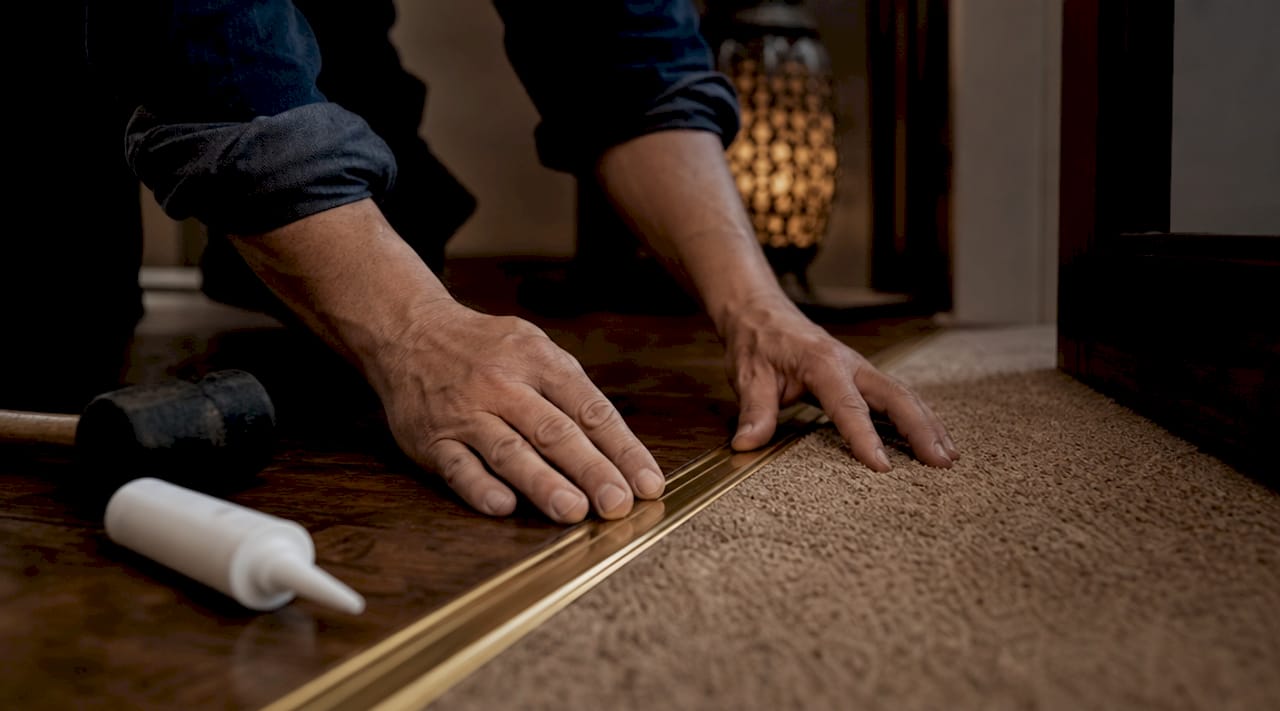
Trims and beading cover the expansion gap left around the perimeter of a room. Most wood and laminate products require expansion gaps of 10 to 15mm to manage natural movement caused by temperature and humidity changes. Scotia and beading sit against the skirting board and hide this gap without restricting the floor’s ability to move.
Transition strips manage the join between two different floor surfaces. The correct type depends entirely on the height difference between the two floors:
- Flat seam or flush reducer: used when the height differential is 6mm or less
- Bevelled reducer: used for differentials between 6mm and 12mm, following the standard 1:2 slope ratio to create a safe ramp
- Ramped threshold: required when the differential exceeds 12mm
- T-moulding: joins two floors of equal height, typically in doorways
- End cap: finishes a floor edge against a fixed object such as a hearth or step
Door bars and thresholds act as structural breaks between rooms, preventing floor buckling where two separate floating floors meet. They also provide a clean visual finish at doorways.
Stair nosings protect the leading edge of each step and reduce slip risk. They are a safety component, not purely decorative.
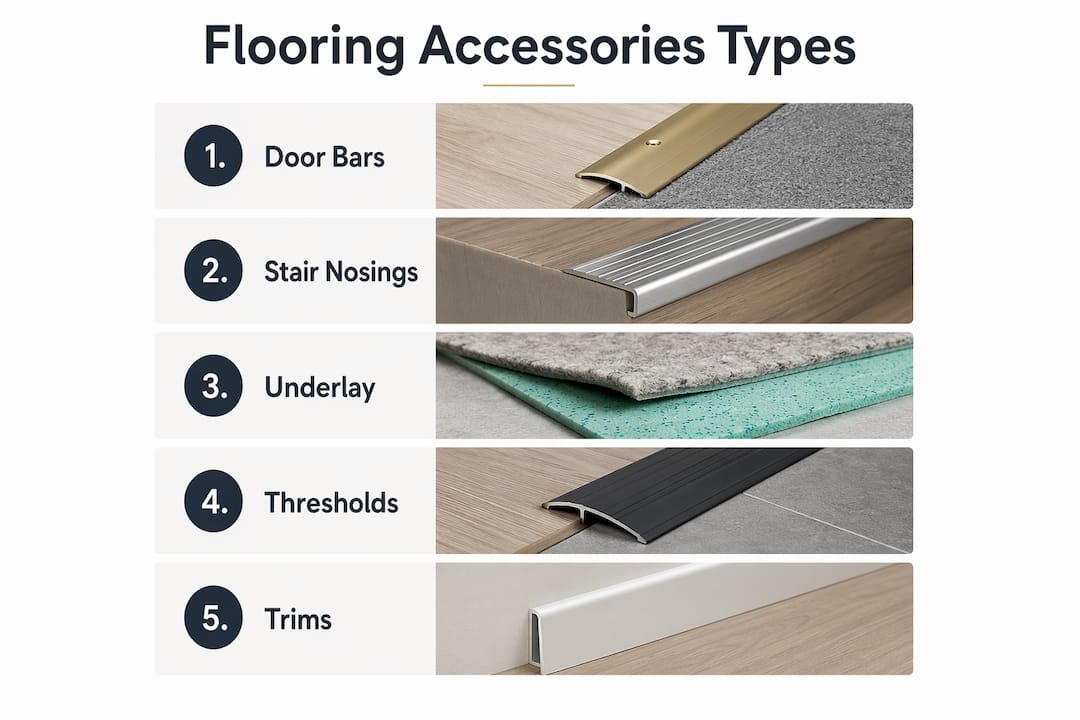
Underlay sits beneath the floor covering and contributes to comfort underfoot, thermal insulation, and sound reduction. The type of underlay must match the floor covering and the subfloor. Using the wrong underlay can void the product warranty, particularly for click-vinyl floors.
Pro Tip: Always select trims that allow the floor to move freely. Floating floors like laminate and LVP must never be fastened directly through the trim into the floor surface. The trim should anchor to the subfloor only.
How do you choose the right flooring accessories?
Selecting the correct accessories requires four decisions made in a specific order. Rushing any of them leads to mismatched finishes, unsafe transitions, or damaged floors.
-
Measure the height differential accurately. Include the floor covering and the underlay in your measurement. Wrong reducer sizes create unsafe ramps and can prevent doors from opening correctly. Measure twice before ordering.
-
Identify your installation method. Fixed floors such as tile or glue-down vinyl require trims that anchor differently from floating floors like laminate or LVP. Improper trim choice for a floating floor can lock the floor in place and cause irreversible buckling within one to two years.
-
Match your finish before you order. Buying trims from a different manufacturer than your floor covering is one of the most common mistakes homeowners make. Colour and finish mismatches are immediately visible and undermine the entire installation. Order trims at the same time as your floor covering, or source them from a specialist supplier who can match the finish precisely.
-
Check expansion gap compliance. For floating floors, transition profiles must cover the full perimeter expansion gap without being fastened to the floating surface. The standard gap is 10 to 15mm. Closing this gap with a trim that is screwed into the floor defeats the purpose entirely.
Pro Tip: If you are fitting click-vinyl, read the manufacturer’s warranty conditions before choosing underlay or trims. Using an incompatible underlay or the wrong profile type can void the warranty completely, leaving you with no recourse if the floor fails.
Homeowners who plan their trim selection alongside the floor covering, rather than as an afterthought, consistently achieve a more professional result.
Trim materials compared: why solid brass and powder coating win
The material your trim is made from determines how long it lasts, how it looks after years of foot traffic, and how much maintenance it demands. Not all trim materials perform equally.
Wooden trims split and swell when exposed to moisture. Plastic trims bend, crack, and fade under UV exposure and heavy use. Rubber trims compress and lose their shape over time. None of these materials hold up in high-traffic areas or anywhere near moisture. Professional installers moved away from them for good reason.
Solid metal trims resist wear, fading, and cracking in ways that wood-effect or plastic alternatives simply cannot match. Solid brass, in particular, offers structural rigidity that means it will not dent under furniture legs or bend under a door. Powder coating adds a hardwearing, colourfast layer that maintains its appearance under daily use without peeling or chipping.
| Material | Durability | Appearance over time | Maintenance | Lifespan |
|---|---|---|---|---|
| Solid brass with powder coat | Excellent, resists dents and bending | Retains colour and finish | Wipe clean | Long-term |
| Wooden trim | Poor, splits and swells with moisture | Fades and chips | Requires sealing and repainting | Short to medium |
| Plastic trim | Poor, bends and cracks under load | Yellows and fades | Low but looks worn quickly | Short |
| Rubber trim | Fair, compresses under load | Loses shape and colour | Low but degrades visibly | Short to medium |
Qualitycarpettrims produces solid brass door bars hand-finished in 10 luxury powder-coated finishes. The structural integrity of solid brass means these trims will not fail under the conditions that destroy cheaper alternatives. The investment is straightforward: pay more once, replace never.
Pro Tip: Choose a powder-coated brass trim that matches your door hardware or skirting board finish. This small detail ties the entire room together and gives the floor a genuinely finished appearance rather than a functional afterthought.
Flooring accessory installation: what you need to know
Most modern flooring profiles are designed with DIY installation in mind. You do not need specialist tools or trade experience to achieve a clean result. What you do need is the right information before you start.
The standard toolkit for fitting flooring trims covers a hacksaw or mitre shears for cutting profiles to length, a tape measure, a pencil, grab adhesive or a screw-in track system depending on the profile type, and a drill for subfloor fixings. Modern accessories are cuttable with basic hand tools, and most profiles come with fitting instructions that are straightforward to follow.
The most common installation mistakes are:
- Choosing the wrong profile height. Fitting a reducer designed for a 6mm differential onto a 12mm height difference creates a steep, unsafe ramp. Always measure floor plus underlay before selecting the profile.
- Fastening through a floating floor. Screwing a trim directly into a laminate or LVP surface locks the floor and prevents expansion. The fixing must go into the subfloor only.
- Cutting profiles inaccurately. An uneven cut at a doorway is visible from across the room. Use a mitre box for straight, clean cuts.
- Ignoring manufacturer instructions. Following the fitting guidance is not optional if you want to preserve your floor warranty. Deviating from it, even slightly, can invalidate your cover.
For a detailed walkthrough of the fitting process, the guide on installing flooring edge trims covers each step clearly. Sourcing your trims from a specialist supplier rather than a general DIY store also makes a practical difference. Specialists stock profiles in coordinated finishes, offer fitting advice, and can match trims to your specific floor covering.
Pro Tip: Before cutting any profile, fit it dry first. Place it in position without adhesive or fixings to check the fit, the height, and the visual match. Adjusting before you commit saves wasted material and time.
Transitions are not purely cosmetic. They carry structural and safety responsibilities, including compliance with building regulations on slope and height. Getting them right matters beyond appearance.
Key takeaways
Flooring accessories are structural and safety components that protect floor performance, manage movement, and deliver a finished appearance. Choosing the wrong type, material, or fit causes lasting damage.
| Point | Details |
|---|---|
| Accessories are structural, not decorative | Trims, thresholds, and door bars manage floor movement and prevent buckling or trip hazards. |
| Height measurement is critical | Always measure floor covering plus underlay before selecting a reducer or threshold profile. |
| Floating floors need specific trims | Trims must anchor to the subfloor only. Fixing through a floating floor causes irreversible damage. |
| Solid brass outlasts all alternatives | Powder-coated solid brass resists dents, fading, and bending where plastic, wood, and rubber fail. |
| Plan trims with your floor covering | Ordering trims at the same time as your floor prevents colour and finish mismatches. |
Why I think most homeowners underestimate flooring accessories
I have seen hundreds of flooring projects where the floor covering itself was excellent and the accessories were an afterthought. The result is always the same: a floor that looks unfinished, moves incorrectly, or starts to fail within a few years.
The mistake I see most often is treating the trim as a cosmetic detail to sort out after the floor is laid. By that point, the height differential is fixed, the expansion gap is set, and the colour palette is committed. If the trim does not match or fit correctly at that stage, the options are limited and expensive.
My strong recommendation is to plan your accessories before you order your floor covering. Decide on the finish of your door bars and thresholds at the same time you choose your floor. This is the approach that produces a genuinely professional result, and it is the approach that specialist suppliers like Qualitycarpettrims are set up to support.
On materials: I will not recommend plastic, rubber, or wooden trims to anyone who wants their floor to look good in five years. Solid brass with a powder-coated finish is the only material that holds up under real domestic conditions. The price difference is modest over the lifetime of the floor, and the visual difference is immediate. If you are going to invest in a quality floor covering, finish it with trims that match that quality.
— Matt
Complete your flooring project with Qualitycarpettrims
If you are ready to finish your floor to a professional standard, Qualitycarpettrims supplies solid brass door bars and thresholds hand-finished in 10 luxury powder-coated colours. Every trim is British-made, built to last, and designed to complement carpet, laminate, vinyl, and hard floor surfaces throughout your home.
The range includes door bars, thresholds, carpet to carpet trims, and matwell frames, all available with expert advice on selecting the right profile for your specific installation. Whether you need a carpet to laminate threshold for a doorway transition or a matwell trim for a hallway entrance, Qualitycarpettrims has the finish and profile to complete your project with confidence. Free samples are available, and the team is on hand to help you match your trim to your floor before you commit to an order.
FAQ
What are flooring accessories used for?
Flooring accessories cover expansion gaps, manage transitions between floor types, protect floor edges, and provide safety at level changes. They are structural components, not purely decorative finishes.
What expansion gap do I need for laminate or wood flooring?
Most wood and laminate products require an expansion gap of 10 to 15mm around the room perimeter. This gap must be covered by a trim or beading that does not restrict the floor’s movement.
Can I fit flooring trims myself?
Most modern profiles are DIY-friendly and require only basic tools such as a hacksaw, mitre shears, and grab adhesive or a screw-in track. Following the manufacturer’s fitting instructions is critical to preserving your floor warranty.
Why should I choose solid brass trims over cheaper alternatives?
Solid brass trims resist denting, bending, and fading under heavy use and moisture exposure. Plastic, wooden, and rubber trims split, warp, or lose their shape over time, making solid brass the more durable and cost-effective long-term choice.
How do I match my trim finish to my floor covering?
Order your trims at the same time as your floor covering, or use a specialist supplier who stocks coordinated finishes. Buying trims from a different manufacturer frequently results in visible colour and finish mismatches that are difficult to correct after installation.
Recommended
- What is flooring compatibility: a homeowner’s guide
- Explaining hardfloor transitions: a homeowner’s guide
- Defining flooring compatibility: the UK DIY and contractor guide
- Understanding flooring profiles: a UK homeowner’s guide