
Blog
Seamless carpet to hardfloor connections: expert guide

May
TL;DR:
- A proper carpet-to-hardfloor transition protects edges, prevents tripping, and offers a neat finish for varied floor types. Selecting the correct profile depends on height differences, traffic, and location, ensuring durability and safety. Well-installed quality trims enhance room aesthetics, prevent early damage, and provide long-term costs savings.
That awkward gap where your carpet meets the kitchen tiles. The fraying edge that catches under your foot every time you walk through the doorway. The strip that someone bodged in with a random metal bar, leaving a raised lip that trips guests and looks terrible against your new flooring. If any of this sounds familiar, you are not alone. Getting the carpet-to-hardfloor connection right is one of those jobs that many homeowners and contractors overlook until it becomes a very visible problem. This article cuts through the confusion, explains what works and why, and gives you the practical guidance to achieve a finish that is genuinely safe, neat, and built to last.
Table of Contents
- Understanding carpet to hardfloor connections
- Choosing the right transition: matching profile to situation
- How carpet to hardfloor transitions work: under the bonnet
- Expert tips for flawless and lasting transitions
- Why paying attention to flooring transitions pays off
- Find the perfect trim for every flooring project
- Frequently asked questions
Key Takeaways
| Point | Details |
|---|---|
| Purpose-built transitions | Always use a dedicated profile to bridge carpet and hard floors for a secure and attractive join. |
| Choose the right profile | Select threshold, Z-bar, or reducer ties by height, traffic, and environment for best results. |
| Installation details matter | Correct fit and secure grip prevent future problems and extend floor life. |
| Think beyond appearance | Transitions impact safety, maintenance, and property value as much as main floor surfaces. |
Understanding carpet to hardfloor connections
With the need for a refined finish established, it is important to get clear on what a carpet-to-hardfloor connection actually involves.
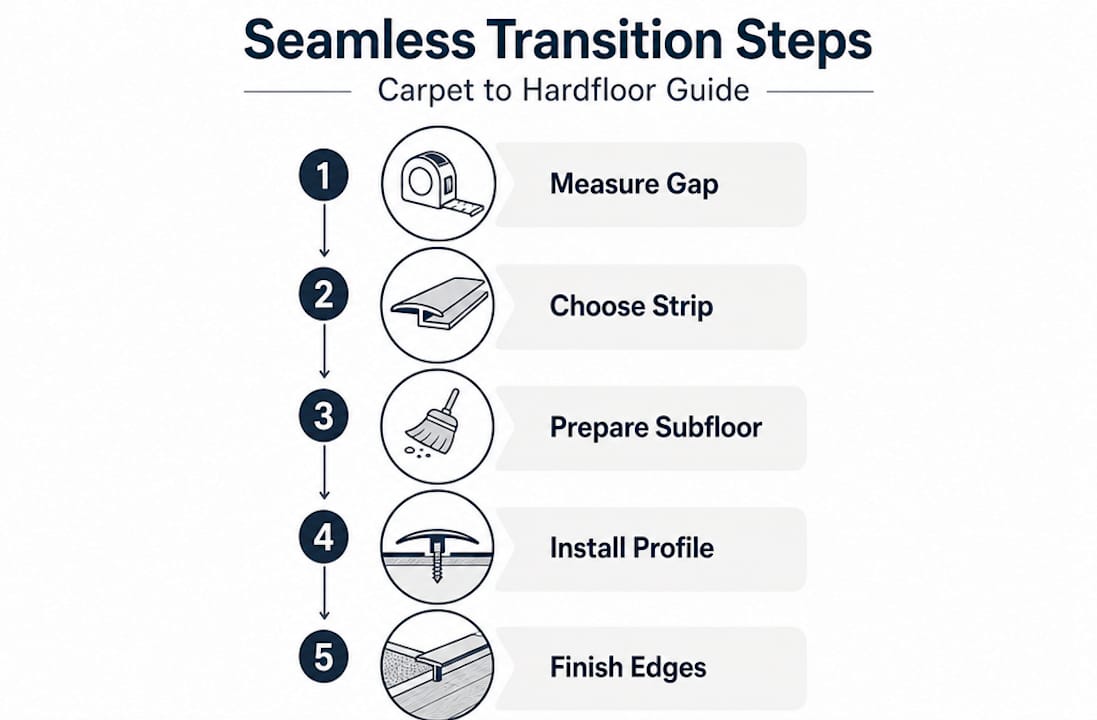
A carpet-to-hardfloor connection is the join between a carpeted area and an adjoining hard surface, whether that is wood flooring, ceramic tile, porcelain, laminate, or luxury vinyl. Left unfinished, this junction creates a visible raw edge, allows the carpet to fray, and presents a real safety hazard. The solution is a purpose-designed transition profile, sometimes called a threshold bar, door bar, Z-bar, or reducer strip, depending on its form and function. As transition strips explain, these profiles span the junction, protect the carpet edge, and create a safe, finished change in floor type, often using a track with grip pins beneath the carpet edge.
Understanding what is carpet transition is really the starting point for any flooring project that involves mixed floor types. The profile sits at the very visible join point, so its function is both practical and aesthetic.
Here are the main types of carpet-to-hardfloor connections you will encounter:
- Threshold bars (door bars): A flat or slightly curved profile that bridges level surfaces neatly at doorways
- Z-bars: A two-part section with a track that grips the carpet edge, leaving a clean exposed face
- Reducer strips: A ramped profile designed for situations where there is a height difference between carpet and hardfloor
- T-bars: Used where both surfaces are at an equal height and the join falls mid-room rather than at a door
A carpet-to-hardfloor connection is not just a cosmetic detail. It protects both floor surfaces from edge damage, prevents tripping hazards, and creates a professional boundary between two different materials.
Getting this definition clear upfront means you can have an informed conversation with suppliers, choose products confidently, and avoid buying the wrong profile for the job.
Choosing the right transition: matching profile to situation
Having defined the key elements, it is time to explore how to select the correct profile for your particular flooring situation.
The single biggest mistake people make is grabbing the first metal bar they find and fitting it regardless of height, room type, or traffic level. The type of profile you need depends on three key variables: whether the two floor surfaces are at the same height, the size of any height difference, and the environment where the transition sits. When the hard floor and carpet differ in height, a ramped or reducer-style profile is required rather than a flat door bar, specifically to avoid creating a trip edge and to deliver a smoother walking surface.
Here is a comparison of the most common profile types and when each is the right call:
| Profile type | Ideal use case | Height difference handled | Typical location |
|---|---|---|---|
| Threshold/door bar | Level or near-level join | Minimal (0 to 2 mm) | Doorways, open-plan divides |
| Reducer strip | Carpet higher than hardfloor | Up to 10 mm | Room thresholds, hallways |
| Z-bar | Carpet edge neatly gripped | Level surfaces | Doorways, room boundaries |
| T-bar | Mid-room equal-height join | None | Open-plan, wide thresholds |
How to identify your transition needs in four clear steps:
- Measure both surfaces. Use a straight edge and tape measure to find the height of the carpet pile plus underlay next to the hardfloor surface.
- Calculate the height difference. If the gap is more than 2 mm, you will need a ramped profile. If it is broadly level, a standard door bar or Z-bar will work well.
- Assess the location. Wet areas like bathrooms or utility rooms need a product that resists moisture. High-traffic halls need a robust, durable material.
- Consider the finished aesthetic. Think about the colour and finish of nearby fixtures, skirting boards, and door furniture to ensure a cohesive look.
For floors that are noticeably uneven, specialist transition strips for uneven floors are the right choice, offering the flexibility to cope with variation without creating a visible gap or a lifted edge.
Pro Tip: If you are planning to change your flooring within five years, choose a profile system that allows the top cover to be removed without disturbing the fixed track. This saves significant time and cost when you eventually update either floor surface. Also factor in underfloor heating; some systems raise the floor level slightly, and this can affect which profile you need.
If you are working on a bathroom or kitchen where carpet meets tile, a carpet to tile transition strip designed specifically for that junction gives you both the height management and moisture resilience the situation demands.
How carpet to hardfloor transitions work: under the bonnet
Once you have picked the right product, understanding how they are installed and how they function is crucial for a quality finish.
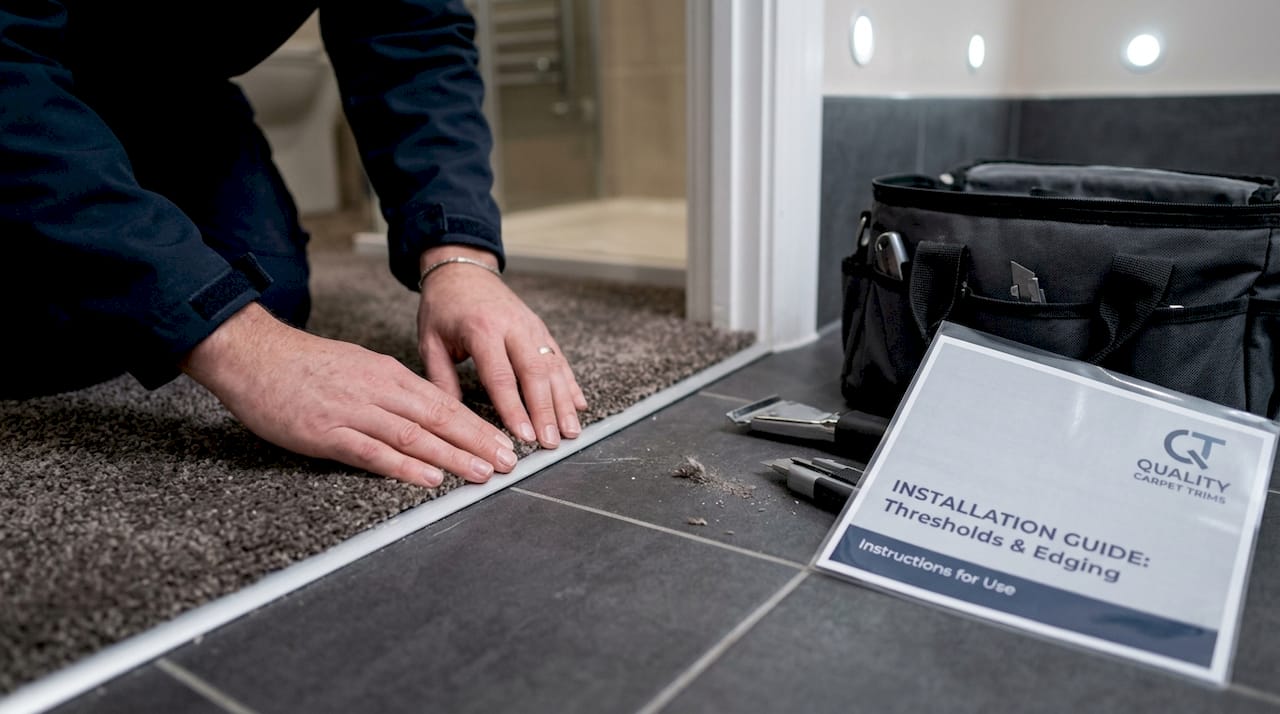
The mechanics of a carpet-to-hardfloor profile are actually quite clever. Most systems involve a base track that is fixed to the subfloor, often with screws or adhesive depending on the subfloor type. The carpet edge is then tucked into or over this track so that grip pins or spikes beneath the profile clamp the carpet firmly in place. This mechanical grip holds the edge without the need for adhesives or staples, which could damage the carpet backing. The hard floor side simply butts up to the profile and is not locked into the track in the same way.
Here is a summary of how the key variables affect performance:
| Factor | Impact on performance | What to check |
|---|---|---|
| Subfloor type (concrete vs timber) | Affects fixing method | Use correct fixings for each base |
| Carpet pile height | Determines track depth needed | Match profile to pile thickness |
| Grip pin density | Affects holding strength | Higher traffic needs firmer grip |
| Profile width | Affects visual span and strength | Wider profiles for larger gaps |
For detailed technical guidance, the threshold bars explained resource covers the specific mechanics of different bar styles and how each grips or supports the floor edges it connects.
Common pitfalls to avoid during installation include:
- Poorly cut carpet edge: Ragged or uneven cuts mean the profile cannot grip evenly, leaving lumps and gaps that look untidy and will loosen over time
- Loose track fixing: If the base track moves even slightly, the whole profile will shift and eventually work loose, creating exactly the kind of raised edge you were trying to avoid
- Wrong profile depth: Fitting a profile that is too shallow for a thick carpet pile means the edge will bow up and not sit flat
- Skipping subfloor preparation: Any debris, adhesive residue, or unevenness under the track leads to rocking, noise, or a visibly poor join
- Fitting the wrong profile type: This is perhaps the most common error, and it comes back to not measuring correctly before buying
The result of poor installation is not just cosmetic. A loose or ill-fitting transition can catch on shoes, cause trips, damage the carpet backing over time, and require complete refitting far sooner than a well-installed profile would.
Expert tips for flawless and lasting transitions
Bringing together correct selection and fit, expert tips ensure professional and enduring result.
The foundation of a successful transition is preparation. Before you even open the profile packaging, the subfloor on both sides of the join must be clean, dry, and level. Any debris or adhesive left from previous flooring will prevent the track from sitting flat. Take the time to scrape, sand, and vacuum thoroughly.
As Floorscape recommends, selecting the right profile comes down to three considerations: whether floor levels match, the size of any height difference, and the environment including foot traffic and slip risk. Use these as your checklist before every purchase.
Practical tips for installation and long-term performance:
- Dry-fit first. Before fixing anything permanently, lay the profile in place and check the fit visually and with your foot. Walk over it. If it rocks or you can see a gap, adjust before committing
- Use the correct fixings. Screws into concrete need rawlplugs; timber subfloors can take direct screws. Using the wrong fixing leads to a loose track within weeks
- Cut the carpet cleanly. A sharp carpet knife and a metal straight edge are all you need, but the quality of this cut directly determines how neat the finished profile looks
- Test the grip before finishing. Once the carpet edge is tucked under or into the profile, press firmly along the whole length and check it holds. Any loose section will work free under foot traffic
- Match your finishes. A beautiful oak floor with a brushed brass door handle deserves a brushed brass profile, not a mismatched chrome strip
The difference between a professional finish and a DIY-looking result often comes down not to the flooring itself, but to the quality and fit of the transition between surfaces.
For doorways with a visible bar from both rooms, an explained door bars guide is invaluable for understanding how to achieve a profile that looks correct from both sides of the door.
Maintenance is worth considering too. High-quality solid metal profiles need very little upkeep. A wipe down during regular cleaning is sufficient. If the carpet edge does work loose over years of heavy traffic, it is usually a matter of pressing the edge back into the grip pins rather than replacing the bar entirely.
Why paying attention to flooring transitions pays off
Here is something we see time and again in our experience supplying trims to both homeowners and professional contractors across the UK. Transitions are almost always treated as an afterthought. The budget is spent on the main flooring, the fitters are booked, and only when the carpet and hardfloor are both down does someone say, “Right, we need something to join these up.” That rushed approach leads to poor choices, mismatched finishes, and fittings that fail far too quickly.
The role of threshold strips in a finished room is genuinely significant. A well-chosen, well-fitted trim does not just protect the floor edges; it signals that the whole room has been finished with care. Estate agents often mention it. Visitors notice it, even if they cannot articulate exactly why a room looks polished. Conversely, a bent, poorly fitted, or visually mismatched bar immediately draws the eye and signals corners cut elsewhere.
The hidden costs of a poor transition are real. Callbacks from clients asking why the carpet is fraying. Replacements needed within two or three years because the profile was the wrong type. Worse, a raised edge that causes a trip and creates a liability issue in a commercial setting. None of these outcomes are expensive to prevent. They are, however, expensive to fix after the fact.
Our view is simple: choose your trims at the planning stage, at the same time as you choose your flooring. Think about finish, profile type, and height difference before a single plank or tile goes down. Order the correct product for the specific junction. The cost difference between a high-quality solid metal profile and a cheap generic bar is negligible in the context of a flooring project. The difference in outcome over five or ten years is enormous.
Find the perfect trim for every flooring project
Getting the knowledge right is only half the battle. The other half is sourcing trims that are genuinely up to the job.

At Quality Carpet Trims, every bar we supply is a solid metal product, hand-finished in one of ten beautiful finishes, from classic chrome and antique brass to contemporary matt black and brushed gold. These are British-made, built to last, and designed to complement your home rather than simply fill a gap. Browse the full range of carpet to hardfloor trims to find the right profile for your exact situation, with detailed fitting guidance included. If you are unsure which type suits your project, the flooring trim types explained guide will walk you through every option with clarity and confidence.
Frequently asked questions
Do I need a transition strip between carpet and hardfloor?
Yes. A purpose-designed transition profile is strongly recommended wherever carpet meets hard flooring, as it protects both edges, prevents fraying, and removes tripping hazards while creating a neat, finished appearance.
Which transition strip should I choose if my carpet is higher than the hardfloor?
A ramped or reducer-style profile is the correct choice, since a height difference between carpet and hardfloor requires a graduated profile to prevent a raised trip edge and to create a smooth walking surface.
How does a carpet transition strip grip the carpet?
Most profiles use a mechanical system of upward-facing pins or spikes embedded in a base track, which grip the carpet edge firmly without adhesive, while the hard floor side simply butts up to the profile face.
Can I install a transition bar myself?
Many transition bars are straightforward to fit as a DIY project, particularly on level subfloors, but on uneven or problematic surfaces it is worth engaging a professional fitter to ensure a secure and safe result.
Recommended
- Carpet to Tile Transition: Achieving Seamless Floors
- Complete guide to hardfloor edge strips: seamless floors
- Achieve seamless floor transitions: step-by-step UK guide
- Hardfloor To Hardfloor Trims – We have the floor transition strip you need!
- What You Need to Know Before Picking Vinyl Flooring for Your Home
- Fliesen verlegen: Schritt-für-Schritt-Anleitung mit Profi-Tipps