
Blog
Defining interior finishing accessories: a 2026 guide

Jul
What are interior finishing accessories and why do they matter?
Interior finishing accessories are the elements that sit between raw construction and a fully realised living space. They cover joints, protect edges, conceal expansion gaps, and give every room its sense of completion. Without them, even the most carefully chosen furniture and paint palette can leave a space feeling unresolved.
The industry term for this category is “interior trim and millwork,” though “finishing accessories” has become the standard shorthand among homeowners and designers alike. Their role is genuinely dual: functional on one side, aesthetic on the other.
Functional roles:
- Covering the expansion gap between flooring and walls
- Protecting wall surfaces from furniture impact
- Concealing seams where different flooring types meet
- Providing safe, trip-free transitions between floor levels
- Sealing joints that would otherwise collect dirt and moisture
Aesthetic contributions:
- Adding colour, texture, and visual weight to a room
- Creating proportion and scale at floor, wall, and ceiling junctions
- Acting as the visual punctuation that ties a design narrative together
- Reinforcing a room’s architectural character, whether period or contemporary
A room without finishing accessories is like a sentence without full stops. The ideas are there, but nothing signals where one thought ends and another begins.
Common types of finishing trims and what each one does
Understanding the types of wall trim helps you make deliberate choices rather than defaulting to whatever the builder left behind. Each category has a specific job.
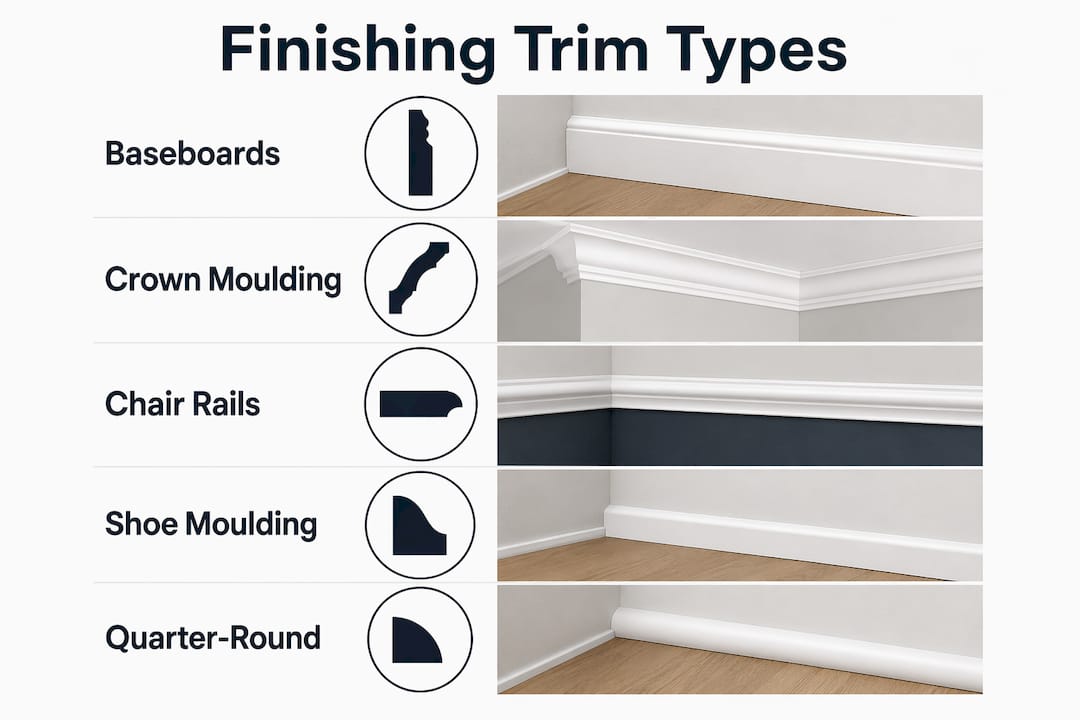
Baseboards sit at the base of every wall, hiding the gap where the wall meets the floor. They are the most universal trim in any home, and their height and profile set the visual tone for the entire room.

Crown moulding runs at the junction of wall and ceiling, typically at a 45-degree angle with hollow space behind it. It creates a graceful transition and is closely associated with period or upscale interiors.
Chair rails are horizontal strips installed roughly 90–120cm above the floor. Originally designed to stop chair backs from scuffing plaster, they now serve as a decorative dividing line between two wall treatments.
Casing frames doors and windows, covering the expansion gap between the frame and the surrounding wall. It ranges from flat and minimal to deeply profiled and ornate.
Flooring transition trims are where function becomes most visible. These strips bridge two different floor surfaces at a doorway or room boundary, covering the raw edges and preventing trip hazards.
- Shoe moulding hides the gap between a baseboard and the floor with a taller profile than quarter-round.
- Quarter-round provides a decorative joint transition at the base of walls, following every curve of an uneven floor.
- Door bars and threshold strips manage the transition between carpet, laminate, vinyl, and hard flooring at doorways.
Pro Tip: Shoe moulding and quarter-round look similar but serve different purposes. Shoe moulding is taller and sits flush against the baseboard to close a larger gap; quarter-round is a true quarter-circle profile used for decorative joint coverage. Choosing the wrong one leaves a visible gap or an awkward overlap.
The material of these trims determines how long they last. Plastic and aluminium trims dent, warp, and split under foot traffic and temperature changes. Solid brass trims hold their shape and finish for years, which is why durable metal trims are the professional choice for high-traffic areas.
How finishing accessories shape the look and feel of a room
Finishing accessories are essential storytellers in interior design. They do not merely decorate; they create warmth, depth, and a sense that a space has been considered from floor to ceiling.
The most effective accessories work through three qualities: colour, texture, and scale. A brass threshold strip catches light differently from the flooring on either side of it, adding a metallic accent that echoes door handles or light fittings. A deep baseboard profile gives a room visual weight at its base, making the walls feel anchored rather than floating.
Aesthetic benefits of well-chosen finishing accessories:
- They introduce texture contrast, setting hard metal against soft carpet or warm timber
- They create visual rhythm by repeating a finish or profile across multiple rooms
- They establish proportion, with taller baseboards making ceilings feel higher
- They unify disparate elements, connecting flooring to walls to furniture in one coherent palette
Visual rhythm and restraint distinguish professional interiors from cluttered ones. The goal is not to fill every junction with a different profile; it is to select a consistent language and apply it throughout. A single finish repeated across door bars, threshold strips, and edge trims reads as intentional. Mixing three different metals across the same floor plan reads as oversight.
Accessories are also not merely decorative but contribute to how lived-in and complete a room feels. A bare flooring edge, however well-laid the floor itself, signals that the job is unfinished.
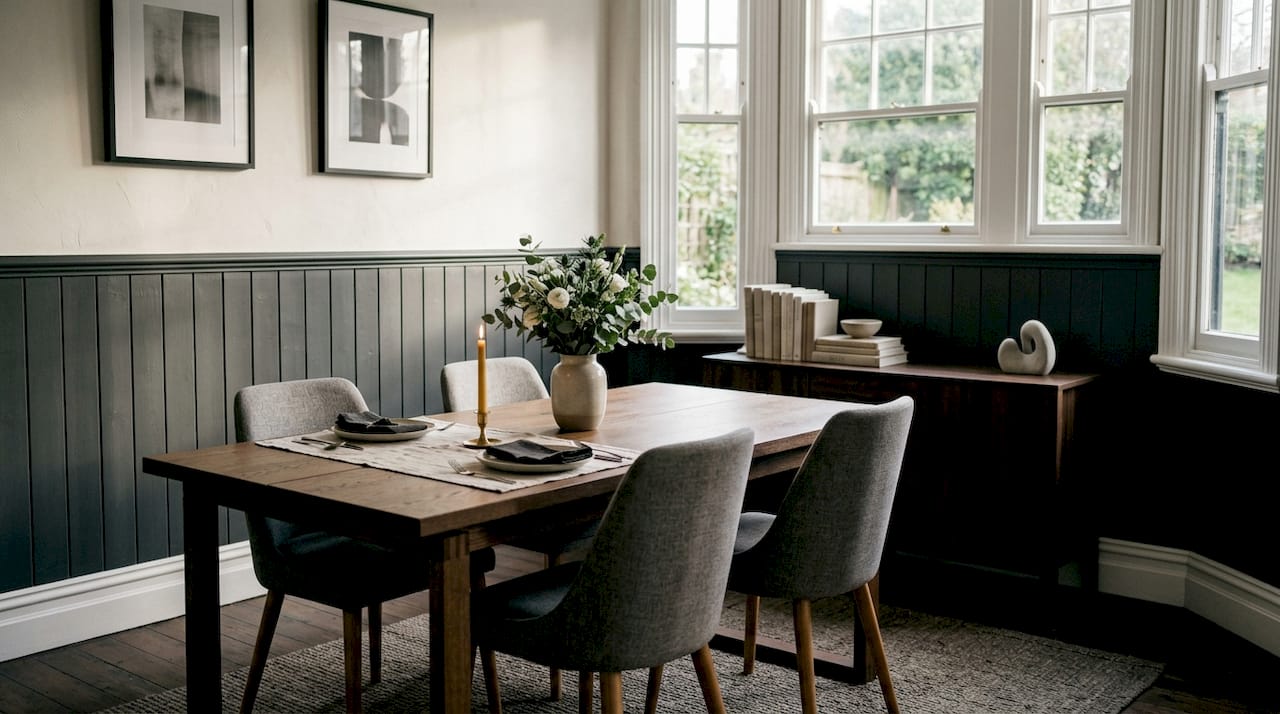
Styling tips and mistakes to avoid when choosing finishing accessories
The most common error in selecting finishing accessories is overcrowding: too many profiles, too many finishes, and no clear hierarchy. The result is a room that feels busy rather than considered.
Mistakes that undermine design quality:
- Mixing metal finishes without a unifying logic (chrome threshold, brass handles, nickel switches)
- Ignoring scale, fitting a narrow baseboard in a room with high ceilings
- Choosing accessories that clash with the room’s colour palette or flooring tone
- Selecting trims based on price alone, then replacing them within a few years
Styling principles that work:
- Choose one metal finish and carry it across all trim, hardware, and fittings in the same space
- Match baseboard height to ceiling height: taller rooms warrant deeper profiles
- Let the flooring material guide the transition trim profile, not the other way around
- Treat colour matching in trims as seriously as you treat wall paint selection
Intentional selection is the principle that separates a polished interior from a generic one. Every accessory should offer either functional value, aesthetic value, or both. If it does neither, it has no place in the scheme.
Good accessorising also means connecting your choices to the overall design language of the home. A contemporary flat with clean lines calls for minimal profiles and a brushed finish. A Victorian terrace with cornicing and panel doors calls for something with more depth and warmth.
How to install finishing accessories correctly
Installation quality determines whether a trim looks professional or amateurish, regardless of how much the trim itself cost. The method varies by trim type, but the principles are consistent.
Flooring transition trims and door bars are typically fixed with a central track screwed into the subfloor, with the trim body clipping or pressing over the top. This allows for slight adjustment and means the trim can be removed without damage if the flooring is ever replaced. Measure the doorway width accurately before ordering; most standard door bars are available in set lengths that can be cut to fit with a fine-toothed metal saw.
Baseboards and wall trims are usually nailed or glued to the wall, with the joint between trim and floor filled with a flexible decorator’s caulk rather than a rigid filler. Rigid filler cracks as the building moves; caulk accommodates it.
Key installation best practices:
- Always measure twice and cut once; a miscut on a solid brass trim wastes material
- Use the correct fixings for your wall type: timber studs, masonry, and metal frames each need different anchors
- Leave a small expansion gap at the ends of long trim runs to allow for seasonal movement
- Wipe away any adhesive or caulk residue immediately; it is far harder to remove once cured
- For carpet-to-hard-floor transitions, fit the trim before laying the carpet so the edge tucks cleanly underneath
Pro Tip: When fitting a door threshold bar over two different floor heights, choose a profile designed for height variation rather than forcing a flat bar to bridge the gap. The right profile sits flush on both surfaces and removes the trip hazard entirely.
For DIY fitters, ordering a free sample before committing to a full length is the single most useful step. Colour and finish always look different in person than on screen, and a sample confirms the match before any cutting begins.
Why solid brass trims are the right choice for UK interiors
Material choice is where most interior finishing projects either succeed or fail long-term. Plastic trims split at the edges within a few years of foot traffic. Aluminium trims dent and warp, particularly in doorways where they take repeated impact. Neither holds a finish reliably; both look tired quickly.
Solid powder-coated brass offers longevity that cheaper materials cannot match. The brass substrate resists denting and bending under load; the powder-coat finish bonds to the metal rather than sitting on top of it, so it does not peel or chip the way painted finishes do on softer materials.
Why solid brass outperforms the alternatives:
- Will not split, bend, or dent under normal foot traffic or furniture movement
- Powder-coat finish is far more durable than paint on plastic or lacquer on aluminium
- Available in ten hand-finished luxury colours, from satin gold to anthracite, to match any interior palette
- British-made and hand-finished, with consistent quality across every piece
- Compatible with carpet, laminate, vinyl, and hard flooring transitions
Qualitycarpettrims supplies hand-finished solid brass trims across ten finishes, each designed to complement the flooring and hardware choices already in a home. The range covers door bars, threshold strips, edge trims, and carpet-to-hard-floor transitions, all manufactured in the UK.
Maintenance is straightforward. Wipe with a damp cloth to remove dust and debris. Avoid abrasive cleaners, which can dull the powder-coat surface over time. For high-traffic commercial settings, a quarterly check of the fixing screws keeps the trim sitting flat and secure.
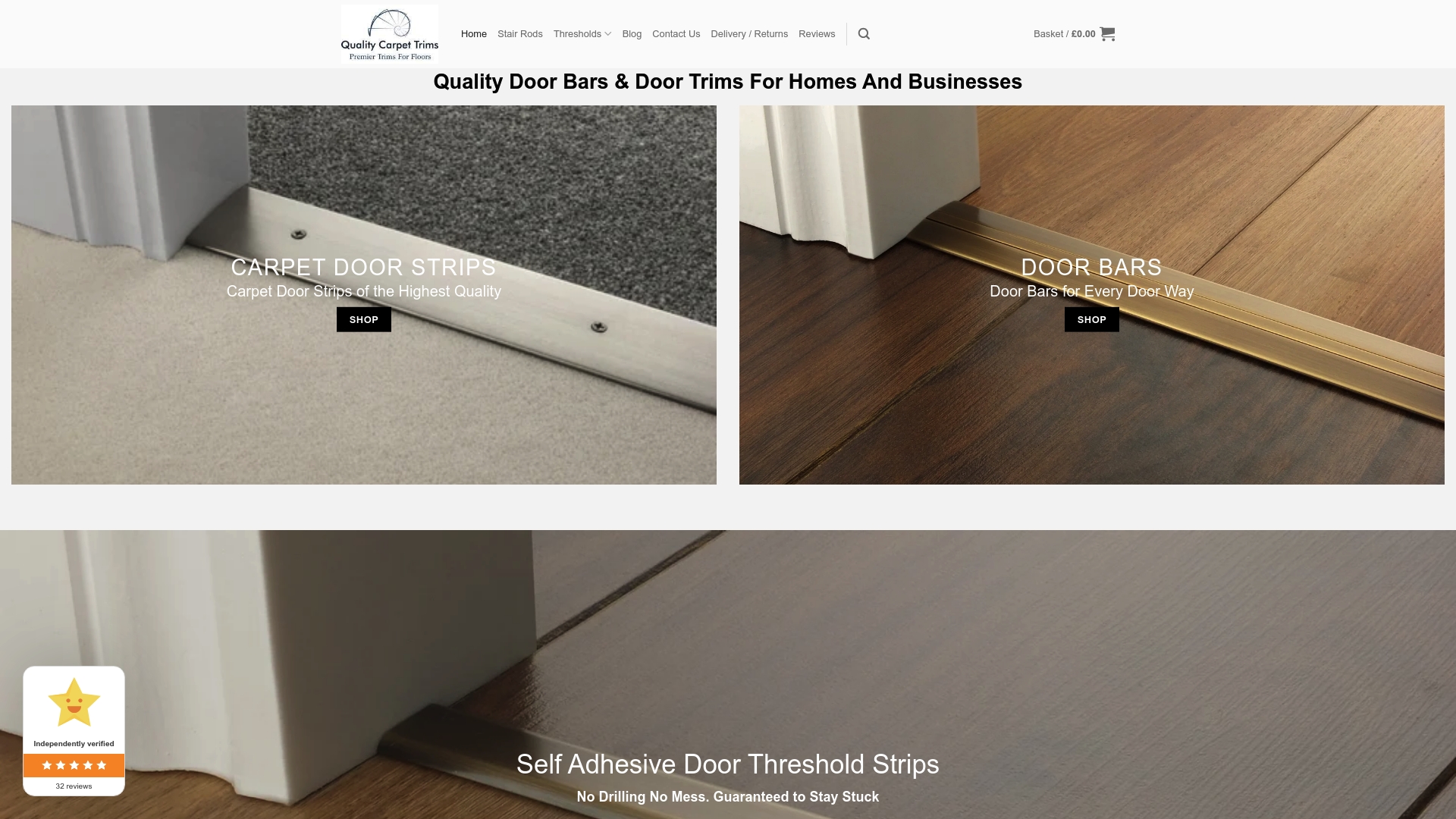
Qualitycarpettrims offers free samples so you can confirm the finish against your flooring before ordering. Browse the full range of premium flooring trims and find the profile and finish that completes your interior properly.
Key takeaways
Interior finishing accessories serve both a structural and a visual purpose: without the right trim in the right material, even a well-designed room feels incomplete.
| Point | Details |
|---|---|
| Dual role of finishing accessories | Every trim covers a structural gap and contributes to the room’s visual language simultaneously. |
| Material durability matters | Solid brass resists denting, splitting, and warping; plastic and aluminium fail under regular foot traffic. |
| Ten finish options | Qualitycarpettrims hand-finishes solid brass trims in ten luxury colours to match any interior palette. |
| Intentional selection over quantity | Each accessory must earn its place by offering functional or aesthetic value, not simply filling a junction. |
| Installation method affects longevity | Using the correct profile, fixings, and flexible caulk prevents cracking and keeps trims sitting flat for years. |
Recommended
- Defining flooring accessories: a homeowner’s complete guide
- Understanding flooring accessories: a homeowner’s guide
- Upgrade interiors with innovative flooring trims for 2026
- Hand-finished trims: the UK homeowner’s guide