
Uncategorized
Defining flooring accessories: a homeowner’s complete guide

Jun
TL;DR:
- Flooring accessories finish and protect floor surfaces while supporting proper movement and structural integrity. Choosing high-quality materials like solid brass ensures longevity and prevents common issues such as buckling, splitting, or dents. Proper installation according to standards maintains warranties, safety, and a professional appearance.
Flooring accessories are the functional and decorative components that finish, protect, and connect floor surfaces throughout your home. The industry term for this category is “flooring trims and transitions,” though homeowners commonly search for them as flooring accessories. They include stair nosing, T-mouldings, reducers, end caps, thresholds, scotia, and quarter round profiles. Choosing the right materials matters enormously. Solid brass trims with luxury powder-coated finishes outlast cheaper alternatives and hold their appearance for years. Defining flooring accessories correctly from the start of your project saves you from costly mistakes and poor-looking results.
What are flooring accessories and why do they matter?
Flooring accessories are defined as the trim profiles, transition strips, and edge components that complete a floor installation. They sit at junctions between rooms, at doorways, along stair edges, and at the perimeter of any floor. Without them, your floor looks unfinished and, more critically, performs poorly over time.
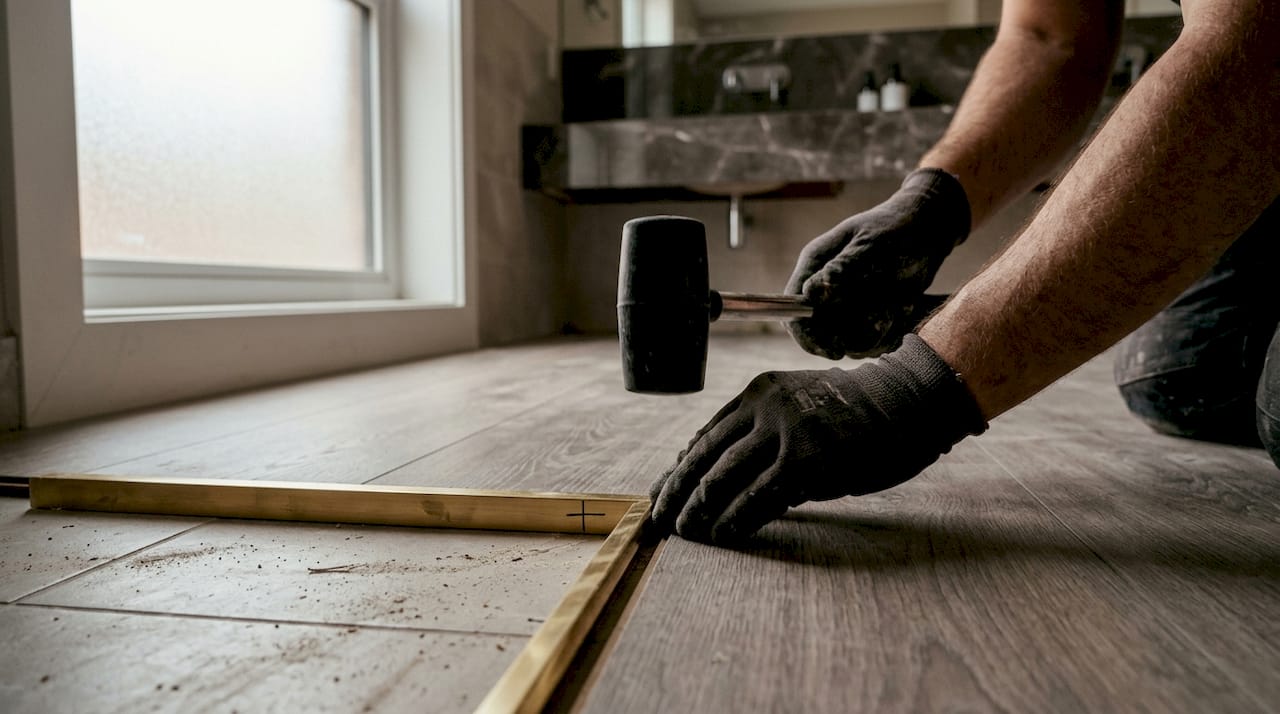
Flooring accessories serve a functional engineering role beyond decoration, and correct trim installation maintains manufacturer warranties and prevents floor buckling. That means skipping them is not just an aesthetic choice. It is a structural one that can void the guarantee on your new floor.
The importance of flooring accessories becomes clear when you consider that every floating floor needs room to expand and contract with temperature and humidity changes. Trims cover the gaps that allow this movement while keeping the floor looking neat. They also protect exposed edges from chipping, lifting, and general wear.
What are the main types of flooring accessories and their specific functions?
Each flooring accessory type solves a specific problem. Understanding the differences helps you buy exactly what your project needs and nothing more.
- T-moulding: Connects two floors of equal height in a doorway or open-plan junction. The T-shape sits over a gap between the two surfaces.
- Reducer: Transitions between two floors at different heights. Used where laminate meets a lower vinyl or tile surface.
- End cap: Finishes an exposed floor edge, such as where flooring meets a sliding door track or a step down.
- Stair nosing: Covers the front edge of each stair tread. Protects the most vulnerable part of any staircase and improves safety.
- Scotia and quarter round: Covers the expansion gap at the base of a wall or skirting board. Flexible enough to follow uneven walls.
- Threshold: Sits in a doorway to cover the join between two floor types, often at an exterior door or between rooms with different floor heights.
The table below summarises each type, its primary use, and why material quality matters.
| Accessory type | Primary use | Why material quality matters |
|---|---|---|
| T-moulding | Equal-height room junctions | Must flex slightly without cracking or bending |
| Reducer | Height-differential transitions | Needs to hold its profile under foot traffic |
| End cap | Exposed floor edges | Resists chipping and lifting at vulnerable edges |
| Stair nosing | Stair tread protection | Takes direct impact; must not dent or split |
| Scotia / quarter round | Perimeter expansion gap cover | Follows wall contours without snapping |
| Threshold | Doorway transitions | Faces constant foot traffic and door movement |
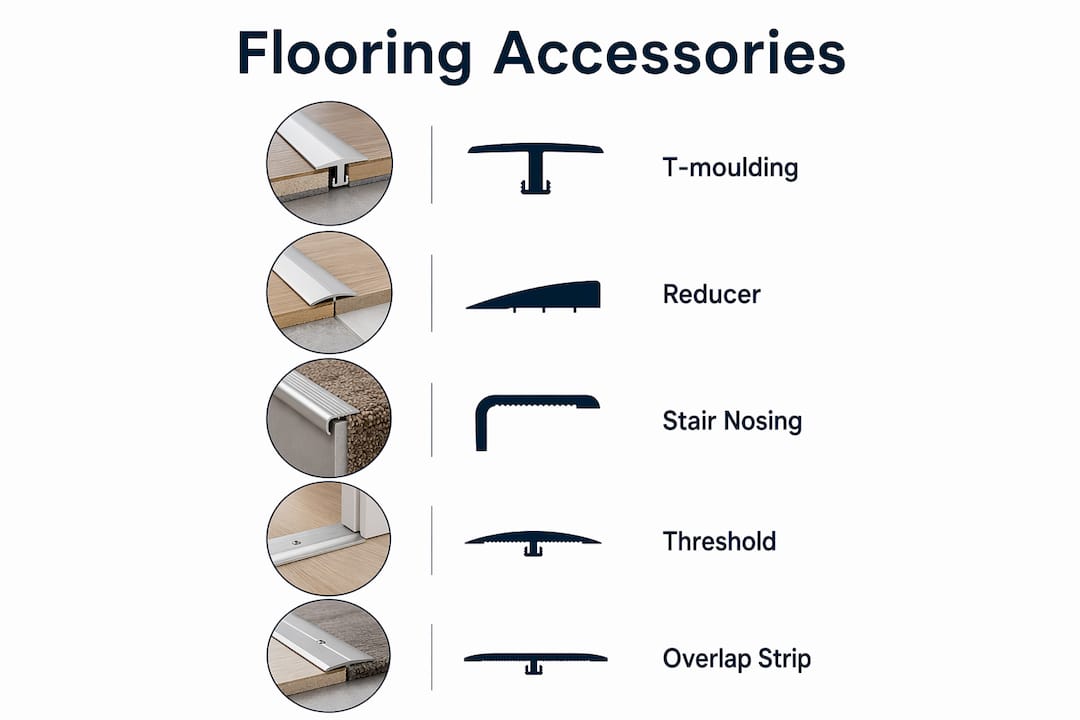
Solid brass and powder-coated trims resist splitting, bending, and denting in ways that wooden, plastic, and aluminium trims simply cannot match. Wooden trims swell and crack with moisture. Plastic trims flex and discolour. Aluminium trims dent under impact and scratch easily. Solid brass holds its shape and finish for the lifetime of your floor.
How do flooring accessories support flooring movement and structural integrity?
Floating floors move. That is not a flaw. It is how they are designed to work. Laminate, engineered wood, and click vinyl all expand and contract with changes in temperature and humidity. If they cannot move freely, they buckle.
Floating floor installations require an expansion gap of 1/4 to 3/8 inch around the entire perimeter to allow natural floor movement. That gap must remain unobstructed. Trims like scotia and T-mouldings cover it visually without blocking it physically.
Not leaving expansion gaps causes floors to buckle and voids manufacturer warranties. This is one of the most common and expensive DIY mistakes. The fix is straightforward: always nail your base shoe or scotia into the skirting board, never into the floor itself. Nailing into the floor pins it down and prevents the movement it needs.
- Measure and mark your expansion gap before laying the first board.
- Lay the floor, maintaining the gap consistently at every wall and fixed surface.
- Fit T-mouldings and end caps over movement gaps at doorways and step-downs.
- Fit scotia or quarter round at the perimeter, nailed into the skirting board only.
- Check that no trim is compressing the gap before finishing.
Pro Tip: Overlap stair nosing is required for floating floors because it sits over the floor surface and moves with it. Flush nosing is only correct for glued-down installations. Fitting flush nosing to a floating floor pins the tread edge and causes lifting within months.
What installation standards and measurements govern flooring accessories in the UK?
UK building standards set clear requirements for stair nosing dimensions and transition heights. These are not suggestions. Non-compliance affects both safety and warranty validity.
Stair nosing must meet safety projections of 3/4 inch to 1 1/4 inch where tread depth is less than 11 inches, as per current building standards. This projection provides the visual and physical cue that tells your foot where the step ends. Too little projection and the risk of misjudging a step increases significantly.
Transition trim selection depends on the height difference between two floor surfaces. The rules are clear:
| Height differential | Correct transition trim |
|---|---|
| Up to 1/4 inch | Flush reducer |
| 1/4 inch to 1/2 inch | Bevelled reducer |
| Over 1/2 inch | Ramped threshold |
Flooring transitions vary by height differential, and using the wrong profile creates a trip hazard. A ramped threshold where a flush reducer would suffice looks clumsy. A flush reducer where a ramped threshold is needed creates a dangerous lip.
“Correct trim installation maintains manufacturer warranties and prevents floor buckling.” — National Flooring Authority
Compliance with these standards also matters for home insurance and resale value. A surveyor who spots non-compliant stair nosing or unsafe transitions will flag it. Getting it right the first time costs far less than remedial work.
How to choose the right flooring accessories for your project?
Choosing flooring accessories starts with knowing your installation method. Floating floors and glued-down floors need different trim profiles, and matching flooring profiles to installation type is critical to prevent project failure.
The selection criteria below cut through the confusion:
- Installation method: Floating floors need overlap nosing and free-moving trims. Glued-down floors accept flush profiles.
- Height differential: Measure the height difference between adjoining floors before ordering any transition strip.
- Flooring type: Carpet, laminate, vinyl, and hard floors each have specific compatible trim profiles.
- Finish coordination: Match your trim finish to your door furniture, skirting, or floor colour for a professional result.
- Material durability: Choose solid brass with a powder-coated finish. Wooden trims warp, plastic trims discolour, and aluminium trims scratch. None of them hold up over years of daily use.
Coordinated finishing solutions with matching trims simplify buying and improve project success rates. Buying your trims from a single source that offers multiple coordinated finishes removes the guesswork from colour-matching.
Pro Tip: Order a free sample of your chosen trim finish before committing to a full order. Colours look different under showroom lighting versus the natural light in your home. A sample takes the risk out of the decision.
Qualitycarpettrims offers 10 luxury hand-finished colours across its solid brass trim range, making it straightforward to find a finish that works with your interior.
What are the maintenance and longevity considerations for flooring accessories?
Premium flooring accessories need very little maintenance. That is one of the strongest arguments for investing in solid brass trims with powder-coated finishes from the outset.
Solid brass and powder-coated trims prevent splitting, bending, and denting unlike cheaper materials. A wooden trim that swells in a damp hallway needs replacing within a few years. A plastic trim that yellows under UV light looks tired long before the floor beneath it wears out. Solid brass simply does not do either of those things.
Practical care for solid brass trims is minimal:
- Wipe with a damp cloth to remove dirt and grit that could scratch the finish.
- Avoid abrasive cleaners, which can dull the powder-coated surface over time.
- Check fixings annually, particularly on stair nosing, where movement from foot traffic can loosen screws.
- Inspect transition strips at doorways after any significant temperature change, as the floor beneath may have shifted slightly.
Replacement timing for quality trims is rarely a concern within the first decade. The more common reason to replace a trim is a change in décor rather than wear. Solid brass trims with a powder-coated finish hold their colour and profile far longer than any wooden or plastic alternative, making them the only sensible long-term choice for a home you care about.
Key takeaways
Flooring accessories are functional engineering components, not optional extras. Choosing the wrong type, material, or profile leads to buckling floors, voided warranties, and safety hazards.
| Point | Details |
|---|---|
| Define the right type first | Match each accessory to its specific function: T-moulding, reducer, nosing, threshold, or scotia. |
| Respect expansion gaps | Leave 1/4 to 3/8 inch around the perimeter and never nail trims into the floor itself. |
| Follow height differential rules | Use flush, bevelled, or ramped profiles based on the exact height difference between floors. |
| Choose solid brass over cheaper materials | Wooden, plastic, and aluminium trims split, warp, and dent. Solid brass holds its shape and finish for years. |
| Coordinate finishes across your project | Matching trim finishes to your interior reduces visual clutter and gives a professional result. |
Why I stopped underestimating flooring accessories
Most people treat flooring accessories as an afterthought. They spend weeks choosing the right floor and then grab the cheapest trim they can find on the way to the checkout. I have seen this go wrong more times than I can count.
The most common outcome is a buckled floor within the first year. The homeowner blames the floor. The manufacturer points to the trim installation. The warranty claim fails. The floor gets relaid at full cost. Every single time, the root cause is the same: a trim that was nailed into the floor instead of the skirting, or a gap that was never left in the first place.
The second most common outcome is a trim that looks terrible within two years. Wooden trims swell at doorways. Plastic trims go brittle and crack. Neither of them ages well, and replacing them means disturbing the floor edges you worked hard to finish neatly.
Solid brass trims with a quality powder-coated finish solve both problems. They do not move with moisture. They do not crack under impact. They look as good in ten years as they do on day one. The upfront cost is higher, but the total cost over the life of your floor is lower. That is the calculation most DIYers miss.
Get the accessories right and the floor takes care of itself. Get them wrong and no amount of quality in the boards beneath will save you.
— Matt
Explore solid brass flooring trims from Qualitycarpettrims
Qualitycarpettrims supplies solid brass flooring trims hand-finished in 10 luxury colours, made in the UK and built to last the lifetime of your floor. Every trim in the range is designed to meet UK installation standards, accommodate floor movement correctly, and add a genuinely premium finish to your home.
Whether you need a door threshold bar for a tricky doorway junction, a carpet-to-hard-floor transition, or a stair nosing that will take years of daily use without denting or splitting, the Qualitycarpettrims range has a profile and finish to match. Browse the full solid brass trim shop or request a free sample to see the quality for yourself before you order.
FAQ
What are flooring accessories?
Flooring accessories are the trim profiles and transition strips that finish, protect, and connect floor surfaces. Common types include T-mouldings, reducers, stair nosing, thresholds, and scotia.
Why do floating floors need expansion gaps?
Floating floors expand and contract with temperature and humidity changes. A gap of 1/4 to 3/8 inch around the perimeter allows this movement and prevents buckling.
What is the difference between overlap and flush stair nosing?
Overlap nosing sits over the floor surface and is required for floating installations to allow movement. Flush nosing is fixed directly to glued-down floors for a flat finish.
How do I choose the right transition trim for different floor heights?
Use a flush reducer for height differences up to 1/4 inch, a bevelled reducer for 1/4 to 1/2 inch, and a ramped threshold for differences over 1/2 inch.
Why choose solid brass trims over other materials?
Solid brass trims with powder-coated finishes do not split, bend, or dent under daily use. Wooden, plastic, and aluminium trims all degrade faster and require earlier replacement.
Recommended
- Understanding flooring accessories: a homeowner’s guide
- What is flooring compatibility: a homeowner’s guide
- Explaining hardfloor transitions: a homeowner’s guide
- Industry terminology in flooring: a professional’s guide