
Blog
What Is Carpet Edge Trim? 30% Safer, 3x More Durable

Feb
Not all carpet edge trims are created equal. Many homeowners assume any trim will do the job, only to face premature wear, safety issues, and aesthetic disappointment. The truth is that material choice dramatically impacts durability, safety, and long term value. This guide reveals how carpet edge trims protect your investment, the differences between solid metal and inferior alternatives, and how to select and install the right profile for your UK home renovation.
Table of Contents
- Introduction To Carpet Edge Trims
- Why Carpet Edge Trims Matter: Safety And Protection
- Material Choices: Solid Metal Versus Alternatives
- Aesthetic Options And Finishes For Carpet Edge Trims
- Common Misconceptions About Carpet Edge Trims
- How To Select The Right Carpet Edge Trim Profile
- DIY Installation: Practical Guidance
- Explore Premium Carpet Edge Trims For Your Renovation
- Frequently Asked Questions About Carpet Edge Trims
Key Takeaways
| Point | Details |
|---|---|
| Safety and Protection | Carpet edge trims reduce trip hazards by up to 30% and extend carpet lifespan by 20 to 30%. |
| Material Superiority | Solid metal trims last three times longer than aluminium or PVC and meet UK manufacturing standards. |
| Profile Selection | Matching trim profile to carpet thickness ensures functional safety and clean aesthetic transitions. |
| Aesthetic Variety | Over 10 hand finished metal finishes allow tailored styling for diverse UK home interiors. |
| DIY Friendly | With proper tools and preparation, installation takes approximately 2 hours for most homeowners. |
Introduction to Carpet Edge Trims
Carpet edge trims are precision engineered metal profiles designed to secure and protect the exposed edges of carpets where they meet other flooring surfaces or doorways. Unlike door thresholds that primarily bridge height differences, carpet edge trims specifically safeguard carpet edges from fraying and damage. Their primary functions include protecting carpet edges against wear, improving safety by reducing trip hazards at transitions, and providing neat aesthetic finishes that complement interior design.
Typical scenarios where carpet edge trims shine include carpet to hardfloor transitions in living rooms, carpet to carpet joins in hallways, and doorway thresholds between carpeted and tiled areas. They serve as the finishing touch that transforms rough carpet edges into professional looking installations. Many homeowners confuse these products with general door thresholds, but understanding flooring edge trims explained clarifies that carpet trims focus on edge protection rather than simple height bridging.
The right trim does three critical jobs simultaneously. First, it anchors the carpet securely to prevent lifting and movement. Second, it creates a smooth transition that eliminates tripping hazards common with loose or unfinished carpet edges. Third, it delivers a polished appearance that elevates the overall look of your flooring project. Without proper trims, carpet edges deteriorate quickly in high traffic zones, leading to costly repairs and potential safety incidents.
Why Carpet Edge Trims Matter: Safety and Protection
Safety represents the most compelling reason to invest in quality carpet edge trims. Research shows that proper trims can reduce trip hazards by up to 30% in residential settings, a significant improvement for homes with children, elderly residents, or pets. Loose carpet edges create uneven surfaces that catch feet and cause falls, but securely anchored trims eliminate this risk by holding edges flat and stable.
Beyond immediate safety, trims prevent carpet edge fraying and damage that accelerates in high traffic areas. The constant foot traffic across unprotected carpet edges causes fibers to separate and backing to deteriorate. Quality trims distribute stress evenly along the carpet edge, preserving structural integrity. Industry data indicates that carpets with properly installed edge protection last 20 to 30% longer than those without, translating to substantial savings over time.
The durability benefits extend to both the carpet and the trim itself. Solid metal trims maintain their protective function for decades without bending, cracking, or losing grip strength. This long term reliability ensures continuous safety benefits of flooring trim throughout the carpet’s lifespan. Cheaper alternatives may initially seem adequate but often fail within months, requiring replacement and potentially causing the very hazards they’re meant to prevent.
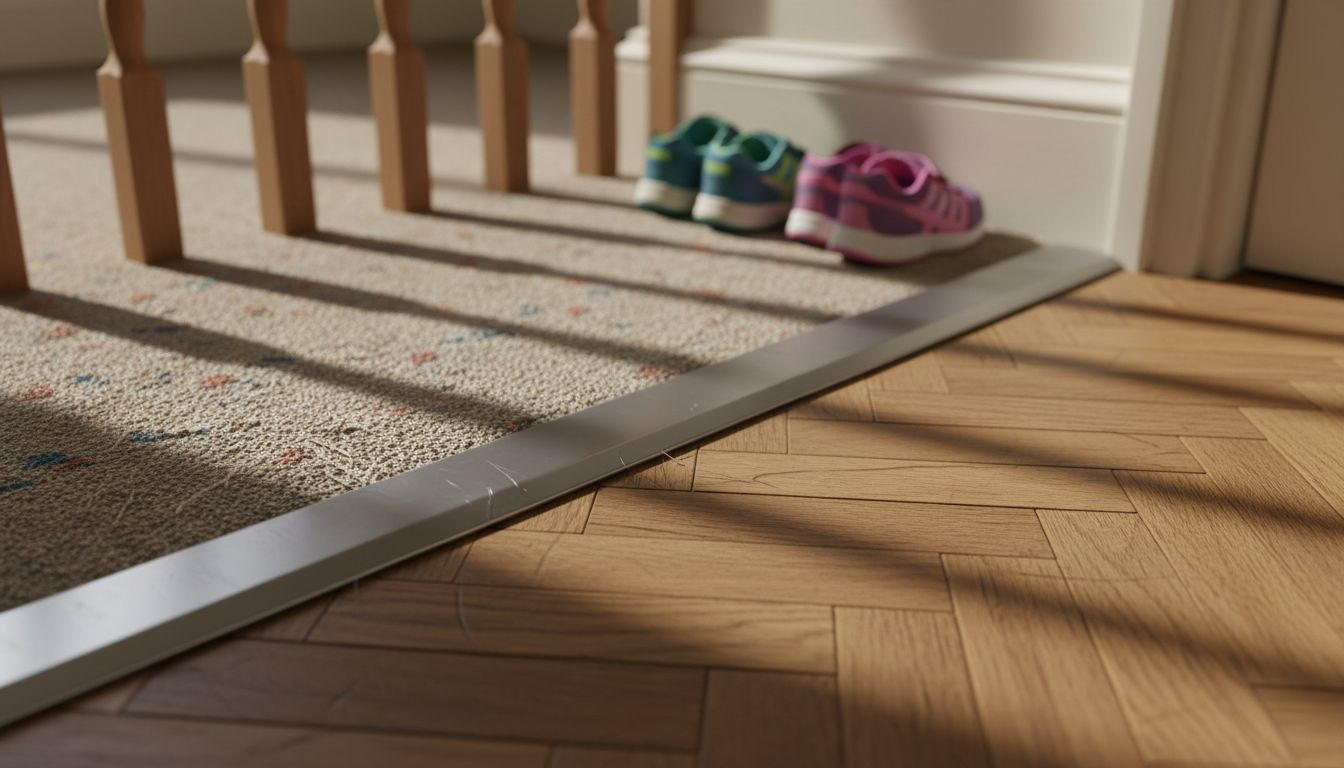
High traffic zones like hallways, staircases, and doorways experience the most severe wear patterns. In these areas, the quality difference between premium and budget trims becomes obvious within the first year. Solid metal construction resists deformation from repeated impacts, maintaining the smooth transition that keeps your home safe.
Material Choices: Solid Metal Versus Alternatives
Material selection fundamentally determines trim performance and longevity. Solid metal trims outlast aluminium or PVC alternatives by a factor of three, making them the superior choice for UK homeowners seeking value. This durability gap stems from basic material properties: solid metal resists bending, maintains structural integrity under stress, and withstands repeated impacts without deformation.
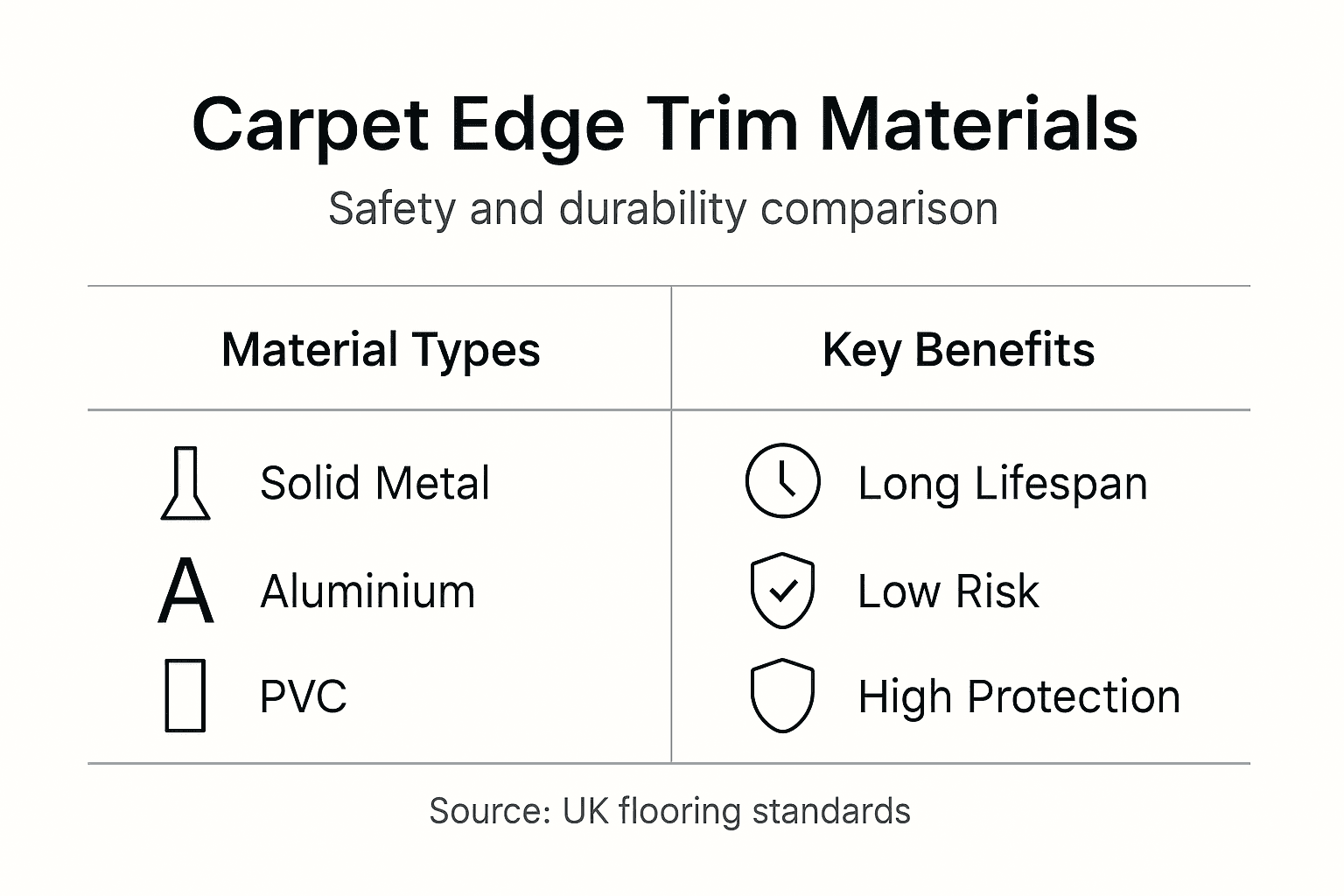
Aluminium trims, while lightweight and initially appealing, bend easily under pressure and wear faster in high traffic areas. The softer metal loses its shape over time, creating gaps that allow carpet edges to lift and fray. PVC trims offer cost effectiveness but lack durability, often cracking or breaking within months of installation. Neither alternative provides the long term reliability that solid metal guarantees.
Pro Tip: For hallways and main doorways where foot traffic is heaviest, always choose solid metal trims. The initial investment pays for itself through extended lifespan and maintained safety performance.
UK manufacturing standards ensure that reputable suppliers deliver trims with precise dimensional tolerances and consistent finish quality, critical for tight flooring transitions and long term durability. British made solid metal carpet edge trims meet these rigorous specifications, providing assurance that your installation will perform as expected.
| Material | Average Lifespan | Durability Rating | Cost Factor | Best Use Case |
|---|---|---|---|---|
| Solid Metal | 15+ years | Excellent | Higher initial | High traffic areas |
| Aluminium | 5 years | Moderate | Medium | Low traffic zones |
| PVC | 3 years | Poor | Lower | Temporary installations |
The misconception that all trims perform similarly leads many homeowners to choose based solely on price, only to face replacement costs and safety concerns within a short timeframe. Understanding material differences empowers informed decisions that prioritize long term value over short term savings.
Aesthetic Options and Finishes for Carpet Edge Trims
Beyond function, carpet edge trims contribute significantly to interior aesthetics. Over 10 hand finished metal finishes allow you to match trims precisely to existing décor, hardware, and design themes. These finishes range from classic brass and chrome to contemporary brushed nickel and antique bronze, ensuring compatibility with any UK home style.
Finish durability matters as much as material strength. Hand finished metal trims maintain their appearance for years without tarnishing, fading, or peeling, unlike coated alternatives that degrade quickly. This lasting aesthetic appeal protects your design investment and eliminates the need for frequent replacements due to cosmetic deterioration.
Customization options extend to profile shapes and widths, enabling you to create seamless transitions that complement both flooring and architectural details. Whether your renovation features traditional Victorian elements or modern minimalist design, choosing carpet trim finishes that align with your vision ensures cohesive results.
Pro Tip: Balance finish style with room usage. Select higher durability finishes like brushed or satin options for hallways and entryways where contact and cleaning are frequent, reserving polished finishes for lower traffic decorative areas.
The variety available from quality suppliers means you never need to compromise between function and form. High quality carpet edge trims deliver both protective performance and visual enhancement, elevating your renovation from functional to exceptional.
Common Misconceptions About Carpet Edge Trims
Several widespread misunderstandings lead homeowners astray when selecting carpet edge trims. The most damaging myth suggests all trims perform equally regardless of material composition. As discussed, solid metal trims outlast and outperform aluminium and PVC alternatives by substantial margins, making material choice critical.
Another common confusion conflates carpet edge trims with door thresholds. While both manage flooring transitions, carpet edge trims are often confused with door thresholds, but trims specifically protect carpet edges while thresholds primarily bridge height differences between flooring types. Understanding this distinction helps you select the correct product for your specific application.
Many DIYers believe aluminium trims offer comparable durability to solid metal at lower cost. The reality is that aluminium bends more easily under pressure, loses shape over time, and requires earlier replacement. This false economy costs more in the long run through repeated purchases and installation labor.
The assumption that any profile will work for any carpet thickness creates installation problems and safety risks. Incorrect profile selection results in trims that sit too high or too low, creating trip hazards or failing to secure the carpet properly. Understanding carpet edge trim misconceptions prevents these costly errors.
Finally, some homeowners think professional installation is always necessary. While complex projects benefit from expert help, most carpet edge trim installations are well within DIY capability given proper guidance and preparation. Recognizing trim and threshold differences and following manufacturer instructions enables successful results.
How to Select the Right Carpet Edge Trim Profile
Choosing the correct profile requires understanding carpet thickness, adjacent flooring height, and transition requirements. Follow this systematic approach for accurate selection:
- Measure your carpet thickness including underlay using a ruler or tape measure at the transition point.
- Measure the adjacent flooring surface height to determine the level difference.
- Calculate the total height differential that the trim must accommodate.
- Select a profile with appropriate depth and lip dimensions to cover the carpet edge fully while creating a smooth transition.
- Verify that the trim width suits your doorway or transition space without protruding excessively.
Profile depth and lip size directly affect both safety and appearance. A profile too shallow exposes carpet edges to damage, while one too deep creates an unnatural step. Matching profile dimensions to your specific measurements ensures flush transitions that look professional and function safely.
| Carpet Thickness | Adjacent Flooring | Recommended Profile | Transition Type |
|---|---|---|---|
| 8 to 12mm | Same level hardfloor | Low profile edge trim | Carpet to laminate |
| 12 to 15mm | Lower hardfloor | Standard ramp profile | Carpet to tile |
| 15mm+ | Vinyl or thin floor | Deep profile trim | Thick carpet to vinyl |
Common UK home scenarios include living room carpet meeting kitchen tile, hallway carpet joining hardwood flooring, and bedroom carpet transitioning to bathroom vinyl. Each scenario requires profile assessment based on actual measurements rather than assumptions. The guide to select the right carpet edge trim profile provides detailed specifications for various combinations.
Wrong profile selection consequences include visible gaps allowing carpet fraying, trip hazards from protruding edges, and aesthetic mismatches that detract from your renovation quality. Taking time to measure accurately and match profiles correctly prevents these issues.
DIY Installation: Practical Guidance
Installing carpet edge trims successfully requires basic tools, careful preparation, and attention to detail. Most homeowners complete installation within 2 hours using this straightforward process:
- Gather necessary tools including a hacksaw or metal cutting blade, drill with appropriate bits, screwdriver, measuring tape, pencil, and safety glasses.
- Prepare the transition area by removing old trims if present, cleaning the subfloor thoroughly, and ensuring the carpet edge is cut straight.
- Measure the trim length required and cut the metal profile accurately using a hacksaw with smooth, controlled strokes.
- Position the trim over the carpet edge, ensuring it sits flush against both carpet and adjacent flooring without gaps.
- Mark fixing points through the trim’s pre drilled holes onto the subfloor below.
- Drill pilot holes at marked points to prevent splitting and ensure secure fixing.
- Attach the trim using appropriate screws or fixing pins, working from one end to the other to maintain alignment.
- Check the finished installation for stability, smoothness, and proper carpet edge coverage.
Common mistakes include failing to cut trims square, resulting in angled joints that look unprofessional. Inadequate fixing methods allow trims to lift over time, recreating the hazards they’re meant to eliminate. Positioning trims too far from the carpet edge leaves gaps for fraying, while placing them too close pinches fibers and causes damage.
Pro Tip: Always prepare surfaces by vacuuming and ensuring they’re completely dry before installation. Apply gentle downward pressure when positioning trims to compress carpet slightly, creating a tight fit that prevents future lifting.
Following manufacturer instructions specific to your chosen trim ensures optimal results. Quality suppliers provide detailed fitting guidance tailored to their products. For comprehensive installation support, visit resources for install carpet edge trim techniques.
Explore Premium Carpet Edge Trims for Your Renovation
Your flooring renovation deserves the quality and reliability that only solid metal carpet edge trims deliver. Quality Carpet Trims specializes in British made, hand finished profiles across 10 beautiful finishes, ensuring you find the perfect match for your home. Each trim meets rigorous UK manufacturing standards for dimensional accuracy and lasting durability.
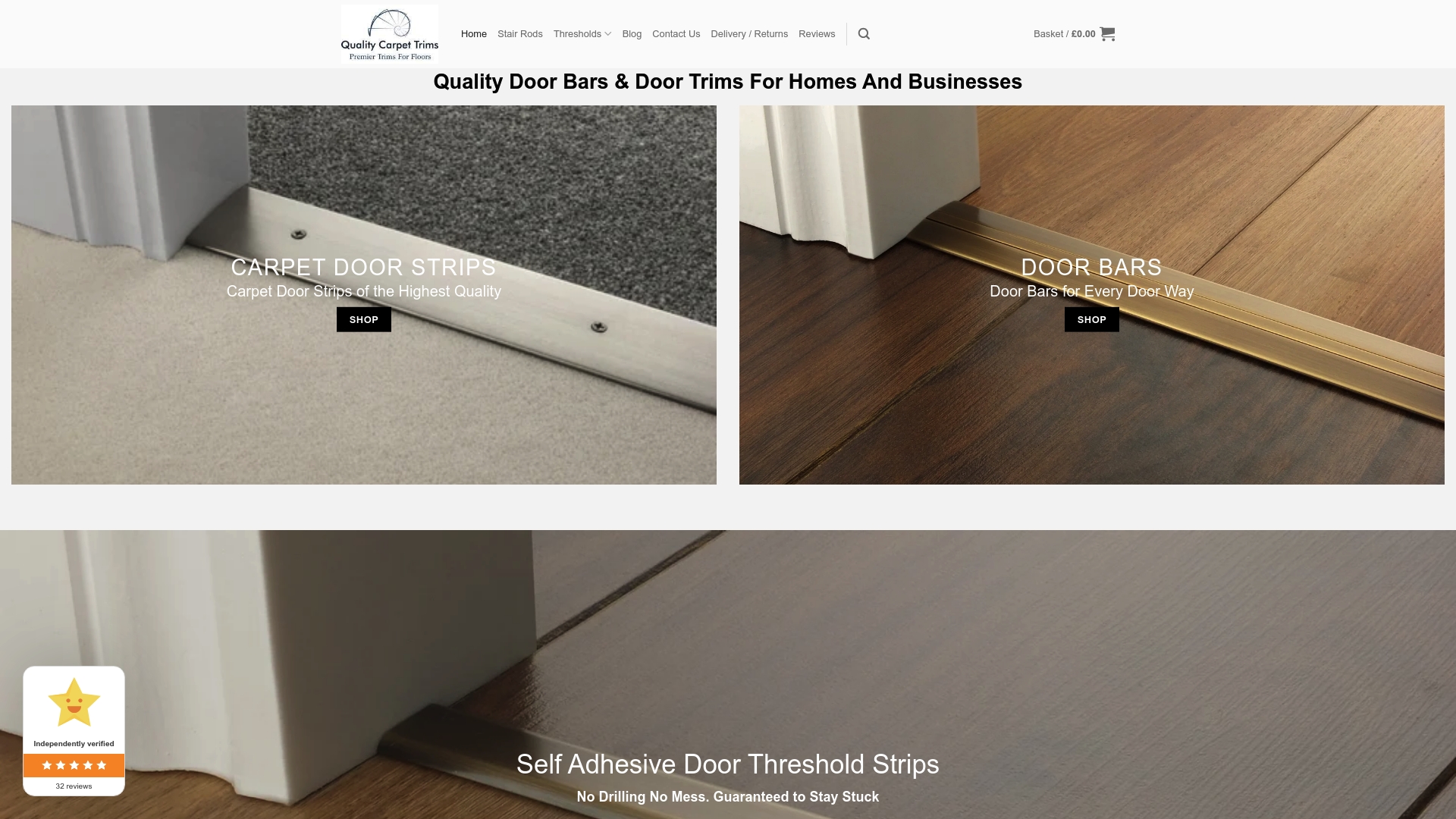
Ordering online provides convenient access to expert product information, free samples to test finish compatibility, and fast delivery to keep your project on schedule. Whether you need premium carpet edge trims for a single doorway or complete solutions for whole home renovations, the comprehensive range covers every requirement. Explore specialized options like carpet to hardfloor trims and matwell flooring trims to complete your professional finish.
Frequently Asked Questions About Carpet Edge Trims
What tools are essential for installing carpet edge trims?
You need a hacksaw for cutting metal profiles, a drill with appropriate bits for pilot holes, screwdriver for fixing, measuring tape and pencil for marking, and safety glasses for eye protection. Most homeowners already own these basic tools, making DIY installation accessible without specialized equipment purchases.
Can carpet edge trims be removed and reused?
Solid metal trims can be carefully removed if you plan to reuse them, though fixing holes in the subfloor may complicate reinstallation. Trims removed without damage to the profile or fixing points can serve in new locations. However, new installations typically benefit from fresh trims to ensure optimal fit and appearance.
How do I maintain the appearance of metal trims over time?
Regular cleaning with a damp cloth removes dust and debris that can dull finishes. Avoid abrasive cleaners or scouring pads that scratch metal surfaces. Hand finished trims resist tarnishing naturally, but occasional application of appropriate metal polish restores luster if needed. Proper maintenance preserves aesthetic appeal for decades.
Are carpet edge trims suitable for pets and children?
Absolutely. Quality trims reduce trip hazards that endanger both children and pets while protecting carpet edges from damage caused by active play and pet claws. The smooth transitions created by properly installed trims are safer than exposed carpet edges. Solid metal construction withstands the wear that pets and children create.
What is the average lifespan of a solid metal carpet edge trim?
Solid metal trims typically last 15 years or more with proper installation and normal use, often outliving the carpets they protect. This exceptional longevity contrasts sharply with aluminium trims averaging 5 years and PVC options failing within 3 years. The extended lifespan justifies the initial investment through reduced replacement costs and continuous safety performance.
Recommended
- Carpet Edge Trim – Carpet Trim Solutions | Quality Carpet Trims
- Square Edge Carpet Trim: Stylish Solutions for a Polished Finish – Quality Carpet Trims
- Discover the Best Floor Edge Trim Solutions for Every Room in Your Home – Quality Carpet Trims