
Blog
Complete Guide to Selecting Carpet Trims for Perfect Finishes

Feb
Every stylish home in the United Kingdom deserves flooring transitions that feel as smooth as they look. Whether you’re transforming a Victorian terrace or modern British flat, the difference is in the detail—specifically, the choice of hand-finished metal carpet trims. Getting these nuances right not only connects your living spaces seamlessly but also blends safety with premium visual impact. This guide helps you make informed decisions at every step, ensuring your redesign delivers both impeccable function and stunning style.
Table of Contents
- Step 1: Identify Your Carpet Transition And Edge Needs
- Step 2: Assess Compatibility With Adjoining Floor Types
- Step 3: Select The Ideal Metal Finish And Style
- Step 4: Measure Accurately For Optimal Fit
- Step 5: Verify Quality And Ensure Seamless Installation
Quick Summary
| Key Insight | Explanation |
|---|---|
| 1. Assess your transition needs | Identify where different floor types meet to ensure a smooth, safe connection and maintain aesthetics. |
| 2. Ensure compatibility of materials | Evaluate height differences and material properties to select the appropriate transition trim style. |
| 3. Choose suitable metal finishes | Select metal trims based on durability and design to enhance both function and appearance in your space. |
| 4. Measure accurately for trims | Use precise measurements to prevent gaps and installation errors, ensuring a seamless transition. |
| 5. Conduct thorough quality checks | Verify trim alignment and durability to maintain visual appeal and functional integrity after installation. |
Step 1: Identify your carpet transition and edge needs
Selecting the right carpet trims requires understanding your specific flooring transition requirements. Your goal is to create seamless, professional-looking connections between different floor surfaces while ensuring safety and aesthetic appeal.
Start by carefully evaluating your floor layout and noting where different flooring types meet. Carpet installation standards highlight critical considerations for achieving smooth transitions. Key areas to assess include:
- Doorways between rooms
- Transitions from carpet to tile, laminate, or hardwood
- Edges near stairs or unusual architectural features
- High-traffic zones requiring additional edge protection
Measuring these transition points accurately is crucial. Look for height differences between floors, potential tripping hazards, and areas needing additional reinforcement. Professional installation guidelines recommend:
- Measuring exact floor height variations
- Identifying surface material compatibility
- Checking overall room traffic patterns
Precise measurement prevents future installation complications and ensures a professional finish.
Consider the functional requirements alongside aesthetic preferences. Different transition zones might require specific trim profiles to manage height differences and provide a clean, secure connection between surfaces.
Pro tip: Keep a detailed floor plan sketch with precise measurements to help select the most appropriate carpet trims for each transition point.
Step 2: Assess compatibility with adjoining floor types
Determining the right carpet trim involves carefully comparing the physical and mechanical characteristics of your different floor surfaces. Floor transitions require precise matching to create a seamless and functional connection between varying floor materials.
To assess compatibility effectively, you’ll need to evaluate several critical factors:
- Height differences between adjoining floors
- Material composition of each surface
- Expansion and contraction properties
- Traffic patterns and wear resistance
- Aesthetic continuity between spaces
Most flooring transitions demand specific trim types depending on your unique situation. The primary trim options include:
Here’s a quick guide to carpet trim types and their best use-cases:
| Trim Type | Ideal Transition Scenario | Key Benefit | Typical Material |
|---|---|---|---|
| Reducer Strip | Height difference between floors | Smooth slope, reduces trip | Aluminium, Brass |
| T-Moulding | Equal heights between surfaces | Seamless join, aesthetic | Aluminium, Brass |
| Threshold Strip | Doorway transitions | Creates a neat boundary | Aluminium, Brass |
| Overlap Reducer | Large height variation | Extra stability, safe step | Aluminium, Brass |
- Reducer strips for height variations
- T-molding for similar height surfaces
- Threshold strips for doorways
- Overlap reducers for significant height changes
Choosing the wrong transition trim can compromise both safety and visual appeal of your flooring installation.
Technical considerations extend beyond simple visual matching. Understanding the mechanical properties of your floor materials helps select trims that accommodate natural movement and potential expansion.
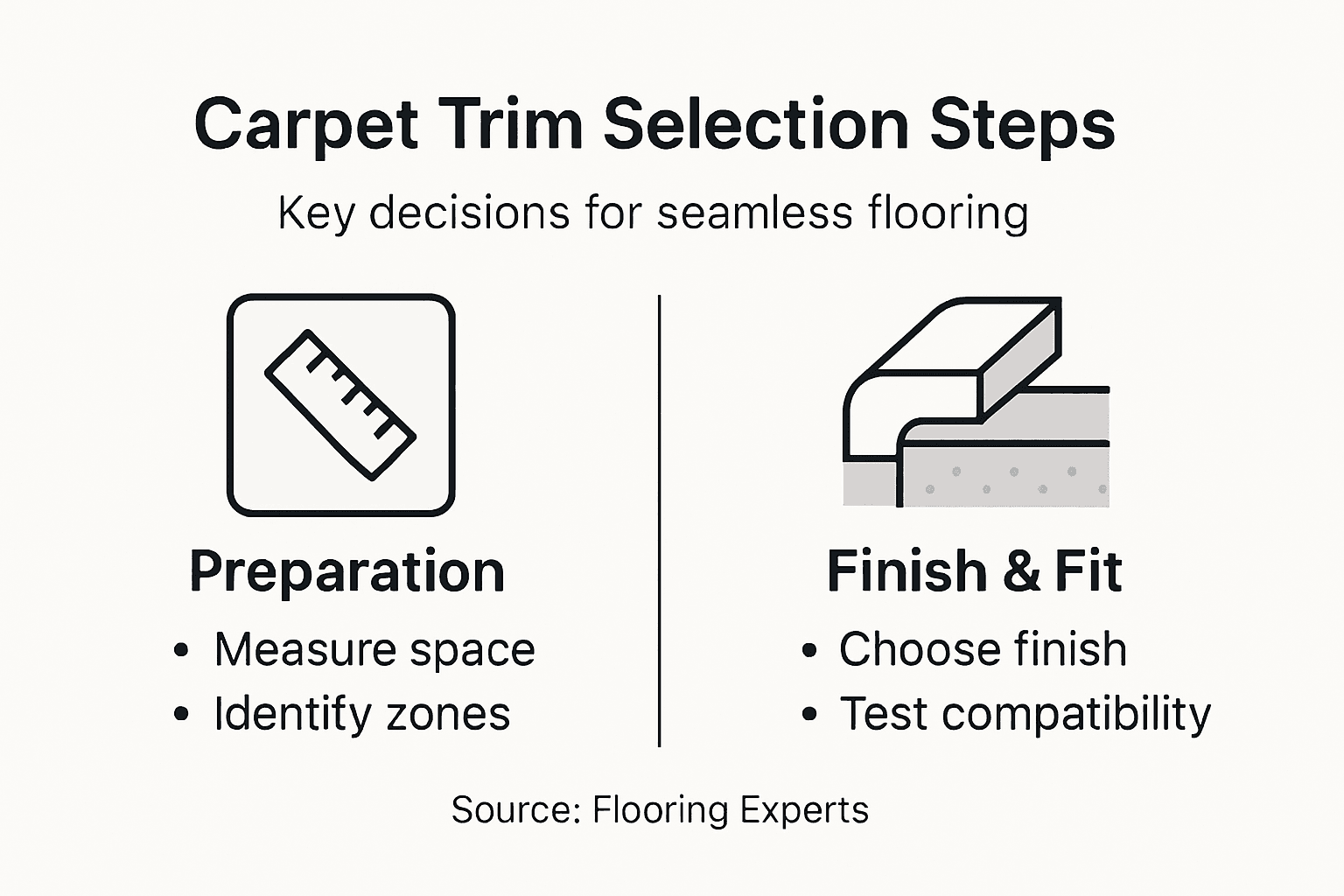
Pro tip: Collect small samples of each adjoining floor material before purchasing trims to ensure precise colour and texture compatibility.
Step 3: Select the ideal metal finish and style
Choosing the perfect metal finish for your carpet trims requires careful consideration of both aesthetic and functional requirements. Metal surface finishes significantly impact durability and appearance, making your selection crucial for long-lasting interior design.
Your ideal metal trim should balance several key characteristics:
- Durability for high-traffic areas
- Complementary colour and texture
- Resistance to corrosion and wear
- Compatibility with surrounding decor
- Ability to withstand environmental conditions
Consider the specific attributes of different metal finishes:
Compare popular metal finishes for carpet trims below:
| Finish Type | Visual Effect | Durability Level | Best Room Placement |
|---|---|---|---|
| Polished | Shiny, modern appearance | High | Living rooms, hallways |
| Brushed | Subtle, textured look | Medium to high | Bedrooms, offices |
| Textured | Unique, tactile surface | High | Entryways, stairs |
| Matte | Minimalist, low-gloss | Medium | Quiet areas, dining spaces |
- Polished surfaces for contemporary spaces
- Brushed finishes for subtle elegance
- Textured trims for added visual interest
- Matte options for understated sophistication
The right metal finish transforms a simple transition strip into a design statement.
Beyond visual appeal, technical considerations like reflection, texture, and maintenance requirements play a significant role in your final selection. Solid brass trims offer superior performance compared to cheaper alternatives, ensuring a premium finish that stands the test of time.

Pro tip: Always request physical samples to assess how the metal finish looks under your specific lighting conditions and against your existing flooring.
Step 4: Measure accurately for optimal fit
Precision is paramount when measuring carpet trims to ensure a seamless and professional installation. Carpet installation standards emphasise accurate measurement as the foundation for a flawless flooring transition.
To achieve the most accurate measurements, follow these essential steps:
- Use a metal measuring tape for reliability
- Measure twice to confirm accuracy
- Record measurements in millimetres for precision
- Allow for slight expansion and contraction
- Check floor levelness before measuring
Your measurement process should include:
- Measuring the total length of the transition area
- Checking height differences between floor surfaces
- Accounting for potential obstacles or irregularities
- Adding 5-10mm extra length for potential adjustments
Millimetre-perfect measurements prevent costly installation mistakes.
Remember that different floor types may require specific measurement techniques. Solid brass trims demand extra attention to ensure a perfect fit, with minimal gaps or uneven edges that could compromise the overall aesthetic and functionality.
Pro tip: Always use a digital calliper for incredibly precise measurements, especially when working with intricate floor transitions.
Step 5: Verify quality and ensure seamless installation
Final verification of your carpet trims demands meticulous attention to detail and adherence to professional installation standards and quality control guidelines.
Essential quality verification steps include:
- Inspect trim alignment precisely
- Check for consistent height transitions
- Verify secure attachment points
- Examine surface smoothness
- Test trim durability under pressure
Your comprehensive quality verification process should encompass:
- Visual inspection for surface imperfections
- Tactile assessment of trim edges
- Checking trim’s resistance to movement
- Confirming colour and finish consistency
- Testing trim stability under foot traffic
Rigorous quality checks prevent future installation failures and maintain aesthetic integrity.
Solid brass trims require extra scrutiny, as their premium nature demands absolute precision. Minor imperfections can compromise both the functional and visual performance of your flooring transition.
Pro tip: Use natural daylight when performing final inspections to reveal subtle imperfections that artificial lighting might conceal.
Achieve Flawless Flooring Transitions with Expert Carpet Trims
Selecting the perfect carpet trims is vital to solve common challenges like uneven floor heights, mismatched finishes, and ensuring safe, seamless connections between different surfaces. The detailed guide highlights key pain points such as measuring accuracy, material compatibility, and choosing the correct metal finish—all crucial for a polished and durable finish.
At Quality Carpet Trims, we understand these precise needs. Our premium solid metal door bars and trims are hand-finished in 10 stunning British-made finishes designed to complement any interior. Unlike inferior aluminium or PVC alternatives, our products offer exceptional durability and aesthetic appeal, helping you avoid installation pitfalls and achieve professional results every time.

Transform your flooring project from challenging to effortless by exploring our comprehensive range at Quality Carpet Trims. Benefit from free samples, expert advice, and fast delivery today to ensure your transitions are smooth, safe, and stylish. Start selecting the ideal trim that matches your measurements and flooring types perfectly now and experience the difference premium quality makes.
Frequently Asked Questions
How do I identify the right carpet trim for my flooring transitions?
To identify the right carpet trim, evaluate your floor layout and determine where different flooring types meet. Measure height differences and assess potential tripping hazards to select trims that provide a smooth transition while enhancing safety and aesthetics.
What factors should I consider when assessing compatibility between different floor types?
Consider height differences, the material composition of adjoining surfaces, and the expected wear resistance when assessing compatibility. Collect samples of each floor type to ensure that the selected trim matches in colour and texture.
How do I choose the correct metal finish for my carpet trims?
Choose a metal finish based on durability, appearance, and compatibility with the surrounding decor. Request samples to see how the metal looks under your lighting conditions to confirm it complements your floor design.
What measuring techniques ensure a perfect fit for carpet trims?
Use a metal measuring tape and measure twice to confirm accuracy for the transition area. Make sure to account for any height differences and add 5-10mm of extra length to your measurements to accommodate adjustments.
How can I verify the quality of my carpet trims before installation?
Inspect your carpet trims for alignment and check that height transitions are consistent before installation. Perform tactile assessments and visual inspections for imperfections to ensure durability and aesthetic appeal.
What common mistakes should I avoid when selecting carpet trims?
Avoid common mistakes like choosing incompatible materials or neglecting to measure accurately, as these can lead to installation complications. Always reflect on function alongside aesthetics to ensure a seamless finish.
Recommended
- Square Edge Carpet Trim: Stylish Solutions for a Polished Finish – Quality Carpet Trims
- 7 Essential Carpet Trim Options for a Seamless Finish
- What Kind Of Carpet Should You Buy For The Bedroom?
- Carpet To Tile Trim – Quality Carpet Trims
- 4m Ceiling Cladding Starter Trim 1 Part