
Blog
Door bars explained: achieve flawless flooring transitions

Apr
TL;DR:
- Door bars are transition strips used to create smooth, safe flooring joins between different surfaces.
- Proper selection and installation of metal threshold bars ensure durability and a professional finish.
- Clear terminology and product specification prevent costly errors in flooring projects.
Door bars explained: achieve flawless flooring transitions
If you have ever searched online for a ‘door bar’ and ended up staring at anti-burglar security devices rather than flooring accessories, you are not alone. The term causes genuine confusion across the industry, and that confusion can lead to wasted time, wrong deliveries, and frustrated fitters on site. This guide is focused entirely on door bars in the flooring sense: the transition strips and threshold bars that create smooth, safe, and visually clean joins between different flooring surfaces. We will cover what they are, the types available, how materials and finishes affect performance, and how to fit them correctly whether you are a DIY enthusiast or a seasoned contractor.
Table of Contents
- What is a door bar? The definition and why it matters
- Types of door bars and threshold strips explained
- Materials and finishes: choosing performance and style
- Fitting and application best practices
- Our view: why clear terminology is the foundation of quality flooring
- Ready to upgrade to premium door bars?
- Frequently asked questions
Key Takeaways
| Point | Details |
|---|---|
| Clarify terminology | Always specify ‘door bars’ for flooring to avoid confusion with security devices. |
| Match type to flooring | Select the right door bar or strip for the floor coverings you need to join. |
| Choose quality materials | Premium metal door bars provide the best durability and visual finish. |
| Install with care | Correct measurement and fitting are essential for seamless transitions. |
| Double-check with suppliers | Confirm terminology to prevent costly ordering and installation errors. |
What is a door bar? The definition and why it matters
In flooring, a door bar is a narrow metal strip fixed across the gap between two different floor surfaces, typically at a doorway or room threshold. Its job is straightforward: cover the raw edges of both floor coverings, prevent lifting or fraying, and create a smooth, safe transition underfoot. The result is a neat, professional finish that protects both your floors and anyone walking over them.
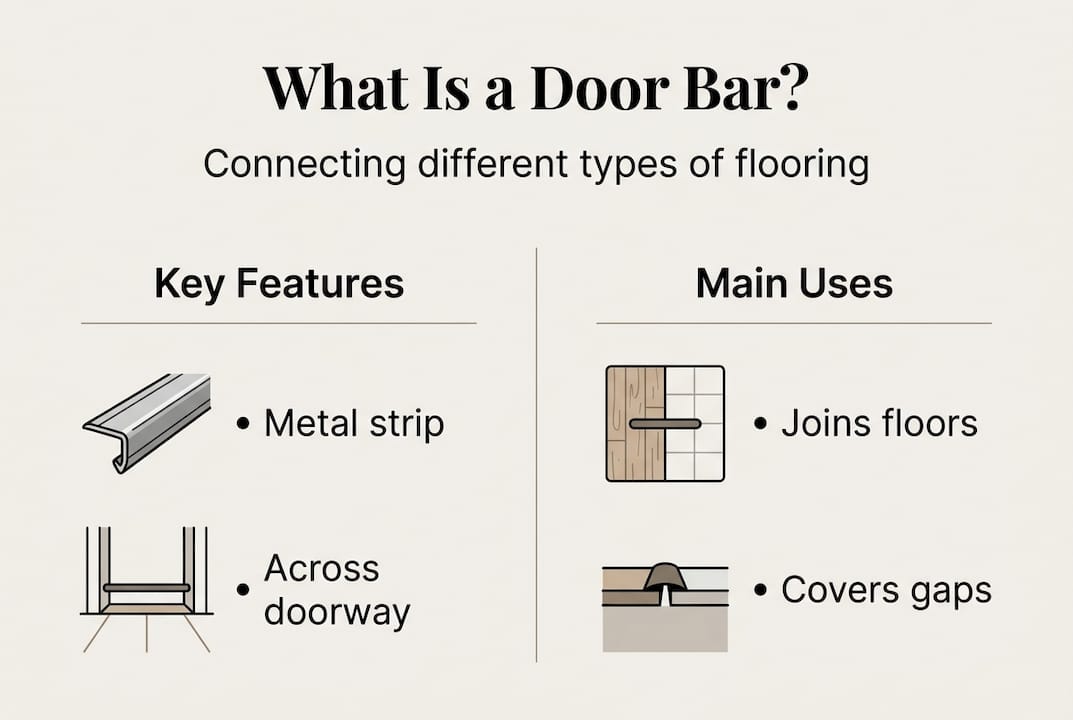
The problem is that the same two words mean something entirely different in a security or hardware context. As confirmed in guidance around door security, a ‘door bar’ can refer to a physical brace or reinforcement bar fitted across a door to prevent forced entry. These products share a name but nothing else. When you ring a supplier and ask for a ‘door bar’ without context, you genuinely risk being sent the wrong product. That is not an exaggeration; it happens regularly on residential renovation projects and commercial fit-outs alike.
The terminology overlaps do not stop there. Flooring door bars are also known as threshold strips, transition strips, carpet bars, carpet trims, and threshold bars. Each term is used by different trades and manufacturers to describe essentially the same category of product, though there are meaningful differences within that category based on profile, fixing method, and the specific flooring types involved.
A door bar bridges more than two floors. It bridges the gap between a professional finish and an unfinished edge that will fray, lift, and eventually become a trip hazard.
Pro Tip: Always confirm with your supplier that you are discussing a flooring transition strip, not a security device, especially if you are ordering over the phone or using a general search engine. Providing the flooring types on either side of the threshold will immediately clarify your requirement and speed up the order process.
Understanding the product correctly from the start shapes every decision that follows, from profile selection to material choice to fitting method. Our understanding door bars guide expands on this further, and if you want the full picture before you buy, the explained guide to door bars sets out all the key distinctions in one place.
The word ‘bar’ in this context simply refers to the bar-like strip shape of the product. It bears no relation to door security hardware, and using the right language with your supplier will prevent costly mix-ups, delays, and return deliveries that set your project back.
Types of door bars and threshold strips explained
Once you are clear on the definition, the next step is understanding which type of door bar suits your specific flooring transition. The profile you choose depends on the floor coverings on either side, the height difference between them, and the aesthetic you are trying to achieve.
Here is a comparison table for quick reference:
| Type | Best suited for | Key feature |
|---|---|---|
| Carpet to carpet bar | Joins two carpet sections | Low profile, grips both edges |
| Carpet to hard floor bar | Carpet meeting laminate, vinyl, or tile | Angled or rebated profile |
| Metal threshold bar | Two hard floors at equal or similar height | Flat bar, decorative and functional |
| Multi-surface bar | Variable height transitions | Adjustable channel or reducer profile |
| Stair nosing threshold | Step edges meeting flooring | Safety-focused, non-slip surface |
As noted in security context guidance, the term ‘door bar’ genuinely spans multiple product categories, which is why specifying the flooring types on both sides is essential before placing any order.
Carpet to carpet bars are the simplest in profile. They grip the raw edges of two carpet sections and hold them flat, preventing the edges from lifting or fraying over time. These are common in older properties where room layouts create unusual carpet joins away from doorways.
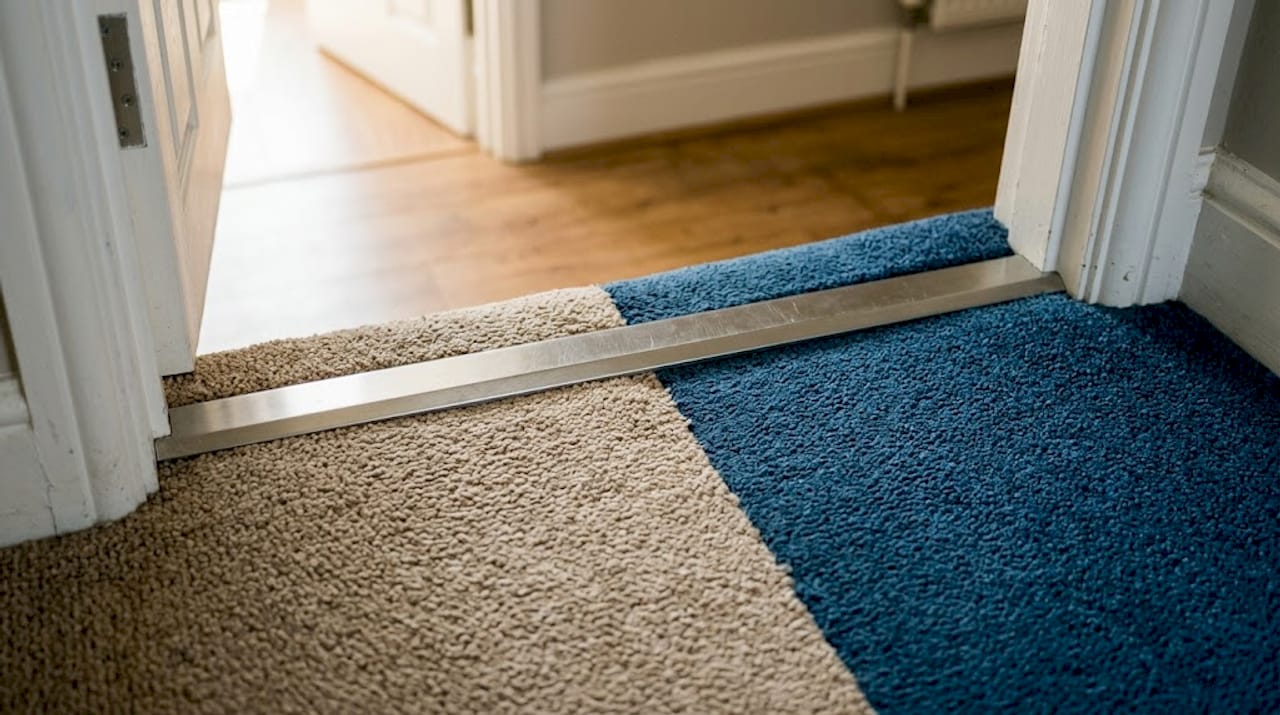
Carpet to hard floor bars are the most frequently fitted type in UK homes and commercial spaces. They account for the majority of transitions between carpeted bedrooms or living rooms and hard-floored hallways, kitchens, or bathrooms. The profile typically includes a rebated edge on the carpet side and a flat or slightly raised edge on the hard floor side.
Metal threshold bars are entirely flat-profile strips used where two hard floor surfaces meet at roughly the same height. These are popular in open-plan spaces, commercial retail environments, and modern residential properties where the design calls for a minimal, clean join.
Multi-surface or reducer bars are engineered for situations where there is a noticeable height difference between two floors. They taper gradually from one height to another, eliminating trip hazards and providing a smooth walking surface. These are particularly useful in renovation projects where you cannot control the height of existing floors. You can explore transition strips for uneven floors for more detail on managing height differences effectively.
For a full breakdown of all threshold profiles, the complete threshold strip guide provides an in-depth reference. You can also browse all available threshold strip options to compare profiles side by side. It is worth noting that while composite step edge products are available in the broader market, solid metal remains the most durable and long-lasting choice for interior thresholds.
Materials and finishes: choosing performance and style
The material and finish of your door bar determine how it performs over the long term and how well it blends with your interior. This is where many buyers make compromises that they later regret, often choosing cheaper materials that wear badly or finishes that clash with their flooring.
Here is a data table comparing the most common door bar materials:
| Material | Durability | Appearance | Best for |
|---|---|---|---|
| Solid brass | Excellent | Premium, warm tone | High-end residential, period properties |
| Zinc alloy | Very good | Versatile, takes many finishes | Mainstream residential and commercial |
| Aluminium | Moderate | Clean but can scratch | Budget projects (not our recommendation) |
| Composite | Low to moderate | Varied | Outdoor decking edges only |
| PVC | Low | Plastic appearance | Avoid for quality interiors |
Solid metal door bars, particularly those made from brass or high-grade zinc alloy, outperform every other option in interior flooring applications. They resist denting under foot traffic, hold their finish over years of daily use, and carry a weight and presence that plastic or composite alternatives simply cannot match.
At Quality Carpet Trims, we supply only solid metal door bars, hand finished in 10 carefully developed finishes. This is a deliberate decision. Aluminium trims scratch and oxidise over time. PVC and plastic trims flex, yellow, and eventually crack. Wooden trims absorb moisture, swell, and lift away from the floor. None of these materials offer the longevity that a properly specified solid metal bar delivers in a real home or commercial environment.
The 10 finish options include warm tones such as satin brass and antique gold for period or traditional interiors, and cooler options such as satin silver and dark graphite for contemporary or Scandi-inspired spaces. Matching the finish of your door bar to your door hardware, light fittings, or skirting board paint colour creates a level of interior coherence that elevates the entire room, not just the floor.
Pro Tip: If you are fitting multiple door bars across a property, order all of them in the same finish batch to ensure colour consistency. Even small batch variations can be noticeable when bars are in adjacent rooms. Browse our solid metal door bar options to compare finishes before committing.
It is worth mentioning that while composite trim alternatives exist for outdoor or decking applications, they are not appropriate for interior flooring transitions where premium appearance and longevity are required.
Fitting and application best practices
Buying the right door bar is only half the job. Fitting it correctly ensures the bar performs as intended and lasts as long as the floor itself. Poor installation is one of the most common reasons door bars fail, lift, or look unfinished, and the mistakes are almost always preventable.
Here is a step-by-step fitting process that works for both DIY and professional installation:
- Measure the doorway width accurately using a steel tape measure. Add 2mm for expansion clearance if fitting into a heated space.
- Cut the bar to length using a fine-tooth hacksaw or metal cutting blade on a mitre saw. Score the finish side first to prevent scratching.
- Prepare the subfloor surface by ensuring it is clean, flat, and free of adhesive residue or debris. Any high spots under the bar will cause rocking and premature loosening.
- Position the bar across the threshold and mark the fixing hole positions with a pencil or awl.
- Drill pilot holes into the subfloor at the marked positions. Use the correct drill bit for the subfloor type: wood, concrete, or screed.
- Secure the bar using the appropriate fixings. For concrete or screed subfloors, use wall plugs and screws. For timber subfloors, direct screws are sufficient.
- Check alignment by standing back and looking along the bar. It should run parallel with the door frame and sit flush with both floor surfaces.
Common mistakes that cause problems after installation include:
- Skipping subfloor preparation, which causes the bar to rock and eventually loosen
- Cutting the bar too short and leaving a visible gap at one or both ends
- Over-tightening fixing screws on a floating floor system, which restricts movement and can cause the floor to buckle
- Fitting the wrong profile for the height difference, creating a raised edge that becomes a trip hazard
A door bar fitted even 2mm out of alignment with the door frame will catch the eye every time the door opens. Take an extra five minutes to get alignment right, and you will never notice it again.
For transitions between carpet and hard floor in particular, it is essential to tuck the carpet edge fully under the bar’s rebated section before fixing. If the carpet pulls back even slightly, the raw edge will be visible. Browse our range of carpet to hardfloor trims to find the profile that suits your specific floor height combination.
Tricky transitions, such as doorways with out-of-square frames, uneven screed, or existing adhesive contamination, may need additional subfloor preparation before the bar can be fitted cleanly. In commercial projects, where multiple transitions exist across large floor areas, it pays to survey every threshold before ordering to ensure you specify the correct profile for each individual join.
Our view: why clear terminology is the foundation of quality flooring
We have seen firsthand how imprecise language creates real problems on flooring projects. A contractor orders ‘door bars’ over the phone, the supplier interprets the term differently, and the wrong product arrives on site. The project stalls while a return and reorder takes place. The client is frustrated. The fitter loses a day’s work. All of it is avoidable.
The hidden cost of terminology confusion in flooring is not just financial. It erodes confidence between trades and clients, creates friction in the supply chain, and leads to rushed decisions when the clock is ticking. We believe that one of the most valuable things any professional can do is build a working vocabulary for flooring products, not because it makes you sound more knowledgeable, but because it removes an entire category of error from your projects.
As highlighted in door security guidance, even well-intentioned searches for ‘door bars’ can lead you to entirely the wrong product category. The solution is straightforward: always specify the floor coverings on both sides, the subfloor type, the transition height, and the finish you want. With those four pieces of information, there is no room for misinterpretation.
For professionals wanting to sharpen their product knowledge, our industry flooring trim terminology resource is a useful reference that cuts through the confusion.
Ready to upgrade to premium door bars?
When you understand exactly what you need, choosing the right door bar becomes straightforward rather than stressful. At Quality Carpet Trims, every bar we supply is solid metal, hand finished in one of 10 beautiful options, and built to last in both residential and commercial environments.
Whether you are finishing a single doorway at home or specifying thresholds across a large commercial fit-out, our range covers every transition scenario. Browse our brass door threshold bars for a premium finish, explore our carpet to hardfloor solutions for the most common transition type, or check our matwell flooring trims for specialist entrance applications. Free samples, fast UK delivery, and expert advice are available across every order.
Frequently asked questions
Are door bars the same as threshold strips?
In flooring, ‘door bars’ and ‘threshold strips’ are often used interchangeably, but as confirmed in security contexts, the term ‘door bar’ can also describe a security device, so always confirm the product type with your supplier before ordering.
Can I fit a metal door bar myself?
Yes, most solid metal door bars are designed for straightforward DIY installation, but careful measurement, correct pilot hole sizing, and precise alignment are essential for a truly professional result.
What is the main benefit of a solid metal door bar?
Solid metal door bars offer far greater durability than plastic, composite, or wooden alternatives, and maintain their finish and structural integrity even under heavy daily foot traffic.
Are there decorative options for door threshold bars?
Absolutely. Premium solid metal door bars are available in a wide range of hand-finished options, including satin brass, antique gold, dark graphite, and chrome, making it straightforward to match any interior design scheme.
Why is accurate terminology important when specifying door bars?
Using precise terms prevents costly ordering mistakes; as noted in flooring guidance, ‘door bar’ can describe entirely different products depending on the trade context, so specifying your floor types and transition requirements removes all ambiguity.
Recommended
- Door bars explained: seamless flooring transitions made simple
- Understanding door bars: enhance flooring transitions with style
- Doorway Details, Sorted: What Thresholds, Door Bars And Transition Strips Actually Do – Quality Carpet Trims
- How T-bars create flawless flooring transitions: UK guide